


Mainland Affairs Council Chairman Joseph Wu (
Ma "will be a clear contender for the presidential position in 2008," in view of the KMT's gains in Saturday's local elections, Wu told a gathering in Washington on Wednesday. "If he is going to compete for that position, he has to demonstrate the sort of national responsibility as a national leader."
Wu's comments came toward the end of a four-day visit to Washington to sound out US reaction to the elections, in which the pan-blue alliance, spearheaded by the KMT, scored a striking victory over the Democratic Progressive Party (DPP) and its pan-green partner, the Taiwan Solidarity Union (TSU).
Wu complained that Ma "has been very vague" on national security issues, such as the military procurement budget and overall national security policy.
If he is going to vie for national leadership, "he has to address the national issues in a very serious manner," Wu said.
Wu said he is concerned that last weekend's election results will embolden the pan-blue camp to continue its "obstructionist" policy toward the DPP government.
He said he is "afraid" that the election results "might give an impression to the pan-blue side that an obstructionist approach against the government might be working, and if so, they might do something more than they have already done."
In particular, they might continue to pursue the so-called "cross-strait peace advancement bill," which, if approved, "is going to be a disaster for Taiwan domestically," and could cause "serious problems for the government in dealing with cross-strait relations as well," he said.
He cautioned the pan-blues to think twice about the implications of the bill, in view of the possibility that the KMT alliance might retake the presidency in 2008.
The bill would strip the Executive Yuan of power in cross-strait policymaking, he said, adding that "any future leader, whether it is [from] the pan-blue side or the pan-green side, would hate to see that, when they are in power, they don't have the power to make decisions on cross-strait relations."
"So, there may be a change, or serious discussions within the pan-blues to rethink their position," in view of the elections, Wu said.
For the Chen administration, cross-strait relations "will remain the same" despite the election results, which will "not have any implications for cross-strait policies," Wu said.
He also took issue with the pan-blue efforts to enact 15 amendments to cross-strait laws, saying "current cross-strait law is going to be destroyed" if the changes pass.
Wu was cautious in saying how Washington would respond to the elections. He noted the US State Department's comment that the elections were evidence of Taiwan's democracy, and that it congratulated Taiwan. He also cited President George W. Bush's statement in Kyoto during his recent Asia trip, urging China to emulate Taiwan's democracy.
"Any kind of democratic development is cherished by the Bush administration," Wu said.
He also said that Taiwan has not been a major foreign policy issue with the Bush administration for at least six months, and that "this can be interpreted in a positive light." But in such a situation, "we are worried that China may take this opportunity to squeeze Taiwan internationally, without being noticed by other countries. We tried to make some of our American friends understand this," Wu said.
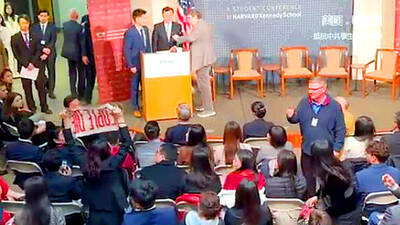
A group of Taiwanese-American and Tibetan-American students at Harvard University on Saturday disrupted Chinese Ambassador to the US Xie Feng’s (謝鋒) speech at the school, accusing him of being responsible for numerous human rights violations. Four students — two Taiwanese Americans and two from Tibet — held up banners inside a conference hall where Xie was delivering a speech at the opening ceremony of the Harvard Kennedy School China Conference 2024. In a video clip provided by the Coalition of Students Resisting the CCP (Chinese Communist Party), Taiwanese-American Cosette Wu (吳亭樺) and Tibetan-American Tsering Yangchen are seen holding banners that together read:

UNAWARE: Many people sit for long hours every day and eat unhealthy foods, putting them at greater risk of developing one of the ‘three highs,’ an expert said More than 30 percent of adults aged 40 or older who underwent a government-funded health exam were unaware they had at least one of the “three highs” — high blood pressure, high blood lipids or high blood sugar, the Health Promotion Administration (HPA) said yesterday. Among adults aged 40 or older who said they did not have any of the “three highs” before taking the health exam, more than 30 percent were found to have at least one of them, Adult Preventive Health Examination Service data from 2022 showed. People with long-term medical conditions such as hypertension or diabetes usually do not
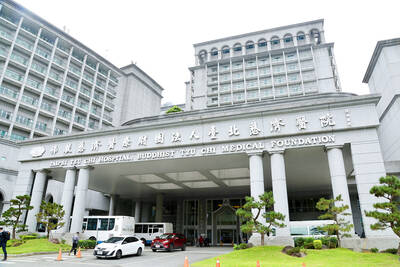
POLICE INVESTIGATING: A man said he quit his job as a nurse at Taipei Tzu Chi Hospital as he had been ‘disgusted’ by the behavior of his colleagues A man yesterday morning wrote online that he had witnessed nurses taking photographs and touching anesthetized patients inappropriately in Taipei Tzu Chi Hospital’s operating theaters. The man surnamed Huang (黃) wrote on the Professional Technology Temple bulletin board that during his six-month stint as a nurse at the hospital, he had seen nurses taking pictures of patients, including of their private parts, after they were anesthetized. Some nurses had also touched patients inappropriately and children were among those photographed, he said. Huang said this “disgusted” him “so much” that “he felt the need to reveal these unethical acts in the operating theater
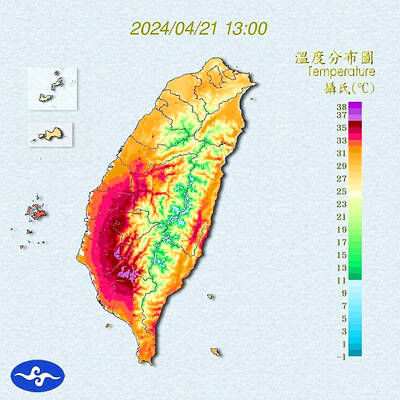
Heat advisories were in effect for nine administrative regions yesterday afternoon as warm southwesterly winds pushed temperatures above 38°C in parts of southern Taiwan, the Central Weather Administration (CWA) said. As of 3:30pm yesterday, Tainan’s Yujing District (玉井) had recorded the day’s highest temperature of 39.7°C, though the measurement will not be included in Taiwan’s official heat records since Yujing is an automatic rather than manually operated weather station, the CWA said. Highs recorded in other areas were 38.7°C in Kaohsiung’s Neimen District (內門), 38.2°C in Chiayi City and 38.1°C in Pingtung’s Sandimen Township (三地門), CWA data showed. The spell of scorching


 RSS
RSS