


The Ministry of Foreign Affairs (MOFA) yesterday vowed to retrieve Taiwanese property in South Korea that was seized by China after Seoul and Taipei broke diplomatic ties 13 years ago.
A multiparty delegation of three lawmakers, led by Democratic Progressive Party (DPP) Legislator Tang Bi-a (唐碧娥), left for Seoul on Wednesday to investigate the land-ownership dispute in which real estate owned by the Republic of China (ROC) was taken over by the People's Republic of China (PRC) after South Korea switched recognition to PRC in 1992.
Tang said the real estate was an annex between the former ROC embassy building and a road. The property was at the time categorized as not being part of the embassy property, but legally owned by the ROC government.
South Korea had agreed not to interfere with properties owned by the ROC government when the two countries broke ties in 1992. However, ownership of the land was given to the PRC in 1995.
The area of the land is 225m2 and located in an upmarket area of central Seoul, and is worth about NT$200 million (US$6.06 million).
MOFA yesterday said the land dispute is currently in the courts, and that the government will step up its efforts to retrieve Taiwan's property.
"The property of the ROC's embassy in South Korea was inherited by the PRC after Seoul switched its recognition of `China' to the PRC in 1992," MOFA deputy spokesman David Wang (王建業) said.
Although Taiwan had contested that the property ownership belongs to Taiwan, the reality of international politics was not conducive to Taiwan's retrieving the land as long as Taiwan's national name remains the "ROC" and most countries adhere to the "one-China" policy, the official said.
Tang said that the properties owned by the ROC government in South Korea are worth more than US$1.2 billion.

Taiwan must first strengthen its own national defense to deter a potential invasion by China as cross-strait tensions continue to rise, multiple European lawmakers said on Friday. In a media interview in Taipei marking the conclusion of an eight-member European parliamentary delegation’s six-day visit to Taiwan, the lawmakers urged Taipei to remain vigilant and increase defense spending. “All those who claim they want to protect you actually want to conquer you,” Ukrainian lawmaker Serhii Soboliev said when asked what lessons Taiwan could draw from Russia’s invasion of Ukraine. Soboliev described the Kremlin as a “new fascist Nazi regime” that justified
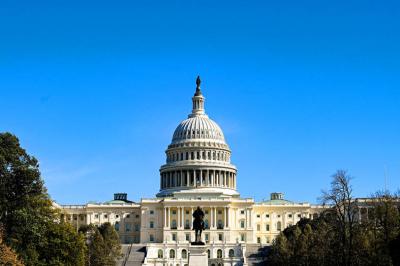
The US House of Representatives yesterday passed the PROTECT Taiwan Act, which stipulates that Washington would exclude China from participating in major global financial organizations if its actions directly threaten Taiwan’s security. The bill, proposed by Republican US Representative Frank Lucas, passed with 395 votes in favor and two against. It stipulates that if China’s actions pose any threat to Taiwan’s security, economic or social systems, the US would, “to the maximum extent practicable,” exclude China from international financial institutions, including the G20, the Bank for International Settlements and the Financial Stability Board. The bill makes it clear that China

‘T-DOME’: IBCS would increase Taiwan’s defense capabilities, enabling air defense units to use data from any sensor system and cut reaction time, a defense official said A defense official yesterday said that a purported new arms sale the US is assembling for Taiwan likely includes Integrated Battle Command Systems (IBCS). The anonymous official’s comments came hours after the Financial Times (FT) reported that Washington is preparing a US$20 billion arms sale encompassing “Patriot missiles and other weapons,” citing eight sources. The Taiwanese official said the IBCS is an advanced command and control system that would play a key role in President William Lai’s (賴清德) flagship defense program, the “T-Dome,” an integrated air defense network to counter ballistic missiles and other threats. The IBCS would increase Taiwan’s
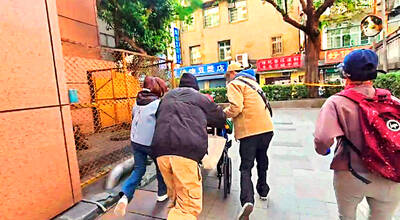
NOMINAL NEWLYWEDS: A man’s family and his wife — his long-term caregiver — are engaged in a legal dogfight over the propriety and validity of the recent union A centenarian’s marriage to his caregiver unbeknownst to his children has prompted legal action, as the caregiver accuses the man’s children of violating her personal liberty and damaging her reputation, while the children have sought a legal option to have the marriage annulled. According to sources, the 102-year-old man surnamed Wang (王) lives in Taipei’s Zhongshan District (中山) and previously worked as a land registration agent. Wang reportedly owns multiple properties and parcels of land worth several hundred million New Taiwan dollars and has ten children. His caregiver, a 69-year-old surnamed Lai (賴), has been caring for him since about 1999,


 RSS
RSS