


Pan-green legislators yesterday accused Taipei Mayor and Chinese Nationalist Party (KMT) Chairman Ma Ying-jeou (
"Ma owes Taipei citizens and the people of Taiwan an immediate apology for mishandling the matter," Democratic Progressive Party (DPP) caucus whip William Lai (賴清德) said.
"He should stop banning spectators from bringing their own flags to national or international events," Lai added.
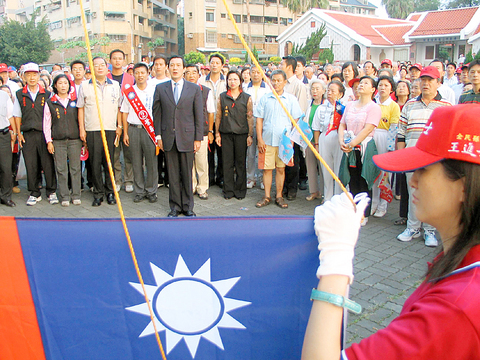
PHOTO: CNA
He was referring to the Asian Short Track Speed Skating championship, which was held on Nov. 5 and Nov. 6 at the new Taipei Arena. While there was a Chinese national flag flying at the venue, Taiwan's national flag was nowhere in sight.
Ma later explained that it was because the event had been privately organized and that the city government had nothing to do with it except for leasing the venue.
Ma said that all international games held in Taipei must follow the rules set by the International Olympic Committee (IOC). The IOC came to an agreement in 1981 that the nation's sports teams would use the name "Chinese Taipei," as well as the "Chinese Taipei Olympic flag" during international events -- instead of the national flag and anthem -- in return for being allowed to participate in international sporting events.
Producing copies of what she called official documents issued by the city government, DPP Councilor Yen Sheng-kuan (顏聖冠), who also serves as a DPP caucus whip at the Taipei City Council, dismissed Ma's explanation as a "lie."
According to Yen, the Asian Short Track Speed Skating championship had been co-organized by the city government's Department of Sports, which subsidized the event with NT$4.1 million.
Yen also cited two other events that had been co-organized by the city government but at which the national flag had also been banned.
One of the events was the Asian Judo Championships 2005, which were held on Saturday and Sunday at the Taipei Arena and jointly organized by the city's Department of Sports. The department contributed NT$3.5 million to the NT$11 million event.
The other was the International Auto Gymkhana organized by the Chinese Taipei Motor Sports Association, to which the city's Department of Education contributed NT$100,000 and the Department of Sports another NT$100,000.
Throwing his weight behind the DPP, Taiwan Solidarity Union (TSU) caucus whip Mark Ho (何敏豪) yesterday questioned Ma's suitability for running in the next presidential election.
"How do they expect voters to elect such a weak-kneed wimp as president?" he asked.
"We strongly condemn Ma and wonder why it is so hard for him to safeguard Taiwan's sovereignty," Ho said.
He added that he is curious to know why the national flag was nowhere to be found at the three events, while China's national flag was flown at the venues.
Although the national flag must be flown in honor of National Day from Oct. 7 to Oct. 28, TSU Legislator Tseng Tsahn-deng (曾燦燈) said that he would like to know why the flags were taken down on Oct. 28, the same day when China's top tourism official, Shao Qiwei (邵琪偉), arrived here on a 10-day visit.
Tseng proposed that those who have never criticized China should be banned from running for the presidency.
TSU Legislator David Huang (
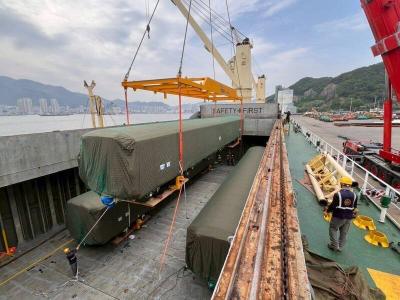
The first of 10 new high-capacity trains purchased from South Korea’s Hyundai Rotem arrived at the Port of Taipei yesterday to meet the demands of an expanding metro network, Taipei Rapid Transit Corp (TRTC) said yesterday. The train completed a three-day, 1,200km voyage from the Port of Masan in South Korea, the company said. Costing NT$590 million (US$18.79 million) each, the new six-carriage trains feature a redesigned interior based on "human-centric" transportation concepts, TRTC said. The design utilizes continuous longitudinal seating to widen the aisles and optimize passenger flow, while also upgrading passenger information displays and driving control systems for a more comfortable
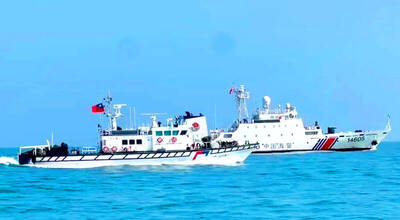
Instead of focusing solely on the threat of a full-scale military invasion, the US and its allies must prepare for a potential Chinese “quarantine” of Taiwan enforced through customs inspections, Stanford University Hoover fellow Eyck Freymann said in a Foreign Affairs article published on Wednesday. China could use various “gray zone” tactics in “reconfiguring the regional and ultimately the global economic order without a war,” said Freymann, who is also a nonresident research fellow at the US Naval War College. China might seize control of Taiwan’s links to the outside world by requiring all flights and ships entering or leaving Taiwan
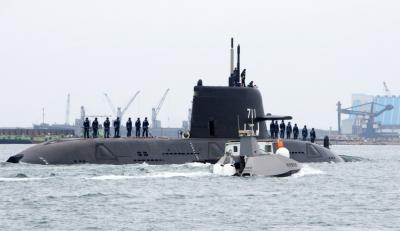
Taiwan's first indigenous defense submarine, the SS-711 Hai Kun (海鯤, or Narwhal), departed for its 13th sea trial at 7am today, marking its seventh submerged test, with delivery to the navy scheduled for July. The outing also marked its first sea deployment since President William Lai (賴清德) boarded the submarine for an inspection on March 19, drawing a crowd of military enthusiasts who gathered to show support. The submarine this morning departed port accompanied by CSBC Corp’s Endeavor Manta (奮進魔鬼魚號) uncrewed surface vessel and a navy M109 assault boat. Amid public interest in key milestones such as torpedo-launching operations and overnight submerged trials,
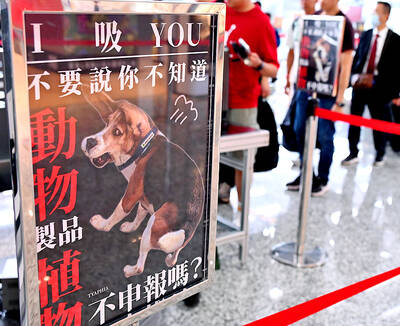
Quarantine awareness posters at Taiwan Taoyuan International Airport have gone viral for their use of wordplay. Issued by the airport branch of the Animal and Plant Health Inspection Agency, the posters feature sniffer dogs making a range of facial expressions, paired with advisory messages built around homophones. “We update the messages for holidays and campaign needs, periodically refreshing materials to attract people’s attention,” quarantine officials said. “The aim is to use the dogs’ appeal to draw focus to quarantine regulations.” A Japanese traveler visiting Taiwan has posted a photo on X of a poster showing a quarantine dog with a


 RSS
RSS