


Savoury ice cream has become a popular fad in trendy Western restaurants, but local vendor Liny Hsueh (
Hsueh's "Dr. Ice" brand offers ice cream, "snowflake ice" (shaved ice) and "bubble ice" (thinly shaved ice) made from shrimp, cuttlefish, tuna, seaweed and laver (purple seaweed) combined with fruits, mint, wasabi, peanut and wine.
Salty, pungent seafood does not seem ideally suited to traditionally sweet and soft ice cream, yet Hsueh has managed to find a harmony between the two to create the nation's only seafood-flavored frozen desserts line.
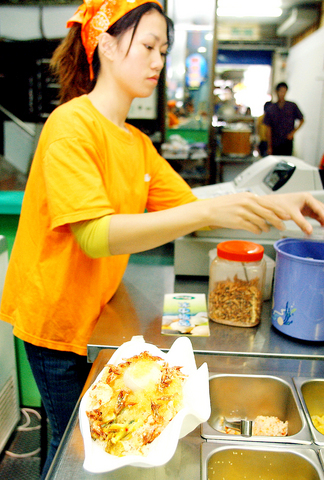
PHOTO: AFP
The combination might even pique the interest of Ferran Adria, Spain's experimental chef famed for his startling combinations of seemingly incongruous ingredients often based on their their similar molecular structure.
Hsueh's ice cream booth sits amongst stalls at an indoor fish market in Bisha port (
She launched Dr. Ice in 2003 and now has two shops in the city better known by their Chinese name "Shia Bing Hsieh Chiang" (蝦冰蟹醬, "shrimp ice crab sauce").
The 13 flavors on offer include pineapple shrimp, wasabi cuttlefish, strawberry tuna and mango seaweed, all in stark colors from orange to green to black.
All are served in white or blue shell on fish-shaped plates and bowls, and some also come with a sprinkle of small dried fish, roe or chopped squid.
"I walked by Shia Bing Hsieh Chiang several months ago and entered out of curiosity. Now I visit the store often with my classmates," 14-year-old student Yvonne Yen said.
"I like the ice cream here, especially the cuttlefish flavor, because of the rich texture and lighter sweet taste. The color [black] is really cool," Yen said.
Peter Lin, a first-time customer who tried shrimp and seaweed flavored ice cream, said he was surprised that it didn't carry the smell or salty taste of seafood.
"I was a little worried that it would taste disgusting and weird," the 41-year-old said.
Hsueh's family initially expressed similar skepticism when she announced she was going to make "snowflakes ice" from shrimp.
"They thought I was crazy because shrimp seemed an impossible ingredient for frozen desserts," the spirited Hsueh, 45, said.
"I had to find a niche in the crowded market of ice desserts and I thought that even though Taiwan is an island with abundant oceanic resources, seafood was never used to make them and I wanted to give it a try," she said.
Hsueh was also encouraged by an old Taiwanese saying which goes: "The number one job is selling ice desserts and the number two is being a doctor."
More inviting still was the dessert market, estimated by industry watchers at over NT$10 billion (US$298.8 million) a year.
The novelty proved an initial success, with Hsueh greeting the patrons at her small store and making up to NT$700,000 a month during summer.
In less than a year she opened her second branch shop in Taipei's bustling Tung Hua Street night market, popular with locals and foreign tourists, but it flopped and closed after six months.
Hsueh decided to focus her efforts in Keelung and opened a booth in Bisha fish market last December, developing a new line of seafood sausage, dumpling and meat balls to make up for the slow winter season.
Now, she is ready to expand again and this time is targeting the sunny southern part of the country, where ice desserts business has an average ten-month sales season compared with five in the north.

NATIONAL SECURITY: Authorities are working to confirm the identities of the military personnel involved and investigating possible illegal conduct and regulatory violations Authorities are probing possible national security implications after Kinmen police and immigration officers on Sunday found a Chinese woman allegedly posing as a tourist while engaging in prostitution involving more than 10 military personnel. The woman, surnamed Chen (陳), has since been deported, authorities said, adding that investigators are still working to confirm the identities of those implicated, as the records only listed code names and aliases. The case stemmed from a report received by the Kinmen District Prosecutors’ Office on Friday last week from the Jinhu Precinct of the Kinmen County Police Bureau. On Sunday, police, along with the National Immigration

GLOBALGIVING: ‘ Caving to external pressure is not acceptable for an organization that has cultivated justice reform and human rights for 30 years,’ one NGO said A slew of non-government organizations (NGOs) have withdrawn from the GlobalGiving fundraising platform after it announced it would use “Chinese Taipei” instead of “Taiwan” from next month. The Taiwan Good Rice Association wrote on Facebook on Friday that it was informed on April 28 via a teleconference call of the change, which was made because the platform wanted to operate in China. Taiwan Good Rice is to terminate all cooperative relationships with GlobalGiving in response to the platform’s “unilateral and non-negotiable” decision to remove references to Taiwan, the NGO said. “Taiwan is in the official name of Taiwan Good Rice Association and the

HEAVY WEATHER: Typhoon Jangmi is due to crash straight into the Ryukyus as airlines look to shift flights to larger aircraft or cancel flights to Okinawa entirely Taiwan’s international air carriers announced flight adjustments over the weekend as Typhoon Jangmi is forecast to hit the Ryukyu Islands today and tomorrow. The Central Weather Administration (CWA) upgraded Jangmi from a tropical storm to a typhoon at 8am yesterday, with the eye located 580km south of Naha city. It was moving north at 19kph. Today, China Airlines’ CI-120, CI-121, CI-122 and CI-123 flights between Taoyuan and Naha, Okinawa, have been canceled as well as CI-132 and CI-133 between Kaohsiung and Naha. EVA Air’s BR-112, BR-113, BR-186 and BR-185 flights between Taoyuan and Naha are also canceled. Low-cost carrier Tigerair Taiwan canceled IT-230,

Chinese Nationalist Party (KMT) Chairwoman Cheng Li-wun (鄭麗文) yesterday briefed her party’s Central Standing Committee regarding her scheduled visit to the US between Monday next week and June 16, saying that her purpose would be to persuade the US that the Republic of China (ROC) Constitution was a “one China” constitution that would foster stable and peaceful cross-strait relations. The ROC Constitution is the most important defense for all Taiwanese citizens, as it upholds our democracy and has contributed to our robust economy, which aligns with international and US interests, she said. “We would not be troublemakers and drag the US under,”


 RSS
RSS