


The vice chairman of a blue-ribbon US government panel monitoring China's strategic challenges to the US said on Wednesday that the sale of AEGIS missile defense systems to Taipei is becoming more and more "relevant" in view of China's continuing buildup of missiles aimed at Taiwan, which appears to be accelerating.
Roger Robinson, vice president of the congressionally-established US-China Economic and Security Review Commission, made his comments while releasing the commission's annual report to Congress.
This year's report warns of China's growing military threat to Taiwan and the consequent growing possibility of a US-China military clash over the Taiwan Strait.
The Bush administration in 2001 denied a request by Taiwan to sell the AEGIS system in deference to strong opposition by Beijing. The administration also doubted that Taiwan's military was capable of incorporating the system in its defensive strategy against an attack from China.
In answer to a question about the special arms budget bill stalled in the Legislative Yuan, Robinson said that the imbalance of force in the Strait in favor of China "has increased so markedly since that arms package was initially configured, we probably have to be thinking about the next echelon of equipment and technology transfers from the United States."
Asked whether that meant the AEGIS, Robinson said at first that he did not want to "speculate too much" about it, but added, "I would only take note of the fact that with 700 ballistic missiles trained against Taiwan, and increasing at the rate of about 150 a year now, it would seem to me that that kind of AEGIS air defense capability is relevant and becoming more relevant over time."
Robinson's estimate of 150 missiles added annually is much higher than earlier estimates and higher than the figure used in the commission's report. A Pentagon report on China's military this summer said China is adding 100 missiles a year, while the commission report put it at 75-120 a year.
The AEGIS system is a combat management tool aboard Arleigh-Burke class destroyers with radar that can detect and track some 100 ballistic missiles simultaneously, while carrying out other defensive activities, and enough inertially-guided interceptors that can take out those missiles.
Taipei had sought the system as particularly well suited to fighting off an attack by missiles of the type aimed at Taiwan. However, the four destroyers that Taiwan sought would have been extremely costly and would not have been commissioned for nearly a decade. Instead, Taipei bought four less-expensive Kidd-class destroyers, the first two of which are now on their way to Taiwan.
In both 2002 and last year, the Bush administration was reported to have discussed the sale of the AEGIS system, but both plans fell through, according to the Washington-based Web site, GlobalSecurity.org. The proposed sale in August last year would have involved four AEGIS warships for US$3.5 billion.
In its report, the commission took to task the pan-blue legislators blocking passage of the special arms budget, saying it "sends a signal of weakness to Beijing and endangers US security interests in the Pacific."
"The United States needs to communicate to Taiwan's pan-blue opposition leaders that they are alienating friends in the US Congress, from whom Taiwan will need support in the case of a crisis, and with whom the pan-blues will have to work were it to regain political power in Taiwan," the report warns.
The report also urges the US Congress and administration to enhance defense coordination with Taiwan, promoting a strong working relationship by exchanging visits of top military officers, conducting interactive combat data exchanges, and expanding US training of Taiwanese officers.
It also urges a strong US military presence in the Western Pacific to fend off any Chinese attack on Taiwan.
Additionally, the report urges the expansion of so-called confidence-building measures between Washington and Beijing to help avoid misunderstandings and defuse crises that may lead to military hostilities in the Strait.
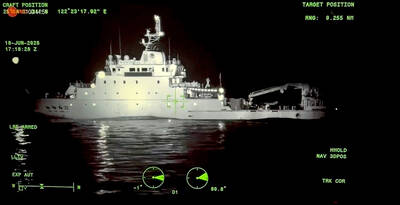
EXCUSES: Beijing is using government and research vessels as a pretext to harass the nation and enter its EEZ, and engage in ‘hegemonic expansion,’ the coast guard said The Coast Guard Administration yesterday said it drove away Chinese oceanographic research vessel Xiang Yang Hong 22 (向陽紅33) from restricted waters after warning it that it was in Taiwan’s exclusive economic zone (EEZ). The Chinese vessel entered restricted waters off the coast of Yilan County’s Suao (蘇澳) at 11:35pm on Thursday, the coast guard said, adding that it dispatched the Lanyu patrol vessel and the boat PP-10077 to shadow the Chinese ship and issue radio warnings ordering it to leave. China has no sovereignty over waters off Taiwan’s east coast, Lanyu’s crew told Xiang Yang Hong 22 over the radio, and demanded

BAIT AND SWITCH: Allowing KMT-run counties to sell to China while the threat of abrupt cancelations hangs overhead is another form of coercion, officials said Beijing is using agricultural purchase offers announced during the Straits Forum to deepen Taiwan’s dependence on the Chinese market, a Taiwanese official said yesterday as they criticized the Taitung County commissioner’s participation in the initiative. During the Straits Forum held in Xiamen on Saturday, Chinese officials announced a sales and purchase agreement for agricultural products from some counties led by the Chinese Nationalist Party (KMT). Taitung County Commissioner Yao Ching-ling (饒慶鈴), who was barred from attending the event in person by the Mainland Affairs Council, participated via video. Under the agreement, China would purchase atemoyas, pomeloes, tea and grouper harvested in Taitung,
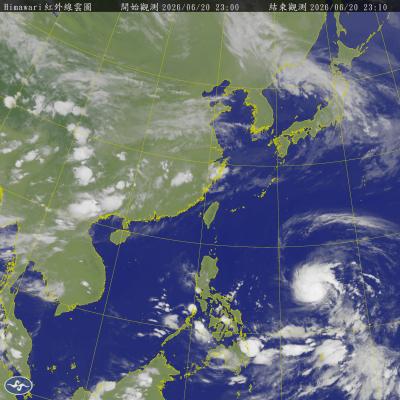
Tropical Storm Mekkhala is forecast to strengthen into a typhoon tomorrow and could come close enough to Taiwan later in the week to prompt a sea warning, the Central Weather Administration (CWA) said yesterday. As of 2 pm, the storm was located 1,870 kilometers southeast of Taiwan's southern tip and moving west- northwest at 23 km per hour. CWA forecaster Cheng Chieh-jen (鄭傑仁) said Mekkhala is expected to continue moving west-northwest through Tuesday under the influence of the Pacific high- pressure system before gradually turning north toward waters east of Taiwan or south of the Ryukyu Islands. The timing and angle of the
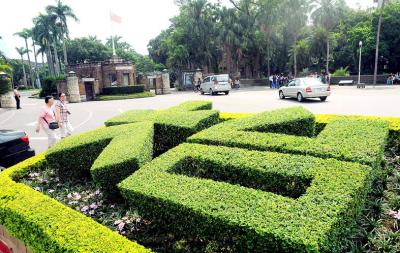
Four Taiwanese universities have been ranked among the world's top 200 institutions in the Quacquarelli Symonds (QS) World University Rankings for next year, the highest Taiwan has ever placed in the category, with National Taiwan University (NTU) achieving its best performance at 54th globally and 17th in Asia. The four Taiwanese institutions in the global top 200 are NTU (54th), National Tsing Hua University (142nd), National Yang Ming Chiao Tung University (177th) and National Cheng Kung University (191st), the rankings showed. All four universities achieved their highest-ever global rankings this year, QS data showed. National Cheng Kung University entered the top 200 for


 RSS
RSS