


The passage of the special arms procurement budget is crucial for raising the nation's defense capabilities and ensuring smooth cooperation with the US and Japan in a Taiwan Strait crisis, a Japanese strategic expert said in a recent interview with the Taipei Times.
Hisahiko Okazaki, a former Japanese ambassador to Thailand and Saudi Arabia, minister in Japan's embassy in Washington and former chief of foreign relations in Japan's defense agency, said that Taiwan has significantly modernized its air and naval forces over the last ten years.
But he added that the nation must further upgrade its capabilities in order to narrow the gap with the US and Japan.
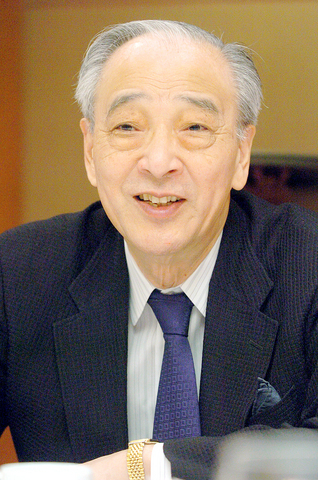
PHOTO: SEAN CHAO, TAIPEI TIMES
The former diplomat and long-time supporter of Taiwan is now the director of the Tokyo-based Okazaki Institute, an independent strategic think tank specializing in security matters.
He was in Taipei late last month for a private trilateral strategic meeting with officials from the US and Japan. The meeting was a follow-up to dialogue in February on beefing up the US-Japan security alliance.
Okazaki said failure to pass the special defense budget will make it difficult for the US and Japan to support Taiwan.
"The rejection of the [US arms] bill indicates that Taiwan doesn't have the will to defend itself," Okazaki said. "If that's the case, it would be very hard for a third party to support it."
He said Taiwan-Japan relations have improved significantly in recent years as the influence of leftist forces in Japan, which were more pro-China, has waned.
"The atmosphere [of Japan-Taiwan relations] has definitely changed. There are many reasons for this development. The Japanese post-war leftist movement is now receding. Also, people have become more aware of the threat from China," he said.
"A decade ago, the pro-Chinese group was supposed to be more liberal and more peace-loving and the pro-Taiwan group was supposed to be more right wing and militaristic. But now nobody thinks so. The pro-China [elements'] political strength was quite strong only a few years ago, but now they've lost influence, particularly in the last election," he said.
Okazaki said the stepping up of the US-Japan security alliance brought to the fore the long-forgotten importance of Taiwan to Japan's security. US and Japanese defense officials made a declaration in Washington this February, the so-called "two-plus-two" declaration which explicitly spelled out peace in the Taiwan Strait as a "common strategic objective" for the US and Japan.
The two-plus-two declaration was a reminder that in 1969 the Sato-Nixon Communique -- signed between Japanese prime minister Eisaku Sato and US President Richard Nixon -- explicitly mentioned that "Taiwan itself" was an important element of Japan's security, Okazaki said.
"The Taiwan question is a very delicate issue. People were afraid of mentioning the importance of Taiwan for a long time," he said. "Nowadays, we say we're interested in the [security] of the Taiwan Strait, but actually in the communique, it didn't even say `Taiwan Strait.' It said `Taiwan itself.'"
Okazaki said the threat to the balance of power in the Taiwan Strait is the lack of transparency in China's military buildup and the possibility of a surprise Chinese attack on Taiwan, which became more likely with the passage of the "Anti-Secession" Law by China in March.
"I am afraid that it practically prevents the possibility of any early warning system from functioning," he said, as it is up to China to decide whether Taiwanese public opinion has leaned too far toward formal independence.
"That means we have to be always prepared for a surprise attack, which from the Chinese perspective, is a legitimate attack required by the law. In diplomatic and military terms, Taiwan is in a state [of constant] ultimatum, totally dependent upon the unilateral Chinese interpretation," Okazaki said.
Regarding the proposal of a Japanese version of the US' Taiwan Relations Act by some Japanese academics, Okazaki said there was a push for this kind of legislation two years ago, but the movement petered out.
However, with the formation of the new cabinet this month, Okazaki said, a new political movement conducive to such legislation may be at hand.
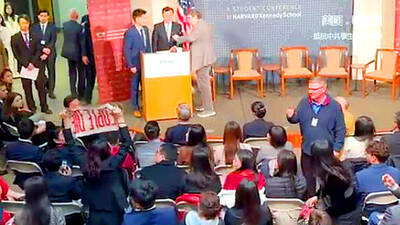
A group of Taiwanese-American and Tibetan-American students at Harvard University on Saturday disrupted Chinese Ambassador to the US Xie Feng’s (謝鋒) speech at the school, accusing him of being responsible for numerous human rights violations. Four students — two Taiwanese Americans and two from Tibet — held up banners inside a conference hall where Xie was delivering a speech at the opening ceremony of the Harvard Kennedy School China Conference 2024. In a video clip provided by the Coalition of Students Resisting the CCP (Chinese Communist Party), Taiwanese-American Cosette Wu (吳亭樺) and Tibetan-American Tsering Yangchen are seen holding banners that together read:

UNAWARE: Many people sit for long hours every day and eat unhealthy foods, putting them at greater risk of developing one of the ‘three highs,’ an expert said More than 30 percent of adults aged 40 or older who underwent a government-funded health exam were unaware they had at least one of the “three highs” — high blood pressure, high blood lipids or high blood sugar, the Health Promotion Administration (HPA) said yesterday. Among adults aged 40 or older who said they did not have any of the “three highs” before taking the health exam, more than 30 percent were found to have at least one of them, Adult Preventive Health Examination Service data from 2022 showed. People with long-term medical conditions such as hypertension or diabetes usually do not
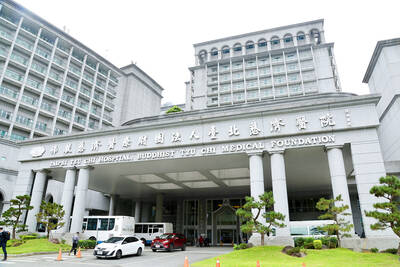
POLICE INVESTIGATING: A man said he quit his job as a nurse at Taipei Tzu Chi Hospital as he had been ‘disgusted’ by the behavior of his colleagues A man yesterday morning wrote online that he had witnessed nurses taking photographs and touching anesthetized patients inappropriately in Taipei Tzu Chi Hospital’s operating theaters. The man surnamed Huang (黃) wrote on the Professional Technology Temple bulletin board that during his six-month stint as a nurse at the hospital, he had seen nurses taking pictures of patients, including of their private parts, after they were anesthetized. Some nurses had also touched patients inappropriately and children were among those photographed, he said. Huang said this “disgusted” him “so much” that “he felt the need to reveal these unethical acts in the operating theater
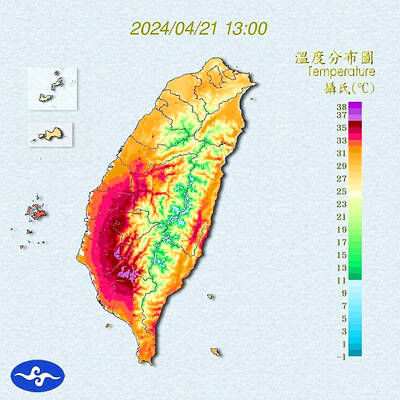
Heat advisories were in effect for nine administrative regions yesterday afternoon as warm southwesterly winds pushed temperatures above 38°C in parts of southern Taiwan, the Central Weather Administration (CWA) said. As of 3:30pm yesterday, Tainan’s Yujing District (玉井) had recorded the day’s highest temperature of 39.7°C, though the measurement will not be included in Taiwan’s official heat records since Yujing is an automatic rather than manually operated weather station, the CWA said. Highs recorded in other areas were 38.7°C in Kaohsiung’s Neimen District (內門), 38.2°C in Chiayi City and 38.1°C in Pingtung’s Sandimen Township (三地門), CWA data showed. The spell of scorching


 RSS
RSS