


The former director of the National Security Bureau's (NSB) special service center, Peng Tzu-wen (彭子文), was reported to have received a stern lecture from a High Court judge yesterday when he appeared in court for a trial in which he is accused of leaking national secrets.
"Try not to be so talkative, because you are a military official," Judge Wang Fu-shing (王復生) was quoting as saying by Chinese-language newspapers, in his remarks to Peng.
When Peng's lawyer referred to Peng as "the general" in the courtroom, the judge snapped, "no titles of office are allowed in my court."
Visibly shocked
Peng and his lawyer seemed visibly shocked by the judge's outburst, the report said.
Peng was indicted in August for leaking national secrets and for potentially putting President Chen Shui-bian's (陳水扁) life in jeopardy, after he disclosed details concerning the deployment of special agents around the president's official residence.
Peng has since been a frequent guest on TV talk shows, using his professional knowledge. He revealed on air details concerning the deployment of special agents' and other plans regarding national emergencies.
Peng told the public that the Presidential Office and the Ministry of National Defense's underground channels would be open on the October 10th National Day, and that two helicopters would be on standby at the Taipei military airport in case of an emergency.
Peng also revealed on TV that he would not "take a bullet for president Chen." Peng is alleged to have leaked the secrets in retaliation after being turned down for promotion. Peng retired as the director of the NSB's special service center in 2003.
Prosecutors have accused Peng of violating the National Secrets Law (國家機密保護辦法).
Peng yesterday told the judge that the NSB and Justice Ministry's Investigation Bureau had illegally recorded his phone calls and that this evidence should be inadmissible in court.
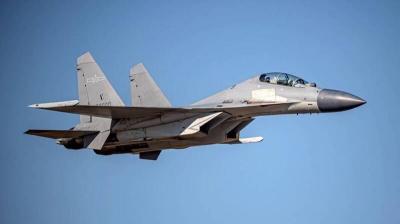
Eight Chinese naval vessels and 24 military aircraft were detected crossing the median line of the Taiwan Strait between 6am yesterday and 6am today, the Ministry of National Defense said this morning. The aircraft entered Taiwan’s northern, central, southwestern and eastern air defense identification zones, the ministry said. The armed forces responded with mission aircraft, naval vessels and shore-based missile systems to closely monitor the situation, it added. Eight naval vessels, one official ship and 36 aircraft sorties were spotted in total, the ministry said.
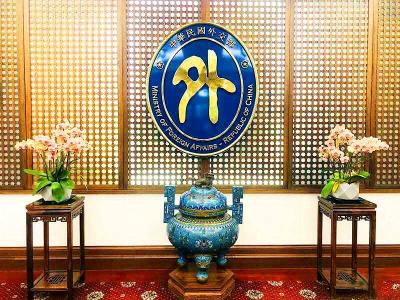
The Ministry of Foreign Affairs (MOFA) today said that if South Korea does not reply appropriately to its request to correct Taiwan’s name on its e-Arrival card system before March 31, it would take corresponding measures to alter how South Korea is labeled on the online Taiwan Arrival Card system. South Korea’s e-Arrival card system lists Taiwan as “China (Taiwan)” in the “point of departure” and “next destination” fields. The ministry said that it changed the nationality for South Koreans on Taiwan’s Alien Resident Certificates from “Korea” to “South Korea” on March 1, in a gesture of goodwill and based on the
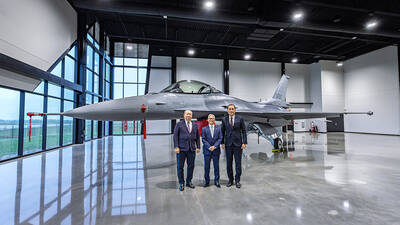
Taiwanese officials were shown the first of 66 F-16V fighter jets purchased by Taiwan from the United States, the Ministry of National Defense said yesterday, adding the aircraft has completed an initial flight test and is expected to be delivered later this year. A delegation led by Deputy Minister of National Defense Hsu Szu-chien (徐斯儉) visited Lockheed Martin’s F-16 C/D Block 70 (also known as F-16V) assembly line in South Carolina on March 16 to view the aircraft. The jet will undergo a final acceptance flight in the US before being delivered to Taiwan, the
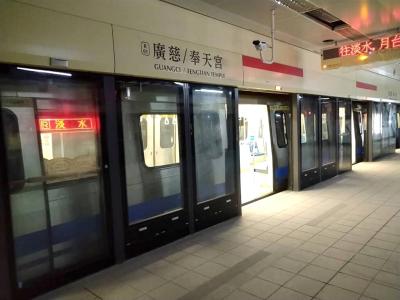
The New Taipei Metro's Sanyin Line and the eastern extension of the Taipei Metro's Tamsui-Xinyi Line (Red Line) are scheduled to begin operations in June, the National Development Council said today. The Red Line, which terminates at Xiangshan Station, would be connected by the 1.4km extension to a new eastern terminal, Guangci/Fengtian Temple Station, while the Sanyin Line would link New Taipei City's Tucheng and Yingge stations via Sanxia District (三峽). The council gave the updates at a council meeting reviewing progress on public construction projects for this year. Taiwan's annual public infrastructure budget would remain at NT$800 billion (US$25.08 billion), with NT$97.3


 RSS
RSS