


Chinese tourists traveling abroad are offering a welcome boost to their host country's economic growth, with Taiwan being no exception, but whether the government is capable of minimizing the social problems associated with welcoming Chinese tourists is open to debate.
As more and more countries become approved tourist destinations for Chinese people and with their disposable incomes on the rise, China's outbound tourism market is expected to grow dramatically.
According to estimates of the WTO, China will become the fourth-largest center of tourists traveling abroad by 2020, with a tourist turnout of 100 million person-time in a year, accounting for 6.2 percent of the global tourism industry.
China's lucrative outbound-tourist market also prompted the Taiwanese government to open its door wider to Chinese nationals, in a bid to reduce its tourism deficit.
Taiwan first opened its doors to Chinese tourists in January 2002, but it has accepted only People's Republic of China (PRC) passport-holders who are already living or traveling overseas.
To increase the visits to Taiwan by Chinese tourists residing in China, the government has in June authorized the Travel Agents Association of the Republic of China on Taiwan, a private organization, to assist in arranging negotiations around this matter with Beijing.
The proposed plan to allow 1,000 Chinese tourists to enter Taiwan every day for a maximum 10-day trip is expected to attract at most 365,000 Chinese annually, 12 times higher than the annual average visits made by Chinese under the current restrictions.
"It is estimated that the plan will earn the nation some NT$15.6 billion (US$490 million) in output value," Fu Don-cheng (傅棟成), director of the department of economic affairs of the Mainland Affairs Council (MAC) -- the country's top cross-strait policy making body -- said.
Despite slow progress in finalizing the cross-strait talks, businesspeople in the travel industry have been preparing for an influx of Chinese tourists.
"The government has given the green light to Taiwanese businesses to attend the International Travel Fair, which will be held in China's Kunming next month," said Sean Chuang (莊秀石), president of Leofoo Development Co.
Led by the Taiwan Visitors Association (TVA), which comprises international airlines, travel agencies, hotels, restaurants, department stores and local visitors associations in the tourism industry, Taiwanese businesses will set up more than 50 stalls at the travel fair.
The Chinese International Travel Fair has been held for years by Beijing's official tourism bureau but, as Taiwanese businesses has now for the first time been invited to take part in it, Chuang regards this year's fair as a kind of warm-up to the opening of Taiwan to Chinese tourists.
Yao Ta-kuang (姚大光), vice chairman of the association entrusted by the government to talk with China, hailed the government's new policy welcoming Chinese tourists.
"Based on my experience, the difference between Chinese tourists and other foreign tourists are that the former prefer visiting central and northern Taiwan and the duration of their stay in Taiwan is longer, which is good for the economy," Yao said.
Like Yao, many people liked to use Hong Kong as an example to prove the economic benefits that Chinese tourists might bring.
However, Wang Shih-hsiung (
"In 2003, 20 years after the opening of Hong Kong to Chinese tourists, the growth rate of Chinese nationals illegally working there was 70 percent, while the growth rate of Chinese nationals working there as prostitutes was 52 percent," Wang said.
Tourists coming to the country only to disappear and work illegally is also a problem facing Taiwan. For example, in the summer of 2004, 17 Chinese tourists disappeared shortly after they arrived at CKS International Airport, and another 13 Chinese tourists went missing shortly after they checked in at their hotel.
The government has expressed confidence in the mechanisms established to manage the problem, with MAC chairman Joseph Wu (吳釗燮) saying that the rate of Chinese tourists absconding in Taiwan is only 0.14 percent. This is a pretty low percentage when compared to statistics of other countries.
"In South Korea, the rate of Chinese tourists going missing is about 11 percent to 13 percent," Wu said, noting that the government is studying more effective measures to deal with related problems and won't open the door for Chinese tourists any wider without proper deterrent measures in place.
However, David Huang (黃適卓), a Taiwan Solidarity Union legislator, said that the government should take notice of the number of people going missing, rather than the percentage.
"The rate of 11 percent to 13 percent of Chinese tourists in South Korea going missing represents about 70,000 people," he said.
Huang suggested that the government put some restrictions on Chinese tourists, as prevention strategies employed in advance would be more effective than apprehending missing people after the fact.
Huang said that the new opening-up policy and the low rejection rate of Chinese tourists' visa applications -- 10 percent -- might cause risks to Taiwan's social security.
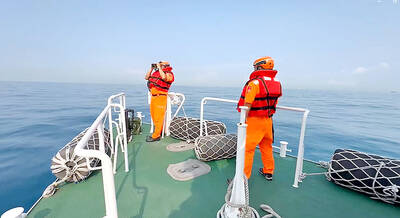
An increase in Taiwanese boats using China-made automatic identification systems (AIS) could confuse coast guards patrolling waters off Taiwan’s southwest coast and become a loophole in the national security system, sources familiar with the matter said yesterday. Taiwan ADIZ, a Facebook page created by enthusiasts who monitor Chinese military activities in airspace and waters off Taiwan’s southwest coast, on Saturday identified what seemed to be a Chinese cargo container ship near Penghu County. The Coast Guard Administration went to the location after receiving the tip and found that it was a Taiwanese yacht, which had a Chinese AIS installed. Similar instances had also

GOOD DIPLOMACY: The KMT has maintained close contact with representative offices in Taiwan and had extended an invitation to Russia as well, the KMT said The Chinese Nationalist Party (KMT) would “appropriately handle” the fallout from an invitation it had extended to Russia’s representative to Taipei to attend its international banquet last month, KMT Chairman Eric Chu (朱立倫) said yesterday. US and EU representatives in Taiwan boycotted the event, and only later agreed to attend after the KMT rescinded its invitation to the Russian representative. The KMT has maintained long-term close contact with all representative offices and embassies in Taiwan, and had extended the invitation as a practice of good diplomacy, Chu said. “Some EU countries have expressed their opinions of Russia, and the KMT respects that,” he

VIGILANCE: The military is paying close attention to actions that might damage peace and stability in the region, the deputy minister of national defense said The People’s Republic of China (PRC) might consider initiating a hack on Taiwanese networks on May 20, the day of the inauguration ceremony of president-elect William Lai (賴清德), sources familiar with cross-strait issues said. While US Secretary of State Anthony Blinken’s statement of the US expectation “that all sides will conduct themselves with restraint and prudence in the period ahead” would prevent military actions by China, Beijing could still try to sabotage Taiwan’s inauguration ceremony, the source said. China might gain access to the video screens outside of the Presidential Office Building and display embarrassing messages from Beijing, such as congratulating Lai
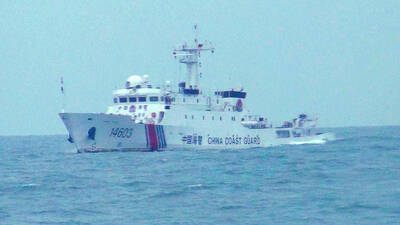
Four China Coast Guard ships briefly sailed through prohibited waters near Kinmen County, Taipei said, urging Beijing to stop actions that endanger navigation safety. The Chinese ships entered waters south of Kinmen, 5km from the Chinese city of Xiamen, at about 3:30pm on Monday, the Coast Guard Administration said in a statement later the same day. The ships “sailed out of our prohibited and restricted waters” about an hour later, the agency said, urging Beijing to immediately stop “behavior that endangers navigation safety.” Ministry of National Defense spokesman Sun Li-fang (孫立方) yesterday told reporters that Taiwan would boost support to the Coast Guard


 RSS
RSS