


The nation's first ever "obstacle-free Web site," an online learning program especially designed for those with mental and physical impairments, was launched yesterday.
In a move to improve job and educational prospects for those with physical and mental disabilities, the Council of Labor Affairs (CLA) employment training division, with assistance from the Taiwan Assistive Technology and Vocational Rehabilitation Association and Sunnet Technology Corporation, started building a Web site six months ago to teach them computer skills, such as how to use word-processing software, surf the Internet and use e-mail.
The project hopes to train 350 members who do not have basic computer literacy skills by the end of this year.
"Today we are witnessing a historical moment in Taiwan's history," said Kuo Fang-yu (郭芳煜), head of the employment and training division of the CLA.
"Although there has been an `earthquake' in the Council of Labor Affairs with the resignation of [CLA chairwoman Chen Chu (陳菊)] it does not subtract from the importance of this day," Kuo added.
The Web site can be found at openstudy.evta.gov.tw.
Kuo said that in the past, one of the biggest obstacles to improving job prospects for the mentally and physically disabled was their lack of computer knowledge, with only 10 percent being IT-literate.
"We all know that if you aren't computer literate you definitely won't get a job," he said, adding that this project was a "breakthrough."
Kang Yong-hua (
"With this Web site, learning will be much more accessible," he said.
Yieh Yao-ming (業耀明), the chair of the Taiwan Assistive Technology and Vocational Rehabilitation Association, outlined a number of original features on the Web site, both in terms of access and content. There are two methods to access the site: one for those with hearing and physical impairments, the other for those with vision problems and those who were intellectually challenged. The hardware for the latter includes a Braille strip which runs alongside the keyboard and a "guidedog for the blind" feature allowing those with vision problems to access the main features of a particular Web page with just a click of a button.
The educational material on the Web site is specially adapted to the needs of those with physical and mental disabilities through the provision of subtitles, a sign language guide who appears in the corner of the screen and oral instructions. Furthermore, only a quick tap at the keyboard is needed to access features, eliminating the need for using a mouse.
Online tutors and a special support team consisting of members of the "Eaglefly" support team (who themselves have disabilities), are on hand to provide support, Kuo said.
Eaglefly member Chen Guan-wu (陳冠武), who teaches computer literacy skills to the physically and mentally disabled, joked, "I am worried that this project will put me out of a job."

A group of Taiwanese-American and Tibetan-American students at Harvard University on Saturday disrupted Chinese Ambassador to the US Xie Feng’s (謝鋒) speech at the school, accusing him of being responsible for numerous human rights violations. Four students — two Taiwanese Americans and two from Tibet — held up banners inside a conference hall where Xie was delivering a speech at the opening ceremony of the Harvard Kennedy School China Conference 2024. In a video clip provided by the Coalition of Students Resisting the CCP (Chinese Communist Party), Taiwanese-American Cosette Wu (吳亭樺) and Tibetan-American Tsering Yangchen are seen holding banners that together read:

UNAWARE: Many people sit for long hours every day and eat unhealthy foods, putting them at greater risk of developing one of the ‘three highs,’ an expert said More than 30 percent of adults aged 40 or older who underwent a government-funded health exam were unaware they had at least one of the “three highs” — high blood pressure, high blood lipids or high blood sugar, the Health Promotion Administration (HPA) said yesterday. Among adults aged 40 or older who said they did not have any of the “three highs” before taking the health exam, more than 30 percent were found to have at least one of them, Adult Preventive Health Examination Service data from 2022 showed. People with long-term medical conditions such as hypertension or diabetes usually do not

POLICE INVESTIGATING: A man said he quit his job as a nurse at Taipei Tzu Chi Hospital as he had been ‘disgusted’ by the behavior of his colleagues A man yesterday morning wrote online that he had witnessed nurses taking photographs and touching anesthetized patients inappropriately in Taipei Tzu Chi Hospital’s operating theaters. The man surnamed Huang (黃) wrote on the Professional Technology Temple bulletin board that during his six-month stint as a nurse at the hospital, he had seen nurses taking pictures of patients, including of their private parts, after they were anesthetized. Some nurses had also touched patients inappropriately and children were among those photographed, he said. Huang said this “disgusted” him “so much” that “he felt the need to reveal these unethical acts in the operating theater
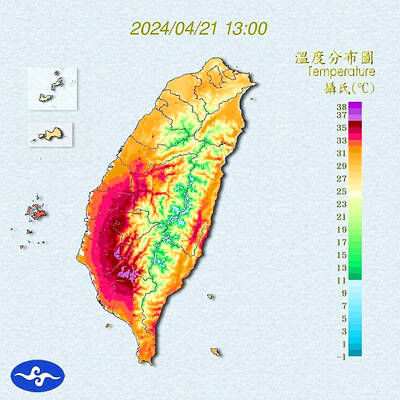
Heat advisories were in effect for nine administrative regions yesterday afternoon as warm southwesterly winds pushed temperatures above 38°C in parts of southern Taiwan, the Central Weather Administration (CWA) said. As of 3:30pm yesterday, Tainan’s Yujing District (玉井) had recorded the day’s highest temperature of 39.7°C, though the measurement will not be included in Taiwan’s official heat records since Yujing is an automatic rather than manually operated weather station, the CWA said. Highs recorded in other areas were 38.7°C in Kaohsiung’s Neimen District (內門), 38.2°C in Chiayi City and 38.1°C in Pingtung’s Sandimen Township (三地門), CWA data showed. The spell of scorching


 RSS
RSS