


The Consumers' Foundation yesterday announced the results of a nationwide inspection of various brands of beverages and juices whose printed labels contained false or unclear information.
During a consumers' organization exchange program in Japan, foundation officials were able to purchase and examine the labels on beverages sold there.
Some brands like Fanta and Suntory are sold both in Taiwan and Japan, allowing comparisons.
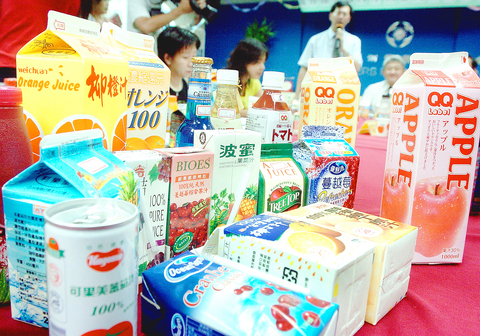
PHOTO: CHU PEI-HSIUNG, TAIPEI TIMES
According to foundation secretary-general Terry Huang (黃怡騰), the Fanta orange soda sold in Japan had the words "this beverage contains no juice" clearly printed on the can, while the Fanta sold in Taiwan had no indication of whether juice was included or not.
"Fanta is an international brand," Huang said. "Why is it that in Japan, the can is clearly labeled but not in Taiwan? Consumers are being cheated here."
On another well-known beverage, Lemon C, originally made by Japanese company Suntory but manufactured here by Vedan (味丹), the words printed on the bottle were clearly different from the original.
On the Japanese bottle, the words "70 lemons worth of Vitamin C in every bottle" were clearly printed, while the Taiwanese bottle merely said "Recommended daily value of Vitamin C in every bottle."
"The Japanese Lemon C contains the Vitamin C of seventy lemons. Nobody can actually consume 70 lemons a day, an indication of the high amount of Vitamin C in the Japanese version, yet in Taiwan, it only contains the `recommended daily value,' which is definitely less than 70 lemons," Huang said.
According to the foundation's calculations, the Japanese Lemon C contained 16.8 times the Vitamin C of that in Taiwan.
"What's worse is that the Taiwanese Lemon C actually contains 600ml instead of the 500ml sold in Japan," Huang said. "It means that our companies are watering down the beverage."
The Consumers' Foundation was not trying to denounce these companies for making artificial juice drinks instead of using pure juice, but hoped that companies would be honest when labeling their products, Huang said.
"There is nothing wrong with concentrated or diluted juice. We just want clear and honest labels," Huang said.
The information on labels must be clear and easily understood by the public, said Wu Chia-cheng (吳家誠), a foundation member.
"Often companies use fancy English or technical terms for preservatives and additives, which nobody understands," Wu said. "The public has the right to know what they are drinking."
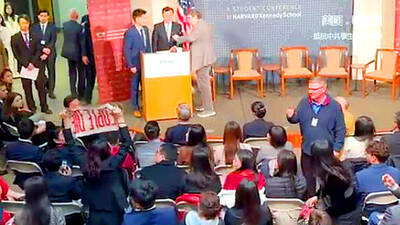
A group of Taiwanese-American and Tibetan-American students at Harvard University on Saturday disrupted Chinese Ambassador to the US Xie Feng’s (謝鋒) speech at the school, accusing him of being responsible for numerous human rights violations. Four students — two Taiwanese Americans and two from Tibet — held up banners inside a conference hall where Xie was delivering a speech at the opening ceremony of the Harvard Kennedy School China Conference 2024. In a video clip provided by the Coalition of Students Resisting the CCP (Chinese Communist Party), Taiwanese-American Cosette Wu (吳亭樺) and Tibetan-American Tsering Yangchen are seen holding banners that together read:

UNAWARE: Many people sit for long hours every day and eat unhealthy foods, putting them at greater risk of developing one of the ‘three highs,’ an expert said More than 30 percent of adults aged 40 or older who underwent a government-funded health exam were unaware they had at least one of the “three highs” — high blood pressure, high blood lipids or high blood sugar, the Health Promotion Administration (HPA) said yesterday. Among adults aged 40 or older who said they did not have any of the “three highs” before taking the health exam, more than 30 percent were found to have at least one of them, Adult Preventive Health Examination Service data from 2022 showed. People with long-term medical conditions such as hypertension or diabetes usually do not
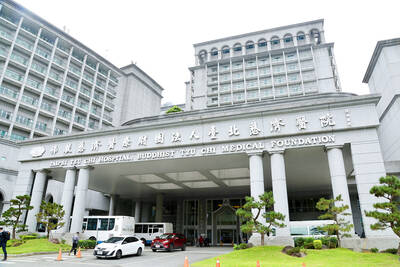
POLICE INVESTIGATING: A man said he quit his job as a nurse at Taipei Tzu Chi Hospital as he had been ‘disgusted’ by the behavior of his colleagues A man yesterday morning wrote online that he had witnessed nurses taking photographs and touching anesthetized patients inappropriately in Taipei Tzu Chi Hospital’s operating theaters. The man surnamed Huang (黃) wrote on the Professional Technology Temple bulletin board that during his six-month stint as a nurse at the hospital, he had seen nurses taking pictures of patients, including of their private parts, after they were anesthetized. Some nurses had also touched patients inappropriately and children were among those photographed, he said. Huang said this “disgusted” him “so much” that “he felt the need to reveal these unethical acts in the operating theater
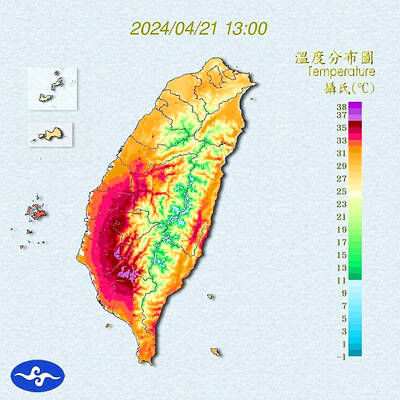
Heat advisories were in effect for nine administrative regions yesterday afternoon as warm southwesterly winds pushed temperatures above 38°C in parts of southern Taiwan, the Central Weather Administration (CWA) said. As of 3:30pm yesterday, Tainan’s Yujing District (玉井) had recorded the day’s highest temperature of 39.7°C, though the measurement will not be included in Taiwan’s official heat records since Yujing is an automatic rather than manually operated weather station, the CWA said. Highs recorded in other areas were 38.7°C in Kaohsiung’s Neimen District (內門), 38.2°C in Chiayi City and 38.1°C in Pingtung’s Sandimen Township (三地門), CWA data showed. The spell of scorching


 RSS
RSS