


Martin Rijnbeek of the Netherlands adopted his daughter Yentl from Taiwan when she was eight months old. He told her about the adoption before she asked, and made sure she knew that if she wanted to, she could always go back to Taiwan to search for her birth parents, whose names and contact information are kept by the adoption agency.
Rijnbeek's case highlights a growing trend in child adoption. In many Western countries, adoption has evolved from a secretive, closed process weighed down by dark stigmas and painful misconceptions into a more transparent experience. There is open contact between adoptive parents and biological parents, and children are increasingly told, even before they can fully understand, how they came to their families.
Child adoption in Taiwan, however, is still viewed as a shameful secret and the last option for infertile people. Even if they do decide to adopt, Taiwanese prefer private adoption to going through legitimate child welfare groups. Statistics from the Child Welfare Foundation show that in Taipei alone, private adoption is used in 94 percent of adoptions every year.
Adoption services in Taiwan are provided by a few child welfare groups or foster care centers, and the government and child welfare advocates are now cooperating to improve adoption services.
As early as 1993, the government had included legal provisions for adoption in a revision to the Child Welfare Law (
Information
Aiming to make adoption more transparent, the Ministry of the Interior's (MOI) Bureau of Child Welfare (
"Adoption is a part of child welfare services. It is our goal to make the adoption process legal and transparent. The information center is designed to protect adoptees' rights to find their birth parents and prevent illegal trade in children or even trafficking," Bureau Chief Huang Bi-hsia (
While congratulating the adoptees -- most of whom had been abandoned because of physical defects or ill health -- on their happy and healthy lives with their new families overseas, Huang discussed new efforts to improve the adoption process in an attempt to boost domestic adoption.
"Frequent home visits to potential adopters and birth parents by social workers are important for the adopted child's benefit. The bureau is also working on a more comprehensive adoption assessment criteria," she said.
Beginning in 2003, the bureau started providing child welfare groups with government subsidies to improve child adoption services, and gave local courts financial assistance to review adoption cases and for counseling services.
Child welfare groups with adoption services also relaxed some restrictions to encourage child adoption. In the past, adoption was only open to married couples, even though no laws have ever banned single people from adopting a child.
Although the government and civil groups are pushing for increased domestic adoption, the practice is in decline in Taiwan. According to the Child Welfare League Foundation, approximately 5,000 children a year are abandoned in Taiwan, and only about 10 percent of those find an adoptive family in Taiwan.
"In addition to the traditional misconception that child adoption is a shameful secret, the inadequate welfare system and medical system scares many people away from having kids, let alone asking them to adopt abandoned children, many of whom have physical defects," said Abby Chen (
Netherlands
In the Netherlands, for example, children's medical and even educational expenses are covered. The child welfare system encourages many Dutch to have a baby or even adopt one. Over the last 15 years, the Dutch have adopted more Taiwanese children than any other country, embracing 663 abandoned children from Taiwan.
In the US, a Child Citizenship Act Project launched last year ensures that citizenship certificates are delivered to children adopted from overseas within 45 days of their arrival in the country.
Government policies may present obstacles to improving the adoption process, child welfare advocates said, but traditional ideas and negative misconceptions about adoption, are what really hurt adoption in Taiwan.
"Taiwanese families view children as precious possessions and a means to carry on the family name. Therefore, adoptive parents in Taiwan are often people who suffer from infertility," Chen said.
The traditional idea, which sees blood relations as defining a family, also keeps many from adopting children, and makes it hard for parents to fully embrace adopted children as their own kids.
For this reason, the foundation invited Taiwan-born adoptees and their Dutch parents for a visit to promote the concept that adoption is all about loving and accepting someone who is not a blood relative as your own child.
Changing a long-standing concept is not easy, and it might be hard to understand where the unconditional love came from when Rijnbeek and his wife decided to adopt a child with special needs. Yentl was abandoned by her birth parents because they couldn't afford to treat a tumor in her left eye. After going to Netherlands, Yentl had several surgeries, but doctors were unable to save her eye. Her physical defect, however, has never been a problem for Rijnbeek.
"A special-needs child is someone who needs you more. You have more time with your child and can develop a more close relationship," he said.
Fears
Asked if he ever worried that Yentl would leave him one day to find her birth parents, a nightmare that scares many Taiwanese away from adoption, Rijinbeek said that he respects her right to know where she came from, and will love her no matter what she chooses to do.
Already on her second visit to Taiwan, Yentl said that she knew from the beginning about the adoption, and her parents bought her books about Taiwan to satisfy her curiousity about her cultural roots.
"Of course I know it is my birth country, but that's it. I don't feel anything. Taiwan is just another country for me," she said.
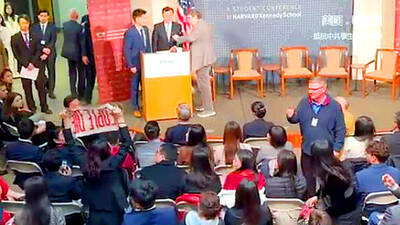
A group of Taiwanese-American and Tibetan-American students at Harvard University on Saturday disrupted Chinese Ambassador to the US Xie Feng’s (謝鋒) speech at the school, accusing him of being responsible for numerous human rights violations. Four students — two Taiwanese Americans and two from Tibet — held up banners inside a conference hall where Xie was delivering a speech at the opening ceremony of the Harvard Kennedy School China Conference 2024. In a video clip provided by the Coalition of Students Resisting the CCP (Chinese Communist Party), Taiwanese-American Cosette Wu (吳亭樺) and Tibetan-American Tsering Yangchen are seen holding banners that together read:

UNAWARE: Many people sit for long hours every day and eat unhealthy foods, putting them at greater risk of developing one of the ‘three highs,’ an expert said More than 30 percent of adults aged 40 or older who underwent a government-funded health exam were unaware they had at least one of the “three highs” — high blood pressure, high blood lipids or high blood sugar, the Health Promotion Administration (HPA) said yesterday. Among adults aged 40 or older who said they did not have any of the “three highs” before taking the health exam, more than 30 percent were found to have at least one of them, Adult Preventive Health Examination Service data from 2022 showed. People with long-term medical conditions such as hypertension or diabetes usually do not
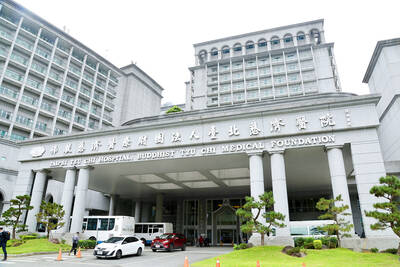
POLICE INVESTIGATING: A man said he quit his job as a nurse at Taipei Tzu Chi Hospital as he had been ‘disgusted’ by the behavior of his colleagues A man yesterday morning wrote online that he had witnessed nurses taking photographs and touching anesthetized patients inappropriately in Taipei Tzu Chi Hospital’s operating theaters. The man surnamed Huang (黃) wrote on the Professional Technology Temple bulletin board that during his six-month stint as a nurse at the hospital, he had seen nurses taking pictures of patients, including of their private parts, after they were anesthetized. Some nurses had also touched patients inappropriately and children were among those photographed, he said. Huang said this “disgusted” him “so much” that “he felt the need to reveal these unethical acts in the operating theater
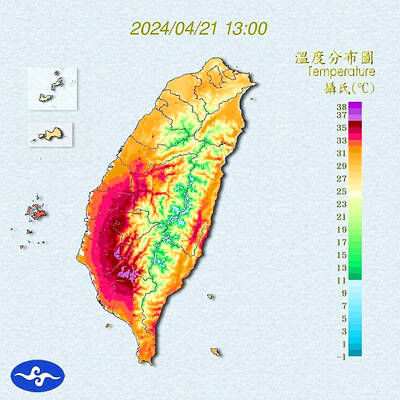
Heat advisories were in effect for nine administrative regions yesterday afternoon as warm southwesterly winds pushed temperatures above 38°C in parts of southern Taiwan, the Central Weather Administration (CWA) said. As of 3:30pm yesterday, Tainan’s Yujing District (玉井) had recorded the day’s highest temperature of 39.7°C, though the measurement will not be included in Taiwan’s official heat records since Yujing is an automatic rather than manually operated weather station, the CWA said. Highs recorded in other areas were 38.7°C in Kaohsiung’s Neimen District (內門), 38.2°C in Chiayi City and 38.1°C in Pingtung’s Sandimen Township (三地門), CWA data showed. The spell of scorching


 RSS
RSS