


Taipei Times: The efforts of civil groups to push for the legalization of policies such as the Sexual Abuse Prevention Act have improved the status of women in Taiwan. Can you share the Garden of Hope Foundation's experience in fighting for women's rights over the past 17 years?
Chi Hui-jung (紀惠容): The Garden of Hope began by providing halfway homes and residential care for child prostitutes, and then spearheaded the anti-child prostitution movement in the early 1990s as we realized that raising public awareness of the issue was as equally important as saving those young girls.
Battling child prostitution, just as fighting for any type of social change, needs both legal regulations and cooperative efforts with other governmental and non-governmental organizations. So we lobbied for years for the enactment of the Child and Youth Sexual Transaction Prevention Act (兒童及青少年性交易防治條例), which was finally passed in 1995. However, legislation alone cannot guarantee the improvement of the situation, and it is the duty of non-governmental organizations to examine the government's effectiveness in the implementation of the law. Since the passage of the law, we have worked with the Taipei Women's Rescue Foundation, the Mennonite Good Shepherd Center and the End Child Prostitution Association to monitor the government's efforts by holding public hearings and issuing annual reports.
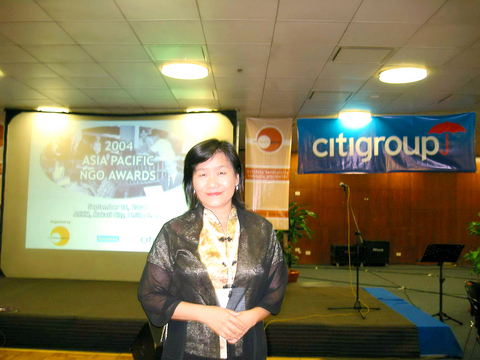
PHOTO COURTESY OF THE GARDEN OF HOPE FOUNDATION
While we celebrate the 10th anniversary of the passage of the law, it is our goal to push the government for the amendment of the act and even come up with a version of our own.
Under our supervision, the government has put greater efforts into preventing child prostitution, but there are still many things that need to be done. For example, the rise of globalization has made human trafficking an international issue, and we must work with foreign countries to prevent girls from being sold to other places and stop foreign prostitutes from being sent to Taiwan. Another issue we want to address -- as we are currently pushing for an amendment of the relevant law -- is the problem with the Internet. Cyber space has also become a hotbed for youth-sex trafficking, and it is as informative as it is dangerous for our teens.
From the protection of young prostitutes to promoting the anti-prostitute movement, the improvement of women's and girls' rights has always been our goal. But years after the promotion of gender equality empowered women in many ways, we cannot help but wonder, where do women stand in the 21st century? I think it is time to tell society and women themselves that females are not a second-class sex. So the foundation is transforming itself from a protective service provider for girls and women to a supporter and believer. We started to promote the concept of empowerment to young girls, encouraging them to develop their abilities and believing that they can be as strong as their male counterparts.
TT: It seems like NGOs has become an important force in the push for greater social reforms in Taiwan and their influence sometimes even surpasses the government's. In your opinion, how effective are NGOs in Taiwan?
Chi: The rise of NGOs here has been one of the most startling developments since the transition from authoritarianism to democracy. I am very confident of our civil organizations and NGOs, and I believe they play a vital role in pushing for social change and in monitoring the government.
I always think that there are four sectors in Taiwan. The first sector is the government, which holds the greatest power and is the country's authority to make policy decisions. The second sector includes legislators and businesses. While legislators are responsible for making or amending the laws and policies, businesses have full influence over the economic sphere. NGOs are the third sector, which I think is the most idealistic among the four sectors, and is a positive force in society. The fourth sector is the media, whose influence over public opinion makes it powerful.
While NGOs have a positive influence in society, they are not without their weaknesses. The most serious problem most NGOs face is the financial issue. Because NGOs rely mostly on private donations, an economic downturn could hurt some organizations and make it tougher for them to survive. In addition, many NGOs suffer from mismanagement and lack efficiency, and are therefore often unable to provide professional services. Although NGOs are dedicated to helping others through direct or indirect action, their services are limited to certain groups and it is hard for them to expand their services, because of limited staffing and tight budgets.
It is important for NGOs to make connections with each other. Networking facilitates interaction between experts in different areas, promotes the sharing of ideas and issues and makes it possible for NGOs to provide comprehensive services to society as a whole.
The necessity of improving the quality of NGOs has intensified as they play a greater role in society. That's why the Garden of Hope decided to join the International Organization for Standardization (ISO) program, establishing a self-regulating quality mechanism to increase scrutiny of the organization, and to build professionalism and institutionalization. The foundation is the first NGO in Asia to be an ISO member, which is still an unfamiliar concept to most of organizations in the region. I encourage all NGOs to take the initiative to implement the quality of the program. In an age of globalization, I also think that it is important for local NGOs to take a global view and try to make as much connection with other organizations as possible.
TT: What do you think about Taiwan's NGOs as compared to those in other countries around the world?
Chi: Speaking from my experience of networking with international organizations, I think NGOs in Taiwan are quite mature and the issues we address are no different than other NGOs around the world. Taiwan's democracy movement, I think, provided a great deal of value for the development of NGOs, giving us plenty of space to thrive and freedom to fight for what we believe in. Currently there are a total of 15,000 registered NGOs in Taiwan that provide diverse services and address issues that are similar to those in other parts of the world, such as environmental issues and the rights of disabled people, women and children.
Our experience of fighting for gender equality and the achievements we've made for women's rights in Taiwan, however, actually sets a good example for other countries. I've been invited to Nepal and Cambodia to share my experiences in the anti-child prostitution movement, international human trafficking and other women's issues. So I think the development of NGOs in Taiwan has been quite successful.
Because Taiwan is a small island, it is much easier and faster to promote issues and raise public awareness than in other countries such as the US, where it may take years for a message to be introduced to every part of the country. It has only been six years since the passage of the Domestic Violence Prevention Act (家庭暴力防治法), but now the public is familiar with the issue, and the government has been forced to establish a more effective mechanism for the protection of abused women and children.
TT: Speaking of the issue of domestic violence, the recent frenzy about the former supermodel Wang Jing-ying's (
Chi: After that incident, I immediately wrote an article to discuss the issue and asked the media not to report too much gossip. To my surprise, there were a lot of in-depth reports and discussions about ways to ask for help or apply for restraining orders, and the media deserves some credit for raising public awareness despite its voyeuristic interest in Wang and her husband's private life.
Beyond helping promote a general understanding of the seriousness of the issue, I think the incident highlighted the shortcomings of the Domestic Violence Prevention Act. The foundation and 10 other civil groups launched the Violence Prevention Legislative Change Alliance to push for changes to the nation's domestic abuse act for the establishment of a comprehensive sexual harassment law and for enacting stiffer punishments for sex offenders.
We wanted the act to include the establishment of short-term shelters and long-term residences for victims of domestic violence in every city and county, and a support system to provide victims with job training and employment opportunities.
For victims of domestic violence, knowing that they have a safe place to go after an incident and that they will be able to support themselves financially is very important. Currently it is local governments' choice whether or not to set up shelters. Besides the government-run shelters in Taipei and Kaohsiung, civil groups have set up most other shelters in other cities and counties. We hope that in the future, all the local governments will establish shelters for abused women and their children so that these people can regain control over their lives, physically and mentally, before moving out on their own.
Employment assistance, on the other hand, provides training for victims to learn professional skills, so that those women can be financially independent and empower themselves to leave their abusive husbands without having to worry about money.
Another problem with the act is the approval time for restraining orders. Even the temporary order, which is designed to help victims who face immediate danger, takes about four hours to get approved. Not only does the issuing of an order take too long, but it requires victims to be in immediate danger in order to qualify for one. Isn't it ridiculous to ask a victim to wait until she faces a threat to her life before being qualified for a restraining order? We need a more reasonable and practical law to protect victims of abuse.
The foundation is also thinking about expanding our services to the abusers by providing them with counseling and other resources to prevent them from hurting their loved-ones again. In the long run, I think the anti-domestic abuse movement should focus on the education of men, because we all know that the problem comes from them. Educating our men to respect women, learn better communicative skills and ways to deal with stress other than resorting to violence will be a much more effective way to ultimately end domestic violence.
TT: As a successful female leader of a civil group and a long-time women's rights advocate, what direction do you think the feminist movement will take in the future? Do you have any suggestions for young girls?
Chi: Statistics from the UN in 2003 showed that the competitiveness of Taiwanese women ranked 21st in the world -- the top in Asia. As Taiwan and other countries made progress in getting more women involved in policy-making process, I think this century and the next will be women's age. Having said that, the world still belittles women in subtle ways, and the "glass ceiling" has yet to be shattered.
The efforts in fighting for gender equality, therefore, must continue. We and many other civil groups are now putting our efforts into educating the next generation of girls and boys about the concept of gender equality. We want boys to know that they are born with many advantages given to them in society, and that they need to respect women more and be willing to share resources with their female counterparts.
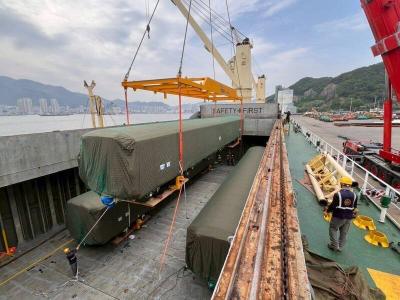
The first of 10 new high-capacity trains purchased from South Korea’s Hyundai Rotem arrived at the Port of Taipei yesterday to meet the demands of an expanding metro network, Taipei Rapid Transit Corp (TRTC) said yesterday. The train completed a three-day, 1,200km voyage from the Port of Masan in South Korea, the company said. Costing NT$590 million (US$18.79 million) each, the new six-carriage trains feature a redesigned interior based on "human-centric" transportation concepts, TRTC said. The design utilizes continuous longitudinal seating to widen the aisles and optimize passenger flow, while also upgrading passenger information displays and driving control systems for a more comfortable

Taiwan's first indigenous defense submarine, the SS-711 Hai Kun (海鯤, or Narwhal), departed for its 13th sea trial at 7am today, marking its seventh submerged test, with delivery to the navy scheduled for July. The outing also marked its first sea deployment since President William Lai (賴清德) boarded the submarine for an inspection on March 19, drawing a crowd of military enthusiasts who gathered to show support. The submarine this morning departed port accompanied by CSBC Corp’s Endeavor Manta (奮進魔鬼魚號) uncrewed surface vessel and a navy M109 assault boat. Amid public interest in key milestones such as torpedo-launching operations and overnight submerged trials,

Quarantine awareness posters at Taiwan Taoyuan International Airport have gone viral for their use of wordplay. Issued by the airport branch of the Animal and Plant Health Inspection Agency, the posters feature sniffer dogs making a range of facial expressions, paired with advisory messages built around homophones. “We update the messages for holidays and campaign needs, periodically refreshing materials to attract people’s attention,” quarantine officials said. “The aim is to use the dogs’ appeal to draw focus to quarantine regulations.” A Japanese traveler visiting Taiwan has posted a photo on X of a poster showing a quarantine dog with a

Taiwan’s coffee community has launched a “one-person-one-e-mail” campaign, calling for people to send a protest-e-mail to the World Coffee Championships (WCC) urging it to redesignate Taiwanese competitors as from “Taiwan,” rather than “Chinese Taipei.” The call followed sudden action last week after the WCC changed all references to Taiwanese competitors from “Taiwan” to “Chinese Taipei,” including recent World Latte Art champion Bala (林紹興), who won the World Latte Art Championship in San Diego earlier this month. When Bala received the trophy, he was referred to as representing Taiwan, as well as in the announcement on the WCC’s Web site, until it


 RSS
RSS