


Twenty-two HIV-infected people and AIDS patients living in a halfway home at an apartment complex in Wenshan District face a deadline of today to move out of the community after a fierce protest by community members.
Undeterred by the setback, residents and volunteers at the Midway Home built by the Harmony Home Association expressed a strong desire to remain in the community and called for greater social acceptance of people with AIDS.
The Midway Home is a self-help group and half-way house for AIDS patients and people who are HIV-positive.
"HIV can only be contracted through intercourse, blood transfusions and breast milk. People will not be at risk of contracting HIV by having an AIDS patient living next door," Nicole Yang (
The Midway Home was originally located in Sanchong District. But the landlord, after finding out that people in the organization had AIDS, decided not to renew their lease.
As a result, in June the association moved the Midway Home to the current site. Six children with AIDS, as well as 16 adults who are either HIV-positive or have full-blown AIDS, are living in the shelter.
The local police station revealed the situation to the township officials, sparking fear and resentment in the community, according to Yang.
After learning about their new neighbors, community members issued a statement expressing opposition during a township meeting on July 1 held to discuss the issue.
"Many of the AIDS patients are drug addicts or gay people. We refuse to live under the fear that one day one of those people may stab other residents with a needle or have a bad influence on our children," the statement said.
A representative of the residence surnamed Chen said that despite some people's anger, the community as a whole does not intend to discriminate against AIDS patients and push them out, and thus cause the same anxiety in other neighborhoods.
"I think the government should establish a shelter specifically for AIDS patients so that they can get professional help and not cause public fear," she said.
One resident of the Midway Home, an AIDS patient who goes by the alias of "A-chong," said that he understood the community's fears. But after being cast out from their families and now without a halfway home, Midway Home residents don't know where to go.
"The saddest thing for us [AIDS patients and HIV-positive people] is that while we are alive, we have no place to live, and when we die, no funeral homes will take our bodies," he said.
Yang said that on average, one out of four AIDS patients face discrimination from their own families and friends, and have no homes to return to. As such, the Midway Home may be the only place they can find support and love.
As a friendly gesture to show their desire to stay in the current site, the association promised to ensure a sanitary environment in the community, as well as to provide AIDS-related education and maintain the moral standards in the neighborhood, in a bid to gain the community's acceptance.
But if the community members insist on forcing them out, the Midway Home will have to search for a new site on their own, since the government has provided no assistance.

LOUD AND PROUD Taiwan might have taken a drubbing against Australia and Japan, but you might not know it from the enthusiasm and numbers of the fans Taiwan might not be expected to win the World Baseball Classic (WBC) but their fans are making their presence felt in Tokyo, with tens of thousands decked out in the team’s blue, blowing horns and singing songs. Taiwanese fans have packed out the Tokyo Dome for all three of their games so far and even threatened to drown out home team supporters when their team played Japan on Friday. They blew trumpets, chanted for their favorite players and had their own cheerleading squad who dance on a stage during the game. The team struggled to match that exuberance on the field, with
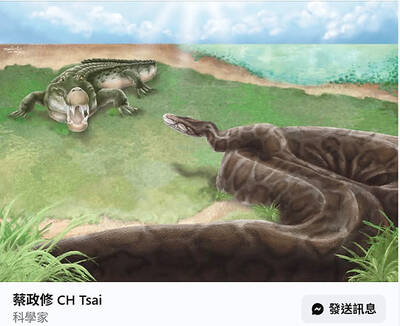
Taiwanese paleontologists have discovered fossil evidence that pythons up to 4m long inhabited Taiwan during the Pleistocene epoch, reporting their findings in the international scientific journal Historical Biology. National Taiwan University (NTU) Institute of Ecology and Evolutionary Biology associate professor Tsai Cheng-hsiu (蔡政修) led the team that discovered the largest snake fossil ever found in Taiwan. The single trunk vertebra was discovered in Tainan at the Chiting Formation, dated to between 400,000 and 800,000 years ago in the Middle Pleistocene, the paper said. The area also produced Taiwan’s first avian fossil, as well as crocodile, mammoth, saber-toothed cat and rhinoceros fossils, it said. Discoveries

Taiwanese paleontologists have discovered fossil evidence that pythons up to 4m long inhabited Taiwan during the Pleistocene epoch, reporting their findings in the international scientific journal Historical Biology. National Taiwan University (NTU) Institute of Ecology and Evolutionary Biology associate professor Tsai Cheng-hsiu (蔡政修) led the team that discovered the largest snake fossil ever found in Taiwan. A single trunk vertebra was discovered in Tainan at the Chiting Formation, dated to between 800,000 to 400,000 years ago in the Middle Pleistocene, the paper said. The area also produced Taiwan’s first avian fossil, as well as crocodile, mammoth, sabre-toothed cat and rhinoceros fossils, it said. Discoveries

Whether Japan would help defend Taiwan in case of a cross-strait conflict would depend on the US and the extent to which Japan would be allowed to act under the US-Japan Security Treaty, former Japanese minister of defense Satoshi Morimoto said. As China has not given up on the idea of invading Taiwan by force, to what extent Japan could support US military action would hinge on Washington’s intention and its negotiation with Tokyo, Morimoto said in an interview with the Liberty Times (sister paper of the Taipei Times) yesterday. There has to be sufficient mutual recognition of how Japan could provide


 RSS
RSS