


A Democratic Progressive Party (DPP) legislator-at-large, Tsai Huang-liang (
His vacancy will be replaced by former DPP legislator Hsu Jung-shu (
"I'm sure you guys will miss me," Tsai told reporters after a press conference organized to bid farewell to the 45-year-old.
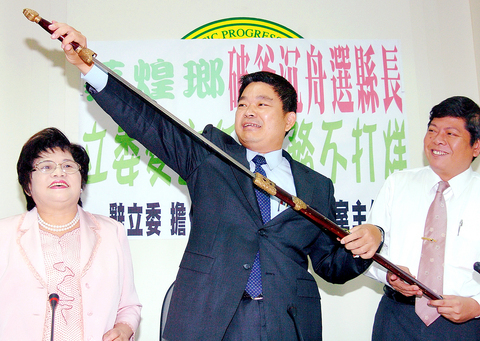
PHOTO: CHANG CHIA-MING, TAIPEI TIMES
Accepting a sword offered by Hsu and a "diploma" presented by DPP caucus whip Lai Ching-te (
Tsai's resignation followed party rules, which require lawmakers to give up their post should they run as candidates in regional elections. His resignation came before the DPP's Central Standing Committee confirmed its nominees for the 16 electoral districts yesterday afternoon.
In addition to Tsai, other candidates for the year-end elections include former minister of justice Chen Ding-nan (
In Yunlin County, former DPP legislator Su Chih-fen (
DPP Legislator Lin Cho-shui (
To be a good caucus leader, Lin said that a person has to be able to negotiate with lawmakers from other parties and government officials.
With his 10-year experience in the legislature, Lin said that he believes Tsai would make a good county commissioner.
Tsai, who entered the political limelight about a decade ago and was elected to the legislature in 1995, said he hopes county residents will give him a chance to serve them and promised to get more funding for local infrastructure projects.
Tsai was born in 1960 into a poor tenant farmer's family of nine in Puli, Nantou County. He graduated from a two-year college program, which was previously affiliated with National Chengchi University and is now affiliated with the National Open University.
The life of the farmer's son took a dramatic turn in 1979 when the Chinese Nationalist Party (KMT) regime cracked down on an anti-government parade in Kaohsiung organized by Formosa magazine -- a brutal chapter in Taiwan's history later coined the Kaohsiung Incident (美麗島事件).
What the government did to those people made Tsai detest the KMT regime and prompted him to join the democratic movement after completing his military service.
He became a DPP member after the regime lifted a ban on political parties in 1986, but began his political career in 1984 as a township representative in his hometown. In the 18 years following, he has assumed positions ranging from township arbitrator, representative of his colleague Hsu's campaign office in Nantou, to county councilor and lawmaker.
Recalling working with Tsai in the days of the KMT era when the two ran an underground radio station, Hsu described Tsai as an articulate, quick-witted, hard-working and practical person.

NATIONAL SECURITY: Authorities are working to confirm the identities of the military personnel involved and investigating possible illegal conduct and regulatory violations Authorities are probing possible national security implications after Kinmen police and immigration officers on Sunday found a Chinese woman allegedly posing as a tourist while engaging in prostitution involving more than 10 military personnel. The woman, surnamed Chen (陳), has since been deported, authorities said, adding that investigators are still working to confirm the identities of those implicated, as the records only listed code names and aliases. The case stemmed from a report received by the Kinmen District Prosecutors’ Office on Friday last week from the Jinhu Precinct of the Kinmen County Police Bureau. On Sunday, police, along with the National Immigration
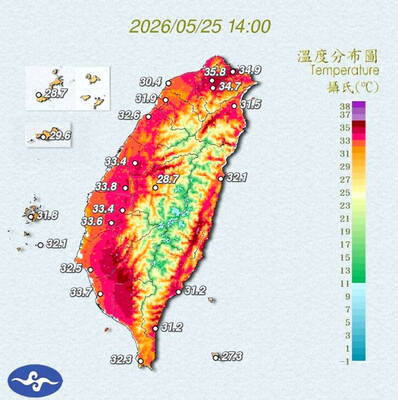
STAY COOL: The HPA recommended that people stay hydrated, use air-conditioning or fans while indoors, wear loose-fitting clothes and walk in the shade while outdoors Employers must implement measures such as installing cooling equipment, and providing drinking water and rest breaks for outdoor workers starting from Monday next week, the Taipei Department of Labor said on Sunday. Employers who fail to comply could face fines of NT$30,000 to NT$300,000 under the Occupational Safety and Health Act (職業安全衛生法), the department said. Businesses in Taipei employing fewer than 100 workers, as well as registered self-employed workers with labor insurance coverage, could receive on-site assessments and guidance from occupational safety consultants to help them apply for central government subsidies to implement or improve heat-protection measures, it said. Under the Ministry of

GLOBALGIVING: ‘ Caving to external pressure is not acceptable for an organization that has cultivated justice reform and human rights for 30 years,’ one NGO said A slew of non-government organizations (NGOs) have withdrawn from the GlobalGiving fundraising platform after it announced it would use “Chinese Taipei” instead of “Taiwan” from next month. The Taiwan Good Rice Association wrote on Facebook on Friday that it was informed on April 28 via a teleconference call of the change, which was made because the platform wanted to operate in China. Taiwan Good Rice is to terminate all cooperative relationships with GlobalGiving in response to the platform’s “unilateral and non-negotiable” decision to remove references to Taiwan, the NGO said. “Taiwan is in the official name of Taiwan Good Rice Association and the

Chinese Nationalist Party (KMT) Chairwoman Cheng Li-wun (鄭麗文) yesterday briefed her party’s Central Standing Committee regarding her scheduled visit to the US between Monday next week and June 16, saying that her purpose would be to persuade the US that the Republic of China (ROC) Constitution was a “one China” constitution that would foster stable and peaceful cross-strait relations. The ROC Constitution is the most important defense for all Taiwanese citizens, as it upholds our democracy and has contributed to our robust economy, which aligns with international and US interests, she said. “We would not be troublemakers and drag the US under,”


 RSS
RSS