

No matter how China develops politically, democracy will be its final destiny, said President Chen Shui-bian (陳水扁) in an article in remembrance of today's 16th anniversary of the Tiananmen Massacre.
The massacre began in Beijing on June 4, 1989, when the Chinese authorities brutally instructed troops to crush pro-democracy demonstrators gathered in Tiananmen Square.
In his weekly e-newsletter published yesterday, the president said it is time to review political developments on both sides of the Taiwan Strait since 1989.
While the massacre stymied China's democratic development, Chen said Taiwan has since accelerated its democratic reforms and has emerged as the "democratic lighthouse" of the world's Chinese societies.
Judging from Taiwan's experience, Chen said he is convinced that repressive rule only restricts humans temporarily, and cannot constrain them for ever.
The value of democracy lies in the fact that diverse opinions can co-exist, Chen said, "although sometimes clamoring might appear in an occasional display of disorder,this, however, cannot be used as an excuse to take away the people's right to be their own boss."
"Pursuing democracy is our ideal, and protecting democracy is our responsibility," Chen said in the article. "Although to China, the shadow of Tiananmen might gradually fade away, the `sun' of democracy is dawning quietly in various corners of China."
"I believe that no matter how bumpy China's political development might be, democracy will be its final destiny," Chen said. "I earnestly hope that China's leaders can respect and protect the people's right to free choice, and hope that the universal values of freedom and democracy will blossom in China eventually."

Starbucks Taiwan’s decision to charge for drink customization, which had been free, has sparked consumer backlash, highlighting the challenge of raising prices without making customers feel they are losing value, experts said. Since Oct. 12, customers who order drinks with less or no ice and ask to have the volume topped up with milk or other liquid have been charged an additional NT$15. Topping off drinks without ice was previously free, and disgruntled customers posted photos on social media showing that iced drinks ordered without ice were only half full if the extra NT$15 was not paid. The posts drew tens of thousands
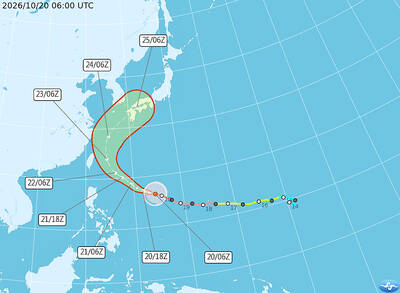
A sea warning for Typhoon Champi might be issued tonight, while the storm’s trajectory would determine whether a land warning is to be issued tomorrow night, the Central Weather Administration (CWA) said yesterday. As of 2pm yesterday, Champi was about 1,536km east-southeast of Taiwan proper’s southernmost point, Oluanpi (鵝鑾鼻), packing maximum sustained winds of 198kph, CWA forecaster Tseng Chao-cheng (曾昭誠) said. The storm was moving west-northwest at 23kph and was expected to strengthen over the next 24 hours before weakening slightly as it approaches cooler waters east of Taiwan, Tseng said. Champi is expected to turn north tomorrow, with the angle of the
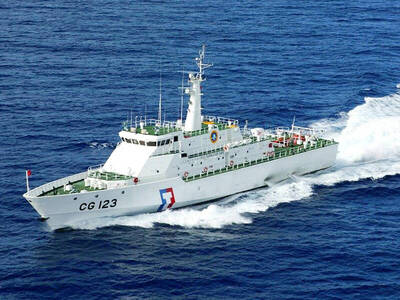
A patrol vessel donated by the Coast Guard Administration (CGA) to the Philippines would not be used in waters near Taiwan or areas where Taiwanese fishing vessels operate, Premier Cho Jung-tai (卓榮泰) said yesterday. The vessel, formerly the CGA's 500-tonne-class Kinmen (金門), was commissioned into the Philippine Coast Guard on Oct. 2. Speaking at the Legislative Yuan, Cho said the Philippines had pledged during the donation process that the vessel would be used only for designated missions and would not operate in waters related to Taiwan. The vessel could even provide assistance to Taiwan if needed, he added. Responding to questions from Chinese
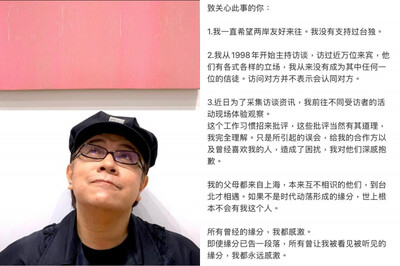
EXPLANATION: Tsai said he attended events featuring various interviewees to observe them firsthand as part of his interview research Television host Kevin Tsai (蔡康永) last night broke his silence over a controversy surrounding his appearance at a campaign event for Democratic Progressive Party Taipei mayoral candidate Puma Shen (沈伯洋), saying he had never supported Taiwan independence. “I have always hoped for friendly cross-strait relations. I have never supported Taiwan independence,” Tsai wrote in a post on the Chinese social media platform Sina Weibo. Tsai, who has hosted television shows in China, attended the opening of Shen’s campaign headquarters on Oct. 4, drawing criticism from Chinese social media users and prompting some Chinese companies to distance themselves from him. China’s Taiwan Affairs Office


 RSS
RSS