

Police yesterday said that suspected energy-drink poisoner Wang Chin-chan (王進展) admitted to lacing Bullwild (蠻牛) and Paolyta B (保力達B) drinks with cyanide as part of a failed attempt to extort money from their manufacturer.
"Wang was cunning and denied that he committed the crime after police detained him at noon on Thursday. But at about midnight, when I showed him a picture of Chou Yi-kuei (周乙桂) [who died after drinking Bullwild], Wang was shocked. He suddenly kneeled down, cried and said, `I did the wrong thing,'" Criminal Investigation Bureau (CIB) commissioner Hou You-yi (侯友宜) told reporters.
Hou said he then asked Wang, "How and where did you get the cyanide?"
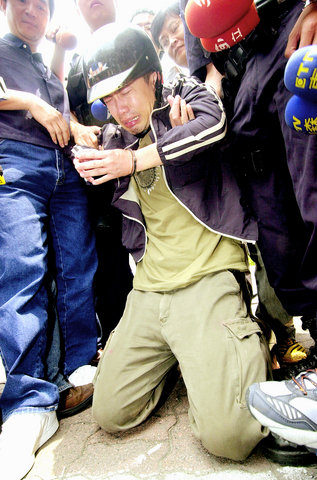
PHOTO: LIAO YAO-TUNG, TAIPEI TIMES
Wang replied that he obtained it from China. He said a Chinese national, Zhang Chi (章池), gave him 300g of cyanide after bringing the poison into the country in hundreds of capsules.
debts
Wang told police he had more than NT$1 million (US$32,000) in debts. His plan had been to poison the drinks and demand money from the manufacturer.
Police said Wang claimed to have had no intention of killing anybody, and so made stickers reading "I am poisonous, don't drink" and placed them on the bottles.
Wang allegedly told police that after Chou had died and police released security footage of Wang in various convenience stores, he became afraid and abandoned the plan to extort money from the company.
Police yesterday found a draft e-mail on Wang's computer at his residence in Taipei County.
The e-mail demanded that Paolyta Co pay him NT$10,000,000 (US$320,000), but the e-mail had not been sent.
Wang allegedly told police he had also planned to make threatening calls from China in which he would direct the beverage company to deposit money in a China-based account.
Police added that Wang committed the crime on May 17.
He left for China on May 19 before returning to Taiwan last Tuesday.
After searching Wang's home, police also found hats, dark glasses and pants similar to those he apparently wore in the security tapes.
Police yesterday morning paraded Wang before reporters outside Taichung police station before escorting him to the prosecutor's office.
`too late'
Wang kneeled down and cried, saying, "I am very sorry for the wrong thing I did to the victims and the public. But now it's too late to be regretful."
Police said Wang robbed a bank at CKS International Airport in 1993. He stole more than NT$5 million, but was arrested eight days later.
Wang was sentenced to 10 years in prison, and was paroled in 2003.
Police said that Wang had lied about the existence of an accomplice in the robbery, and they were therefore examining whether "Zhang Chi" really existed or had any part to play in importing cyanide.
Meanwhile, the Mainland Affairs Council called on the Chinese authorities to help the government investigate the possibility that a Chinese accomplice was involved.
Council Vice Chairman You Ying-lung (
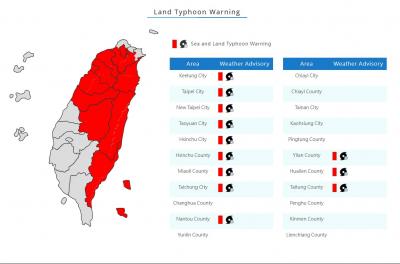
The Central Weather Administration at 5:30am today issued a land warning for Typhoon Bavi, which is expected to have its greatest impact on Taiwan from this evening through tomorrow. As of 8am, the eye of Bavi was about 700km east of Oluanpi (鵝鑾鼻), Taiwan's southernmost point, and was moving northwest at 25kph, the CWA said. The storm was packing maximum sustained winds of 162kph, with gusts of up to 198kph, the weather agency said, adding that Bavi had a storm radius of about 380km. Rainfall is expected to increase in mountainous areas of northern, central and southern Taiwan later today, with the heaviest
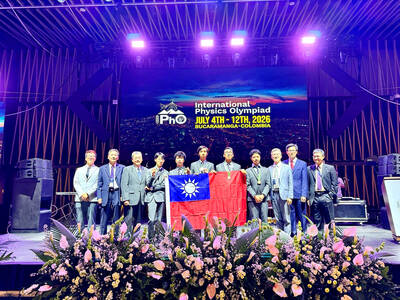
Taiwan tied for first with five golds at the 56th International Physics Olympiad (IPhO) held in Colombia this year, showcasing high school physics prowess. The team, led by National Taiwan Normal University physics professor Chen Chuan-Ren (陳傳仁), was represented by five students, who were chosen from 2,361 students nationwide via multiple selections to receive pre-competition training. Competing with 381 participants from 91 countries, all five students won a gold medal for Taiwan. Other countries earning five golds included China, India, Kazakhstan, South Korea and Russia. One of the five Taiwanese, Chien Kuo High School (CKHS) student Wu Ssu-chien (吳思謙) said he has enjoyed studying
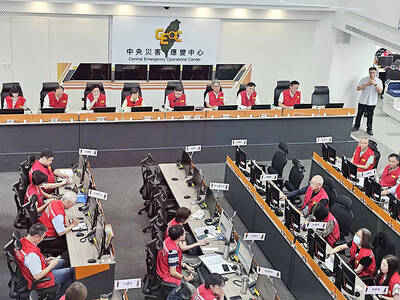
WIDESPREAD CANCELATIONS: Airline and ferry operators have canceled a number of journeys following the issue of a sea warning, with a land warning also expected today Airlines and ferry operators yesterday announced widespread service changes as Typhoon Bavi approaches Taiwan, with authorities urging travelers to monitor updates and avoid nonessential trips to outlying islands. The Central Weather Administration issued a sea warning for Bavi at 2:30pm yesterday and is expected to issue a land warning early today if the typhoon maintains its projected path and speed. AIR TRAVEL Starlux Airlines said flights scheduled from yesterday through Sunday could be rescheduled or canceled, and urged passengers to check the latest flight information before heading to the airport. Tigerair Taiwan said due to safety concerns, yesterday’s IT232 Taoyuan-Naha and IT289 Naha-Kaohsiung flights

Beijing has been offering subsidized trips to China’s Xinjiang region for Taiwanese teachers as part of efforts to influence teachers and, indirectly, students, a government official said yesterday. With China subsidizing the trips, the teachers only need to pay a NT$4,000 registration fee for an eight-day, seven-night tour that includes accommodation and meals, the official said, speaking on condition of anonymity. Participants risk having their personal information collected and their social networks monitored by Chinese authorities, the official said. Chinese authorities are offering separate summer exchange programs targeting Taiwanese teachers and students, with the student program including study-related activities, they


 RSS
RSS