


Vice President Annette Lu (呂秀蓮) yesterday called for reform to the presidential adviser selection system, saying the system has been marred by controversy and is limited in function.
"The presidential adviser system was established by the previous regime. But the advisers' functions are limited and [the existence of the system] has been controversial. Therefore, I would like to take this opportunity to call for reform to the system," Lu said.
Lu made the remarks in response to a question about whether the list of presidential advisers released on Friday represents President Chen Shui-bian's (陳水扁) reconciliation with the Democratic Progressive Party's (DPP) "deep greens," a group which lashed out at Chen when Chinese Nationalist Party (KMT) Chairman Lien Chan (連戰) and People First Party Chairman James Soong (宋楚瑜) made visits to China.
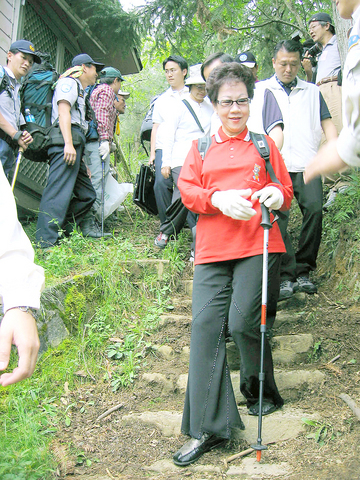
PHOTO: CNA
Instead of answering the question directly, the vice president called for a reform to the system.
To show her appreciation of nature, Lu yesterday held a press conference at Wuling Farm in Hsueh-pa National Park.
Lu also expressed regret over the bill passed in the legislature on Friday which requires the National Assembly to ratify amendments by a three-quarters majority vote. The law also allow the National Assembly members to abstain from a vote.
"In [last Saturday's] election, 83 percent of voters backed parties that support the constitutional amendment package, translating to 249 seats in the National Assembly. Supposedly the constitutional amendments would pass without the need to convene the National Assembly," Lu said.
Not only does the law governing the functions of the National Assembly require a three-quarters majority of votes, it also allows representatives to abstain, a move that the vice president was made "in bad faith."
Lu also said the legislature had turned the National Assembly elections into a joke by passing the law.
"What if some National Assembly representatives who were supposed to vote for the amendments abstain from voting? Should they still get paid?" she said.
When asked to comment on the possibility for a meeting between President Chen and Chinese President Hu Jintao (
Since China has made the "one China" principle a precondition for cross-strait negotiations, and only those Taiwanese politicians who denounce independence are interested in talks with Beijing. Lu said the chance for a Chen-Hu meeting was slim.
"We should not jump to any conclusion before 2008," Lu said, adding that cross-strait issues not only concern Taiwan and China, but also the US.
"As Chen and [US President George W.] Bush are to complete their terms in office in 2008 and China will hold the 2008 Olympic Games that year, there may be a chance for a breakthrough in cross-strait relations," Lu said.
When asked about her teaming up with Shin Kong Wu Ho-su Memorial Hospital deputy superintendent Huang Fang-yen (黃芳彥) to run in the 2008 presidential election, Lu said she may do so, but only under the DPP banner.
Lu said she was surprised that First Lady Wu Shu-chen (吳淑珍) had made such a prediction while she was in the US.
"[Wu] might think that since the DPP won't nominate me as the presidential candidate in 2008, I would therefore quit the party. I can tell you all I will not leave the party," the vice president said.
Lu spent her second day at Wuling Farm planting a cherry blossom trees and sightseeing. The vice president has been active in promoting the farm's upcoming cherry blossom festival.
"Instead of going to Japan to see cherry blossoms, let's come back here to enjoy the spectacular view when all these trees begin to blossom," Lu said.

Fast food chain McDonald's is to raise prices by up to NT$5 on some products at its restaurants across Taiwan, starting on Wednesday next week, the company announced today. The prices of all extra value meals and sharing boxes are to increase by NT$5, while breakfast combos and creamy corn soup would go up by NT$3, the company said in a statement. The price of the main items of those meals, if ordered individually, would remain the same. Meanwhile, the price of a medium-sized lemon iced tea and hot cappuccino would rise by NT$3, extra dipping sauces for chicken nuggets would go up
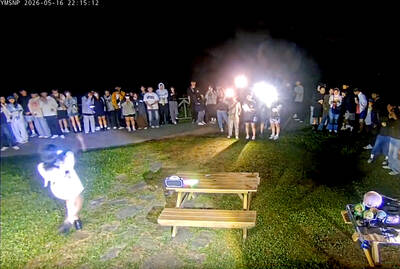
Yangmingshan National Park’s Qingtiangang (擎天崗) nature area has gone viral after a park livestream camera observed a couple in the throes of intimate congress, which was broadcast live on YouTube, drawing large late-night crowds and sparking a backlash over noise, bright lights and disruption to wildlife habitat. The area’s livestream footage appeared to show a couple engaging in sexual activity on a picnic table in the park on Friday last week, with the uncensored footage streamed publicly online. The footage quickly spread across social media, prompting a tide of visitors to travel to the site to “check in” and recreate the

Minister of Digital Affairs Lin Yi-ching (林宜敬) yesterday cited regulatory issues and national security concerns as an expert said that Taiwan is among the few Asian regions without Starlink. Lin made the remarks on Facebook after funP Innovation Group chief executive officer Nathan Chiu (邱繼弘) on Friday said Taiwan and four other countries in Asia — China, North Korea, Afghanistan and Syria — have no access to Starlink. Starlink has become available in 166 countries worldwide, including Ukraine, Malaysia, the Philippines and Vietnam, in the six years since it became commercial, he said. While China and North Korea block Starlink, Syria is not
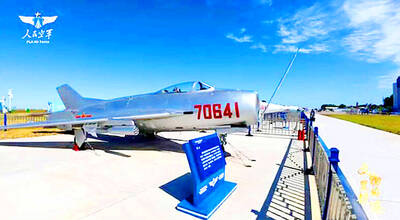
GROUNDED: A KMT lawmaker proposed eliminating drone development programs and freezing funding for counterdrone systems, despite China’s adoption of the technology China has deployed attack drones at air bases near the Taiwan Strait in a strategy aimed at overwhelming Taiwan’s air defense systems through saturation attacks, the Mainland Affairs Council (MAC) said. The council’s latest quarterly report on China said that satellite imagery and open-source intelligence indicate that the Chinese People’s Liberation Army (PLA) had converted retired J-6 fighter jets into J-6W drones, which the PLA has stationed at six air bases near Taiwan, five in China’s Fujian Province and one in Guangdong Province. The report cited J. Michael Dahm, a senior fellow at the US-based Mitchell Institute, as saying that China has


 RSS
RSS