


Allowing for popular referendums on future constitutional amendments is a way to block moves toward Taiwan's independence, Chinese Nationalist Party (KMT) Vice Chairman and Taipei Mayor Ma Ying-jeou (馬英九) said yesterday.
Ma made the remarks in response to claims by Democratic Action Alliance (DAA) activists that inclusion of the right to referendums into the Constitution would promote independence.
Inclusion of the right to referendums in the Constitution is one of the items in the reform package passed by the legislature last August that the 300 delegates of the National Assembly will be charged with approving or rejecting. The National Assembly election will be held today, with 12 political parties and civic groups running in the elections.
Dismissing the activists' claims, Ma said that allowing for referendums on constitutional amendments would make proposals aimed at promoting Taiwan independence or changing the Republic of China's status quo harder to pass.
When the National Assembly is formally disbanded -- another one of the items in the constitutional reform package -- any proposed constitutional amendments redefining the nation's territory or the ROC's formal designation to contain the word "Taiwan" will first have to be passed by the Legislative Yuan and then approved by the Taiwanese people through a referendum, Ma said, adding that this will make changing the status quo more difficult.
Meanwhile, Ma continued to urge the public to come out to vote for today's National Assembly election.
Other items in the constitutional reform package that the National Assembly delegates will deal with include reducing the number of legislative seats from the present 225 to 113, and adopting a "single seat, two votes" legislative electoral system starting with the legislature to be elected in 2007.
The 300 delegate seats for the National Assembly will be allotted to the 12 parties and groups based on the proportion of votes they garner in the election.
DAA convenor Chang Ya-chung (張亞中), a political science professor at National Taiwan University, said that there was no "rational debates or discussions" before the constitutional and electoral reform package was passed by the legislature last year.
If the package is passed by the National Assembly, it will be disastrous for the nation and the people, Chang claimed, adding that inclusion of the right to referendums in the Constitution would lead to de facto independence.
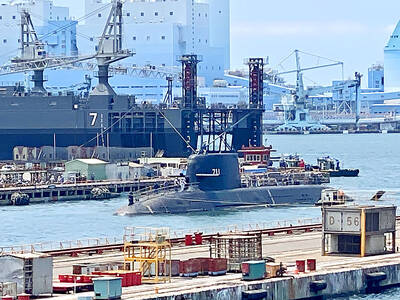
AGING: While Japan has 22 submarines, Taiwan only operates four, two of which were commissioned by the US in 1945 and 1946, and transferred to Taiwan in 1973 Taiwan would need at least 12 submarines to reach modern fleet capabilities, CSBC Corp, Taiwan chairman Chen Cheng-hung (陳政宏) said in an interview broadcast on Friday, citing a US assessment. CSBC is testing the nation’s first indigenous defense submarine, the Hai Kun (海鯤, Narwhal), which is scheduled to be delivered to the navy next month or in July. The Hai Kun has completed torpedo-firing tests and is scheduled to undergo overnight sea trials, Chen said on an SET TV military affairs program. Taiwan would require at least 12 submarines to establish a modern submarine force after assessing the nation’s operational environment and defense
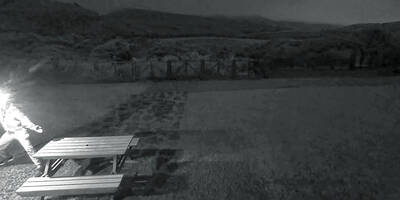
Yangmingshan National Park authorities yesterday urged visitors to respect public spaces and obey the law after a couple was caught on a camera livestream having sex at the park’s Qingtiangang (擎天崗) earlier in the day. The Shilin Police Precinct in Taipei said it has identified a suspect and his vehicle registration number, and would summon him for questioning. The case would be handled in accordance with public indecency charges, it added. The couple entered the park at about 11pm on Thursday and began fooling around by 1am yesterday, the police said, adding that the two were unaware of the park’s all-day live
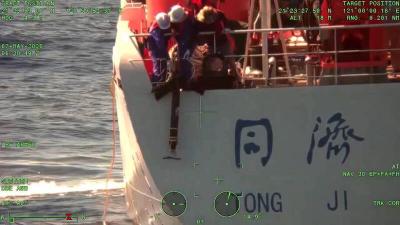
The coast guard today said that it had disrupted "illegal" operations by a Chinese research ship in waters close to the nation and driven it away, part of what Taipei sees a provocative pattern of China's stepped up maritime activities. The coast guard said that it on Thursday last week detected the Chinese ship Tongji (同濟號), which was commissioned only last year, 29 nautical miles (54km) southeast of the southern tip of Taiwan, although just outside restricted waters. The ship was observed lowering ropes into the water, suspected to be the deployment of scientific instruments for "illegal" survey operations, and the coast

A former soldier and an active-duty army officer were yesterday indicted for allegedly selling classified military training materials to a Chinese intelligence operative for a total of NT$79,440. The Taipei District Prosecutors’ Office indicted Chen Tai-yin (陳泰尹) and Lee Chun-ta (李俊達) for contravening the National Security Act (國家安全法) and the Anti-Corruption Act (貪污治罪條例). Chen left the military in September 2013 after serving alongside then-staff sergeant Lee, now an army lieutenant, at the 21st Artillery Command of the army’s Sixth Corps from 2011 to 2013, according to the indictment. Chen met a Chinese intelligence operative identified as “Wang” (王) through a friend in November


 RSS
RSS