


Given the success of his recent trip to China and his status as the leader of the pan-blue camp for the past five years, Chinese Nationalist Party (KMT) Chairman Lien Chan (
Despite the rising tide of support for his continuing in the KMT's top post, many doubt that Lien plans to make another run for party chairman.
The calls for Lien's re-election began early this year, with pan-blue supporters and a number of KMT old guard saying that the party is already facing too many changes to go through a leadership switch.
"In regards to the year-end mayoral and county commissioner elections, only Lien can unite the pan-blue camp to achieve success. To be frank, other people's abilities are too limited," former KMT legislator-at-large Kao Yu-jen (
Given the success of his China trip, says KMT Legislator Hou Tsai-feng (
"The journey to China was so successful because [Beijing] acknowledged Lien's accomplishments," the lawmaker said on Wednesday, casting doubt on the government's ability to handle cross-strait relations.
Furthermore, Hou said, both Legislative Speaker Wang Jin-pyng (
The small but increasing portion of the pan-blue camp that supports Lien seeking another term has caused consternation within the Ma and Wang camps, as the two men struggle to maintain the image of loyalty to Lien despite their eagerness for the chairman position, which many see as the stepping stone to a pan-blue nomination in the 2008 presidential election.
The differences between Wang and Ma's attitudes toward the calls for Lien to keep his job became evident as early as February, when Ma first made clear his intention to run for the KMT's top post.
While Ma was outspoken from the beginning about running in the party's July 16 election, Wang held off on making public his decision until nearly a month after Ma's announcement.
During that period, Wang was secretive about his intentions, saying only that he supported another Lien run for chairmanship, a claim he maintains to this day.
It seems clear, however, that the growing support for Lien has begun to unnerve Wang.
"If Chairman Lien wants to be chairman again, he will have to enter the election process and make his intentions known soon," Wang said on Thursday, in a rare deviation from his usual automatic assertion of support for Lien.
As their campaigns pick up speed, both Wang and Ma have been careful to acknowledge Lien's supporters while filling their weekends with campaign activities.
Speaking to the Taipei Times on Thursday, Ma's campaign confidante and long-time ally, KMT Legislator Wu Yu-shen (
"The KMT is caring party whose supporters are affectionate and loyal. Lien has become the `spiritual leader' of the pan-blue camp," Wu said.
Of course there will be those who hope he can stay on as chairman, just as there are those who hope Ma and those who hope Wang will become the next chairman," Wu said.
"Lien himself established the democratic, inner-party election processes that are used today. Lien supports those processes, and he approves of the fair competition between Wang and Ma," Wu said, hinting that the Ma camp has already dismissed the possibility of Lien's candidacy.
"When [former president] Lee Teng-hui (
As for those who say Lien must seek re-election because there is a need for his continued leadership, Wu cited Lien's own comments to rebut their appeal.
"Lien has said that he will be a lifetime KMT volunteer. After he steps down, he can continue to give guidance in cross-strait relations and party reform," Wu said, indicating that he thinks it is time for Lien to relinquish the post.
Lien has said as much himself. In an interview with the China Television Co (CTV) on Thursday, he stressed that while he has no plans to run again at present, it is not because it would be against the KMT's bylaws to do so.
"To be honest, I just never had any thoughts at all about running again," Lien said at the beginning of the CTV interview.
During a phone interview yesterday with Ho Szu-yin (
"Lien is just trying to leave a political legacy through this trip. He has already made it clear he won't run again," Ho said.
"There's nothing there [to change the situation]," Ho said.

UPGRADE: The Kang Ding-class frigate is replacing its Chaparall missiles with Tien Chien II and Hua Yang VLS, which would provide it with long-range, 360° air defense Taiwan plans to produce 1,200 to 1,376 Hai Chien II missiles (海劍二, Sea Sword II) — also known as TC-2N — to serve as the standard air defense system of the navy’s surface combatant fleet, a source said yesterday. Last week, the Hai Chien II, the naval version of the Tien Kung II missile (天劍二, Sky Sword II), completed a live-fire test in waters off the National Chungshan Institute of Science and Technology’s Jiupeng facility (九鵬) in Pingtung County’s Manjhou Township (滿州). The MIM72 Chaparral and other dated air defense missiles that currently arm Taiwanese ships have inadequate range to combat Chinese

REASONS FOR TRAVEL: An assistant professor said that proposed amendments to penalize drivers if they used drugs overseas would not deter people from traveling People who operate a motor vehicle under the influence of marijuana would have their driver’s license revoked, even if they used the substance while overseas, the Ministry of Transportation and Communications said yesterday, citing proposed amendments to the Road Traffic Management and Penalty Act (道路交通管理處罰條例). The amendments would also authorize the government to revoke the licenses of people determined to have used Category 1 or Category 2 narcotics, even if they were not operating a vehicle while under the influence of drugs, as well as ban them from taking the license test for three years, the ministry said. People aged 18 or
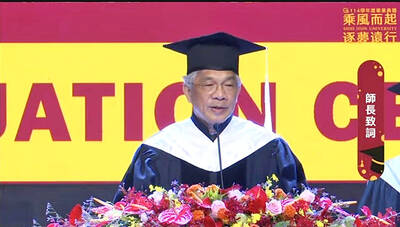
Shih Hsin University President Chen Ching-he (陳清河) yesterday issued a public apology for comments made in his commencement speech last week, stating that he has asked the school to suspend his duties and halt his wages for two months as a show of contrition. At the commencement ceremony on May 30, Chen said, “If you don’t manage your time well, or your own emotions, or your health, then I am telling every one of you — put a quick end to ‘you,’ because the world has no need for ‘you.’” The comments have sparked significant controversy online, and Chen through an open
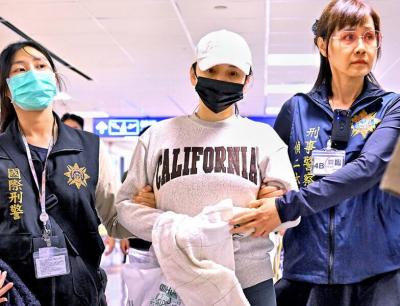
Johanne Liou (劉喬安), a Taiwanese woman who shot to unwanted fame during the Sunflower movement protests in 2014, returned to Taiwan last night after being deported from the US. She is to stand trial in Taiwan for charges involving embezzlement, fraud and drug crimes. The Criminal Investigation Bureau (CIB) said it took her into custody at Taiwan Taoyuan International Airport and would first question her before transferring her to the New Taipei District Prosecutors’ Office. She was arrested upon disembarking a flight from San Francisco that landed shortly before 7pm. Liou absconded to the US in 2019 after jumping bail


 RSS
RSS