


China says they are a symbol of unity which will bring joy to the children of Taiwan, but not everybody in Taiwan sees the giant pandas as cuddly messengers of peace.
Supporters of Taiwanese independence have dismissed China's gift as a "propaganda ploy" designed to melt the hearts of the Taiwanese people and have urged the government to reject the bears.
"The pandas are a trick, just like the Trojan Horse," Taiwan Solidarity Union (TSU) Legislator Huang Shi-cho (黃適卓) said. "Pandas are cute but they are meant to destroy Taiwan's psychological defenses."
President Chen Shui-bian's (
DPP Chairman Su Tseng-chang (蘇貞昌) said that Beijing had classified the shipment of the pandas as "domestic trade," thereby reaffirming its claim that Taiwan is a breakaway province.
"It is clear the pandas have been presented as `goodwill gifts' in order to achieve China's goal of undermining our sovereignty and dividing Taiwan," he said.
China has been using "panda diplomacy" since the Cold War, and has reportedly made at least three earlier attempts to give pandas to Taiwan, all of which have been rebuffed. The government has been conciliatory about the latest offer, insisting its only concern is whether the animals can be looked after correctly, sentiments echoed by the World Wildlife Fund (WWF).
"Even if China's move is being made out of goodwill and not propaganda for reunification, it still has to comply with international laws and our laws," said Executive Yuan spokesman Cho Jung-tai (卓榮泰).
The latest panda offer came as Chinese Nationalist Party (KMT) Chairman Lien Chan (連戰) wrapped up a historic trip to China in which he was feted by senior Chinese leaders, including President Hu Jintao (胡錦濤).
"We hope the pandas, with their tame nature, air of nobleness and cuddly looks will bring joy and laughter to Taiwan compatriots, and children in particular," said a senior Chinese official, in announcing the gift.
Lien's visit was well-received in China, and the KMT-controlled government of Taipei insists that it is ready and willing to welcome the pandas at the Taipei City Zoo.
Taipei Mayor Ma Ying-jeou (馬英九), a KMT vice chairman, is planning to start a fund-raising campaign to find the more than US$600,000 needed each year to take care of the pandas. The city's zoo has already begun construction of a US$6.4 million funded by the Shin Kong Group, one the island's blue chip companies, which is expected to be completed by the end of the year.
"The facilities are modeled after the Hong Kong zoo's panda area and will be ready to provide them with a caring environment, medical treatment and breeding opportunities for the pandas," said Yu Tzu-hsiang (游梓翔), spokesman for the Taipei City Government.
Despite the meticulous preparation, the animal-rights lobby has now joined up with pro-independence supporters to keep the pandas out of Taiwan.
"We object to moving giant pandas from their habitats to be given away as political gifts," said Chen Yu-min (陳玉敏), director of the Environment and Animal Society of Taiwan.
"The purpose of this relocation is not for the conservation of an endangered species but for the entertainment of humans," she said.
There are only about 1,590 pandas living in the wild, all in China, although numbers have risen steadily since falling to around 1,100 in the 1980s.
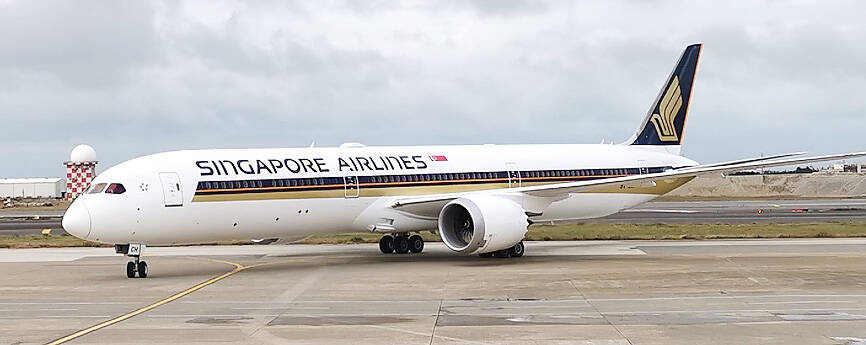
INCREASED CAPACITY: The flights on Mondays, Wednesdays, Fridays and Sundays would leave Singapore in the morning and Taipei in the afternoon Singapore Airlines is adding four supplementary flights to Taipei per week until May to meet increased tourist and business travel demand, the carrier said on Friday. The addition would raise the number of weekly flights it operates to Taipei to 18, Singapore Airlines Taiwan general manager Timothy Ouyang (歐陽漢源) said. The airline has recorded a steady rise in tourist and business travel to and from Taipei, and aims to provide more flexible travel arrangements for passengers, said Ouyang, who assumed the post in July last year. From now until Saturday next week, four additional flights would depart from Singapore on Monday, Wednesday, Friday

Taiwan’s three major international carriers are increasing booking fees, with EVA Airways having already increased the charge to US$28 per flight segment from US$25, while China Airlines (CAL) and Starlux Airlines are set to follow suit. Booking fees are charged by airlines through a global distribution system (GDS) and passed on to passengers. Carriers that apply the fees include CAL, EVA, Starlux and Tigerair Taiwan. A GDS is a computerized network operated by a company that connects airlines with travel agents and ticketing platforms, allowing reservations to be made and processed in real time. Major players include Amadeus, Sabre and Travelport. EVA Air began

WATCH FOR HITCHHIKERS: The CDC warned those returning home from Japan to be alert for any contagious diseases that might have come back with them People who have returned from Japan following the World Baseball Classic (WBC) games during the weekend are recommended to watch for symptoms of infectious gastroenteritis, flu and measles for two weeks, the Centers for Disease Control (CDC) said. Flu viruses remain the most common respiratory pathogen in Taiwan in the past four weeks and the influenza B virus accounted for 55.7 percent of the tested cases, exceeding the percentage of influenza A (H3N2) infections and becoming the local dominant strain, CDC Epidemic Intelligence Center Deputy Director Lee Chia-lin (李佳琳) said at a news conference on Tuesday. There were 82,187 hospital visits for

Alumni from Japan’s Kyoto Tachibana Senior High School marching band, widely known as the “Orange Devils,” staged a flash mob performance at the Grand Hotel in Taipei yesterday to thank Taiwan for its support after the Great East Japan Earthquake. The show, performed on the earthquake’s 15th anniversary, drew more than 100 spectators, some of whom arrived two hours before the show to secure a good viewing spot. The 26-member group played selections from “High School Musical,” “Beauty and the Beast,” and their signature piece “Sing Sing Sing” and shouted “I love


 RSS
RSS