

President Chen Shui-bian (陳水扁) lashed out at China's "one country, two systems" formula yesterday, saying that Hong Kong and Macau's economic and social failures in the wake of their return to China proved the formula is a fraud.
Calling Hong Kong and Macau a "warning to Taiwan's 23 million people," Chen said. "It is impossible for the two sides of the Taiwan Strait to conform politically as long as China does not have real democratic elections, nationalizes its army and lacks freedom of speech and religion."
The "one country, two systems" formula was supposed to guarantee Hong Kong and Macau would retain their capitalist, free-market system after their return to China's sovereignty.
"Experience has clearly proven the so-called `one country, two systems' that was initially designed for the return of Hong Kong are empty words, false words," Chen said. "The `two systems' is fake, the `one country' is true."
Chen's comments to a group of visiting Taiwanese businesspeople based in Hong Kong and Macau came one day after he called on the Beijing authorities to "address the fact that the Republic of China exists."
"The situation faced by Hong Kong and Macau is not how many promises and guarantees China can give but whether or not China can implement democracy and law and order," Chen said.
Citing China's refusal to allow Hong Kong voters to directly elect their leader in 2007 and their full legislature in 2008, Chen criticized Beijing's attempts to intervene in the territory's politics.
"China's one party, dictatorial system works not only like a bird cage that confines the peoples of Hong Kong and Macau freedom and democratic aspirations, but as a manacle that severely slows Hong Kong and Macau's footsteps toward progress and development," he said.
Chen told his visitors that the people of Taiwan hope for peace, normalization of cross-strait relations and for the people of Hong Kong and Macau to enjoy real freedom and democracy.
"But developments are heading in just the opposite direction," he said.
"The Chinese government has tried to use the `one country, two systems' formula to tackle cross-strait issues," he said. "But the biggest contradiction between two sides of the Strait lies not in their separate governments but in the choice of a democratic system and life styles."
He said the "Anti-Secession" Law enacted by Beijing can't prevent independence sentiments and will only widen the rift between the two sides.
He called on China's leaders to follow the global trend of embracing the universal values of democracy, human rights and peace. He said they should speed up political reforms to make China a democracy and "write a new page of progress and prosperity in history for the Chinese people in China, Taiwan, Hong Kong and Macau."
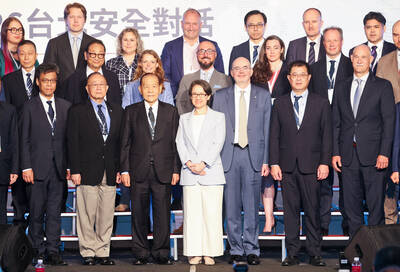
Taiwan’s growing defense preparations might be sending a stronger signal to the US than to Beijing, highlighting the need for Taipei to tailor its deterrence efforts to different audiences, a US security academic said yesterday. Stanford University Freeman Spogli Institute for International Studies fellow Oriana Skylar Mastro made the comment during a Taipei Security Dialogue panel examining lessons Taiwan could draw from the wars in Ukraine and the Middle East. Mastro said she was impressed by Taiwan’s increased defense spending, emphasis on asymmetric capabilities and efforts to prepare society for conflict, but questioned whom those initiatives were influencing. She said when she asked
A total of 400 foreign “high- level” professionals have been naturalized as Republic of China (Taiwan) citizens over the past decade as the government has eased nationality rules to attract talent from a wider range of fields, the Ministry of the Interior said yesterday. The 400th high-level professional, who works in the electronics industry, was approved for ROC citizenship on Aug. 26, the MOI said. The MOI quoted the newly naturalized citizen as saying that Taiwan is a leader in fields such as semiconductors, electronics manufacturing, artificial intelligence development and energy technology. He also said
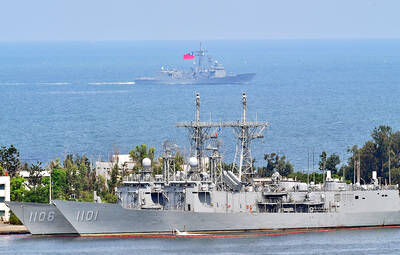
SIZE MATTERS: Large ships are politically attractive as visible symbols of national defense, but small surface combatants are more likely to survive an initial strike Taiwan needs to restructure its naval fleet from focusing on large warships, which are “sitting ducks” for China’s advanced tracking technology, to smaller, stealthy corvettes that are harder to detect but retain sufficient firepower to deter a Chinese invasion, a Taiwanese academic and a former US military commander said in an article published on Friday in the journal Foreign Affairs. Taiwan does not need a fleet capable of competing with the Chinese navy for traditional control of the Taiwan Strait, but rather “sea denial” capabilities that would prevent China from freely using the waterway, Taiwanese aerospace and security expert Holmes Liao
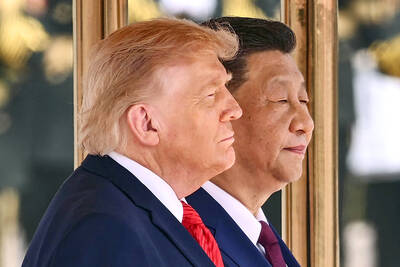
China has warned that it could cancel a planned US-China leaders’ summit if Washington approves new arms sales to Taiwan, a Japanese media outlet quoted sources as saying yesterday. US President Donald Trump, “apparently eager to showcase some diplomatic achievements ahead of November’s midterm congressional elections, places great importance on holding the summit with Chinese President Xi Jinping (習近平),” Japan’s Kyodo News reported. “While preparing for Xi’s upcoming trip, China has restated its position that the Taiwan issue is a ‘red line’ in bilateral relations,” the report said. The report said that when Xi met with Trump in Beijing in May, Xi said


 RSS
RSS