


President Chen Shui-bian's (陳水扁) stance on trips by opposition leaders to China is consistent and has not wavered as his critics claim, Presidential Office Secretary-General Yu Shyi-kun said yesterday.
"President Chen's attitude toward the opposition leaders' China trips has been consistent. It's just that he expresses different points at different times when he speaks on these issues -- sometimes more tactically while some other times more straightforward," Yu said during a media conference yesterday.
Reporters had asked Yu why Chen had attacked the trip to China by Chinese Nationalist Party (KMT) Vice Chairman Chiang Pin-kun (江丙坤) while giving KMT Chairman Lien Chan's (連戰) China trip his blessing.
Yu said that the government's position has also been clear and consistent in regard to next week's visit to China by People First Party (PFP) Chairman James Soong (
Media reports have speculated that Washington has placed pressure on the Chen administration to reduce criticism of the trips.
In response to a question on the Presidential Office's communication with the US, Yu said Taiwan and the US had not raised their level or frequency of dialogue over the visits.
"According to my understanding, the president has not met with American Institute in Taiwan (AIT) Director Douglas Paal for talks on the visits," Yu said.
Presidential Office Deputy Secretary-General Ma Yung-cheng (
Comparing national policy to driving a car, Ma said, "The car might sometimes lean a little to the left or to the right, but it never leaves the road. It just makes adjustments according to the traffic lights -- which are the national interest and public opinion."
Ma said the law clearly prevented opposition leaders from signing any agreements or reaching any type of oral accord with the other side of the Taiwan Strait on issues relating to national sovereignty without the consent or authorization of the government.
Asked for comment on Tuesday's clashes between pan-green and pan-blue camp supporters at CKS International Airport, Yu said the Presidential Office supported the Cabinet in its handling of the matter.
"The Presidential Office supports the Cabinet's decisions in the aftermath of the incident," he said, referring to Premier Frank Hsieh's (謝長廷) pledge on Tuesday to bring the troublemakers to justice.
"It is regrettable that such a thing happened," he said.
Stating that the violence was the result of long-time confrontation between the rival camps, Yu said, "this is the very reason that President Chen has been promoting reconciliation between the two camps to try to bring an end to their confrontation."
Ma said that the reconciliation process was a difficult one.
"It is impossible for political parties that have been in confrontation with each other for the past four years to all of a sudden [solve their differences] ... in four days," he said.
"It takes time, wisdom and patience to address the rivalry and restore mutual trust between the camps," he said.
"Only time can restore the mutual trust that has been lacking between the ruling and opposition parties in the past years. Only time can prove whether or not both sides are sincere," Ma added, suggesting that both sides sit down for talks to seek a resolution, and that "it does not help to put the blame on either side."

FUKUOKA SITUATION: Japanese media reported that the pathogen is expected to be identified by the summer, while the CDC downplayed the idea that it was hMPV A “mysterious cold-like illness” reported in Japan’s Fukuoka Prefecture does not seem to be a new disease, but Japanese authorities have been asked about the situation, the Centers for Disease Control (CDC) said yesterday. The Fukuoka Prefectural Medical Association on Wednesday told a news conference that a “mystery cold” that has become a hot topic on social media is “highly likely to be caused by some kind of viral infection,” Japan’s KBC News reported. “Many people are experiencing symptoms starting with a sore throat, followed by a runny nose, phlegm and a severe cough,” KBC News reported, citing association officials. Health authorities are

Nvidia Corp CEO Jensen Huang (黃仁勳) arrived in Taiwan yesterday ahead of upcoming AI and technology events, saying he plans to meet with clients and Taiwan Semiconductor Manufacturing Co Chairman C.C. Wei (魏哲家) during his visit. After landing at Taipei Songshan Airport, Huang posed for photos with fans and handed out Yakult drinks to reporters and supporters waiting at the scene, saying he has “a lot to do” during the trip. Asked about reports that Nvidia’s planned headquarters site in Taipei’s Beitou Shilin Technology Park could break ground on May 27, Huang said that if the company holds an event, he would

Carrefour Taiwan is to begin using a new name from the start of July, but it cannot divulge the name until then, the chairman of the supermarket chain's parent company said today. President Chain Store Co chairman Lo Chih-hsien (羅智先) was asked by reporters after a shareholders' meeting to confirm whether the company has settled on a new name for the supermarket brand. In March, the government-registered name of two Carrefour Taiwan branches was quietly changed to "Le Chia Kang" (樂家康) in Chinese, raising speculation that has been selected as the name. Lo said that because of local regulations and contractual obligations, the
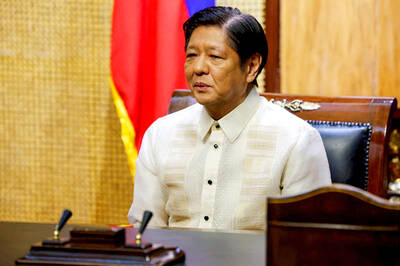
The Philippines would likely be involved in any conflict over Taiwan due to its proximity to the democracy claimed by China, President Ferdinand Marcos Jr said, reiterating a stance that risks angering Beijing. “In the Philippines, we do not have a choice because Taiwan is so close to the Philippines and we have almost 200,000 Filipino nationals living and working in Taiwan,” Marcos said in an interview with Japanese media in Manila on Monday. The Philippine leader’s comments come ahead of a state visit to Japan next week, where he is to meet with Japanese Prime Minister Sanae Takaichi to discuss security


 RSS
RSS