


Taipei might become the nation's first city to adopt hybrid electric vehicles in its mass transportation systems in a bid to tackle air pollution problems.
The city government has also planned to subsidize bus companies that purchase environmental-friendly vehicles with low emissions, a Taipei City Government said yesterday.
Advanced technologies used in existing products were introducedt a symposium called the Prospects and Development of Hybrid Electric Vehicles (HEV), held yesterday by the Environmental Quality Protection Foundation (EQPF) and National Taiwan University.
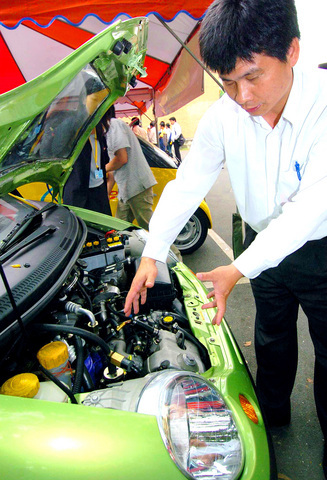
PHOTO: CHIANG YING-YING, TAIPEI TIMES
In the 20th century, the most familiar fuels for transportation were gasoline and diesel.
However, speakers said that many other energy sources that are capable of powering vehicles including electricity, natural gas, fuel cells, ethanol, methanol and propane.
Studies suggest that emissions generated from the hybrid electric vehicles are roughly 90 percent lower in toxic hydrocarbons compared to the emissions from vehicles that use conventional gasoline or diesel.
Chen Yeong-ren (陳永仁), head of Taipei City's Department of Environmental Protection, said that several cities in Western countries have gradually phased out conventional buses by ordering new hybrid electric ones.
According to Chen, there are 4,000 buses running in the city and its neighboring counties, which contribute significantly to air pollution.
"We plan to subsidize bus companies that are willing to purchase and operate hybrid electric buses," Chen said.
It is estimated that the price of one hybrid electric bus is about NT$13.5 million, which is much higher than that of a traditional one, at NT$3.5 million.
"We might just make up the balance by giving out NT$10 million on the purchase of each new hybrid electric bus," Chen said.
Chen predicts that two new hybrid electric buses would be available in Taipei at the end of this year. Next year, Chen said that the city government might further subsidize companies purchasing another five buses.
However, Chen said whether the project would be carried out smoothly depends on the stance of the Environmental Protection Administration (EPA), which has planned to financially support local governments for the promotion of hybrid electric vehicles as a strategy to tackle air pollution problems.
"The advantages of hybrid electric vehicles -- such as low emissions and high energy efficiency -- will definitely result in not only better air quality but also cut down on the medical costs incurred from respiratory diseases," Chen said.
EQPF secretary-general Eric Liou (劉銘龍) said that energy efficiency and energy conservation were highlighted yesterday during Earth Day.
"What can we do in our daily life to treasure the limited resources of this planet? It's time to change our conventional and wasteful lifestyle," Liou said.
Various hybrid electric vehicles were on display at the symposium, and test run by some governmental officials.
Meanwhile, President Chen Shui-bian (陳水扁) yesterday said in the opening speech at the 2005 National Conference for NGOs that the government would review its national development projects to ensure Taiwan's sustainability.
"After the Kyoto Protocol took effect in February, Taiwan has been working on strategies that will actively revise policies and adjust industrial structures to curb greenhouse gas emissions," Chen said.
Chen also said that more practical strategies would be drafted at next national energy conference, which is scheduled to be held in June.

A group of Taiwanese-American and Tibetan-American students at Harvard University on Saturday disrupted Chinese Ambassador to the US Xie Feng’s (謝鋒) speech at the school, accusing him of being responsible for numerous human rights violations. Four students — two Taiwanese Americans and two from Tibet — held up banners inside a conference hall where Xie was delivering a speech at the opening ceremony of the Harvard Kennedy School China Conference 2024. In a video clip provided by the Coalition of Students Resisting the CCP (Chinese Communist Party), Taiwanese-American Cosette Wu (吳亭樺) and Tibetan-American Tsering Yangchen are seen holding banners that together read:

UNAWARE: Many people sit for long hours every day and eat unhealthy foods, putting them at greater risk of developing one of the ‘three highs,’ an expert said More than 30 percent of adults aged 40 or older who underwent a government-funded health exam were unaware they had at least one of the “three highs” — high blood pressure, high blood lipids or high blood sugar, the Health Promotion Administration (HPA) said yesterday. Among adults aged 40 or older who said they did not have any of the “three highs” before taking the health exam, more than 30 percent were found to have at least one of them, Adult Preventive Health Examination Service data from 2022 showed. People with long-term medical conditions such as hypertension or diabetes usually do not
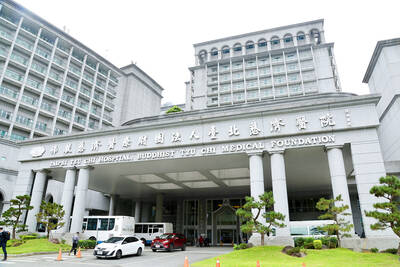
POLICE INVESTIGATING: A man said he quit his job as a nurse at Taipei Tzu Chi Hospital as he had been ‘disgusted’ by the behavior of his colleagues A man yesterday morning wrote online that he had witnessed nurses taking photographs and touching anesthetized patients inappropriately in Taipei Tzu Chi Hospital’s operating theaters. The man surnamed Huang (黃) wrote on the Professional Technology Temple bulletin board that during his six-month stint as a nurse at the hospital, he had seen nurses taking pictures of patients, including of their private parts, after they were anesthetized. Some nurses had also touched patients inappropriately and children were among those photographed, he said. Huang said this “disgusted” him “so much” that “he felt the need to reveal these unethical acts in the operating theater
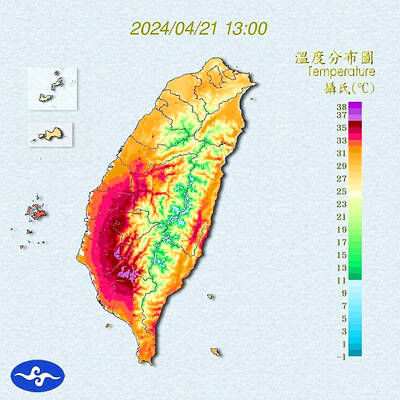
Heat advisories were in effect for nine administrative regions yesterday afternoon as warm southwesterly winds pushed temperatures above 38°C in parts of southern Taiwan, the Central Weather Administration (CWA) said. As of 3:30pm yesterday, Tainan’s Yujing District (玉井) had recorded the day’s highest temperature of 39.7°C, though the measurement will not be included in Taiwan’s official heat records since Yujing is an automatic rather than manually operated weather station, the CWA said. Highs recorded in other areas were 38.7°C in Kaohsiung’s Neimen District (內門), 38.2°C in Chiayi City and 38.1°C in Pingtung’s Sandimen Township (三地門), CWA data showed. The spell of scorching


 RSS
RSS