


Ending a month of secretive planning and media speculation, the Chinese Nationalist Party (KMT) yesterday announced that KMT Chairman Lien Chan (
The KMT also announced the itinerary of Lien's trip, although it remained uncertain whether he will report to the government before his departure.
"This trip will be the first time that the leaders of the Chinese Communist Party (CCP) and the KMT have met in 56 years. I will candidly, and honestly, exchange views with CCP Chairman Hu Jintao (
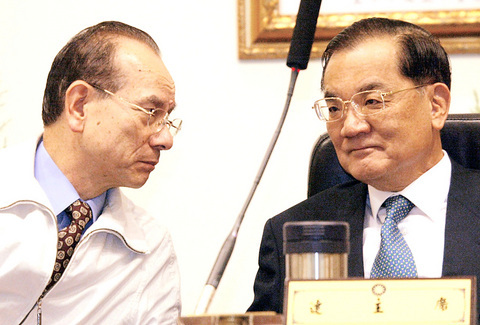
PHOTO: AP
The most notable feature of the itinerary for the eight days and seven nights that Lien will spend in China is the planned meeting with Hu on April 29.
The trip, which the KMT has nicknamed Lien's "journey of peace," will take Lien and his delegation to four Chinese cities: Nanjing, Beijing, Xi'an and Shanghai, in that order, KMT Secretary-General Lin Feng-cheng (林豐正) said in a report delivered at the committee meeting yesterday.
The delegation will leave for China on April 26, and will spend the next day visiting the Sun Yat-sen Mausoleum in Nanjing. On April 28, Lien will head to Beijing to meet with standing committee members of China's Politburo, as well as Jia Qinglin (
The KMT has scheduled the Lien-Hu summit for the afternoon of April 29, after Lien is to deliver a speech to students at Peking University.
"[During the meeting] it is planned that there will be constructive dialogue about the peaceful development of cross-strait relations," Lin said in his report, emphasizing that the talks are expected to have an "important, meaningful effect" on the peaceful stabilization of the cross-strait situation.
After meeting with Hu, Lien and the KMT delegation will head to Xi'an on April 30, where Lien will visit his ancestral home and head to Shanghai on May 1. After giving a speech to the Taiwanese business community in Xian, the entire entourage will head back to Taiwan on May 3.
While Lin did not say yesterday what results the Lien-Hu meeting might produce, local experts have speculated that the CCP might grant Lien some sort of political boon, such as the withdrawal of the missiles it has aimed at Taiwan.
More than 100 members of the local media are expected to follow the KMT entourage to China to chronicle Lien's meeting with Hu.
Lien said yesterday he believes that if the meeting with Hu takes place under the condition that both sides are willing to work toward mutual benefits, and with peace, goodwill and sincerity forming the basic principles of the discussion, they will be able to explore a number of topics in depth.
"There are certain differences between [Taiwan and China], and there are also a certain number of similarities. The correct attitude [to take] is to seek a way to co-exist despite our differences while working to expand the effects of our similarities," Lien said.
A number of members of the KMT's Central Standing Committee yesterday offered suggestions and expressed support for Lien's trip.
Taipei Mayor Ma Ying-jeou (
Since 1992, however, the definition of "one China" has become increasingly ambiguous, and a return to the policy as it was in 1992 should be made clear for the Lien-Hu meeting, Ma said.
During the KMT administration the government said that a consensus had not been reached. After the KMT became an opposition party, however, it began to insist that both sides had agreed that there was only one China, but the definition of one China was open to different interpretations.
Ma also said that the delegation shouldn't seek to usurp the government's role in cross-strait relations.
As leader of an opposition party, Lien can reach a mutual consensus of views with China, but the realization of such a consensus is up to the administration to work out with the Chinese government, Ma said.

FUKUOKA SITUATION: Japanese media reported that the pathogen is expected to be identified by the summer, while the CDC downplayed the idea that it was hMPV A “mysterious cold-like illness” reported in Japan’s Fukuoka Prefecture does not seem to be a new disease, but Japanese authorities have been asked about the situation, the Centers for Disease Control (CDC) said yesterday. The Fukuoka Prefectural Medical Association on Wednesday told a news conference that a “mystery cold” that has become a hot topic on social media is “highly likely to be caused by some kind of viral infection,” Japan’s KBC News reported. “Many people are experiencing symptoms starting with a sore throat, followed by a runny nose, phlegm and a severe cough,” KBC News reported, citing association officials. Health authorities are

Nvidia Corp CEO Jensen Huang (黃仁勳) arrived in Taiwan yesterday ahead of upcoming AI and technology events, saying he plans to meet with clients and Taiwan Semiconductor Manufacturing Co Chairman C.C. Wei (魏哲家) during his visit. After landing at Taipei Songshan Airport, Huang posed for photos with fans and handed out Yakult drinks to reporters and supporters waiting at the scene, saying he has “a lot to do” during the trip. Asked about reports that Nvidia’s planned headquarters site in Taipei’s Beitou Shilin Technology Park could break ground on May 27, Huang said that if the company holds an event, he would

Carrefour Taiwan is to begin using a new name from the start of July, but it cannot divulge the name until then, the chairman of the supermarket chain's parent company said today. President Chain Store Co chairman Lo Chih-hsien (羅智先) was asked by reporters after a shareholders' meeting to confirm whether the company has settled on a new name for the supermarket brand. In March, the government-registered name of two Carrefour Taiwan branches was quietly changed to "Le Chia Kang" (樂家康) in Chinese, raising speculation that has been selected as the name. Lo said that because of local regulations and contractual obligations, the
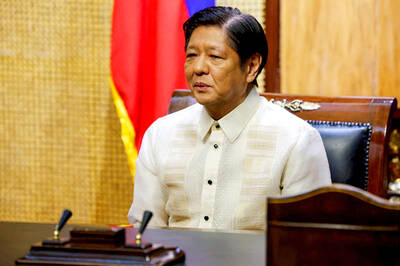
The Philippines would likely be involved in any conflict over Taiwan due to its proximity to the democracy claimed by China, President Ferdinand Marcos Jr said, reiterating a stance that risks angering Beijing. “In the Philippines, we do not have a choice because Taiwan is so close to the Philippines and we have almost 200,000 Filipino nationals living and working in Taiwan,” Marcos said in an interview with Japanese media in Manila on Monday. The Philippine leader’s comments come ahead of a state visit to Japan next week, where he is to meet with Japanese Prime Minister Sanae Takaichi to discuss security


 RSS
RSS