


Chinese Nationalist Party (KMT) Vice Chairman Chiang Pin-kun (
"The so-called `10-point agreement' is actually [Beijing officials'] response to our requests to protect the legal rights of Taiwanese investors in China, since protecting Taiwanese businessmen and investors in China has always been the KMT's priority," Chiang said during a meeting with Premier Frank Hsieh (
Prior to yesterday's meeting, Chiang had never publicly admitted to reaching the agreement. He declined to say whether the agreement exists in written form, or if it is an oral agreement.
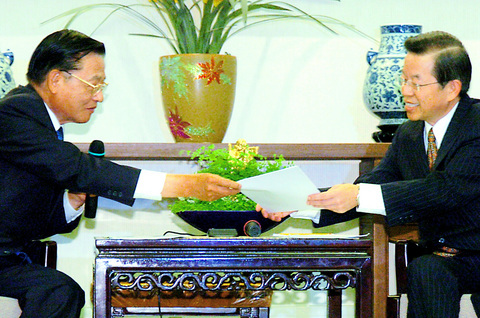
PHOTO: SEAN CHAO, TAIPEI TIMES
Chiang, accompanied by several KMT lawmakers, arrived at the Executive Yuan at 5pm to meet with Hsieh after coming under severe criticism for his controversial trip to China and the "10-point agreement."
Prosecutors have meanwhile opened an investigation into Chiang's actions in China to determine whether he violated any laws.
Chiang said yesterday that, as an economics expert, he believes that cooperation between different political parties and creating harmony between Beijing and Taipei will pave the way to solving domestic economic problems.
He said that he would be more than happy to be the key to such cooperation and that he would dedicate himself to the task.
"KMT Chairman Lien Chan (連戰) asked me to take the trip either on March 12 or March 29, because March 12 is the birthday of Dr Sun Yat-sen (孫中山), the party's founder, and March 29 was the day when 72 martyrs died for Sun's unsuccessful revolution," Chiang said.
"I understood that my departure after the March 26 rally against the `Anti-Secession' Law would be controversial and would be condemned. But it was something I had to do, especially when there is a chance to speak out for my fellow Taiwanese people," he said.
Chiang said that every single statement he made in China was made for the benefit of the Taiwanese people.
He said he told Chinese officials more than once that it was very stupid of them to establish the Anti-Secession Law, which would only irritate Taiwanese people and destroy any harmony existing in the Strait.
"Our policies are to protect and defend the Republic of China against Taiwan independence, against a military strike on Taiwan by the Chinese military and to maintain business cooperation across the Strait. These policies never change," Chiang said.
Hsieh said that he understood Chiang's comments, and added that he had also planned to visit China four years ago while he was the mayor of Kaohsiung.
He said he eventually decided not to go because of the legal implications.
"I am a lawyer and I know the rules and respect them as well," Hsieh said.
"I do not have any authority over the prosecutors' investigation, and it would not be appropriate for me to comment on the matter at this moment, but I hope that it will not stop you [Chiang] from dedicating yourself to the country," Hsieh said.
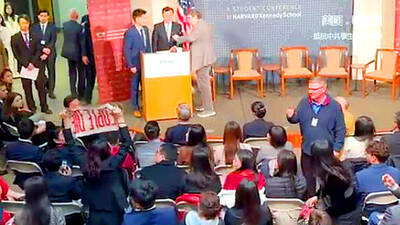
A group of Taiwanese-American and Tibetan-American students at Harvard University on Saturday disrupted Chinese Ambassador to the US Xie Feng’s (謝鋒) speech at the school, accusing him of being responsible for numerous human rights violations. Four students — two Taiwanese Americans and two from Tibet — held up banners inside a conference hall where Xie was delivering a speech at the opening ceremony of the Harvard Kennedy School China Conference 2024. In a video clip provided by the Coalition of Students Resisting the CCP (Chinese Communist Party), Taiwanese-American Cosette Wu (吳亭樺) and Tibetan-American Tsering Yangchen are seen holding banners that together read:

UNAWARE: Many people sit for long hours every day and eat unhealthy foods, putting them at greater risk of developing one of the ‘three highs,’ an expert said More than 30 percent of adults aged 40 or older who underwent a government-funded health exam were unaware they had at least one of the “three highs” — high blood pressure, high blood lipids or high blood sugar, the Health Promotion Administration (HPA) said yesterday. Among adults aged 40 or older who said they did not have any of the “three highs” before taking the health exam, more than 30 percent were found to have at least one of them, Adult Preventive Health Examination Service data from 2022 showed. People with long-term medical conditions such as hypertension or diabetes usually do not
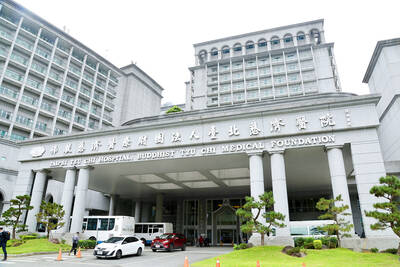
POLICE INVESTIGATING: A man said he quit his job as a nurse at Taipei Tzu Chi Hospital as he had been ‘disgusted’ by the behavior of his colleagues A man yesterday morning wrote online that he had witnessed nurses taking photographs and touching anesthetized patients inappropriately in Taipei Tzu Chi Hospital’s operating theaters. The man surnamed Huang (黃) wrote on the Professional Technology Temple bulletin board that during his six-month stint as a nurse at the hospital, he had seen nurses taking pictures of patients, including of their private parts, after they were anesthetized. Some nurses had also touched patients inappropriately and children were among those photographed, he said. Huang said this “disgusted” him “so much” that “he felt the need to reveal these unethical acts in the operating theater
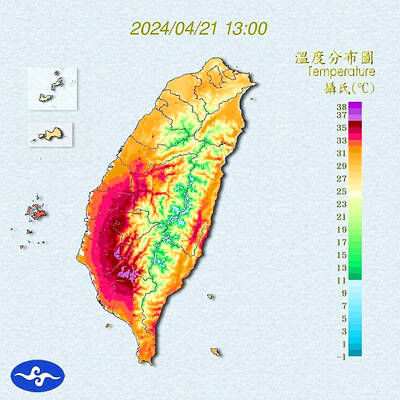
Heat advisories were in effect for nine administrative regions yesterday afternoon as warm southwesterly winds pushed temperatures above 38°C in parts of southern Taiwan, the Central Weather Administration (CWA) said. As of 3:30pm yesterday, Tainan’s Yujing District (玉井) had recorded the day’s highest temperature of 39.7°C, though the measurement will not be included in Taiwan’s official heat records since Yujing is an automatic rather than manually operated weather station, the CWA said. Highs recorded in other areas were 38.7°C in Kaohsiung’s Neimen District (內門), 38.2°C in Chiayi City and 38.1°C in Pingtung’s Sandimen Township (三地門), CWA data showed. The spell of scorching


 RSS
RSS