


Officials from the Ministry of Foreign Affairs attended the funeral of Solomon Islands Foreign Minister Laurie Chan Hok Si's (
Chan's maternal grandfather Lu Szu-chang (
After the Chinese civil war, he spent most of his life in Hong Kong before moving to Taiwan with one of his daughters around 10 years ago, according to the ministry.
Chan was born in the Solomon Islands shortly after her parents emigrated there.
Lin, who conveyed condolences to Lu's family on behalf of Foreign Affairs Minister Mark Chen (
Chan's mother was also at the funeral.
While Lu's residence in Taiwan had contributed to strengthening diplomatic relations between Taiwan and the Solomon Islands, a group of Solomon Islands opposition lawmakers have recently visited China, according to Lin.
Noting that the Solomon Islands is a democratic country, Lin said it is natural it listens to "various kinds of voices."
The opposition lawmakers have illusions about China and seek to develop a relationship with it, but their visit to Beijing would not affect the Solomon Islands' ties with Taiwan, Lin said.
Lin also announced that the parliamentary speaker of the Pacific archipelago nation of Kiribati will lead a delegation on an official visit to Taipei.
The delegation is scheduled to arrive on Saturday. Members of the delegation include lawmakers from both the ruling and opposition parties.
"This shows both the ruling and opposition parties in Kiribati are supportive of the country's relations with Taiwan," Lin said.
The delegation is slated to meet with President Chen Shui-bian (
Kiribati established diplomatic ties with Taiwan in November 2003.
Meanwhile, the Marshall Islands Finance Minister Brenson Wase will lead a group of finance officials, including the country's Banking Commissioner Alfred Alfred Jr, on a visit to Taiwan from April 6 to 10.
The delegation will visit a number of government agencies, including the International Cooperation and Development Fund, Lin said.
Regarding President Chen Shui-bian's (
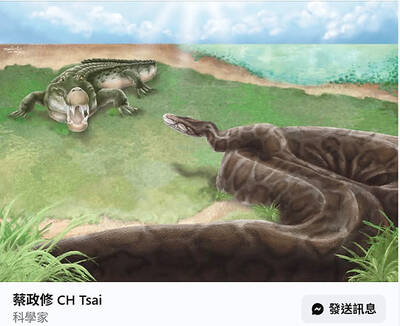
Taiwanese paleontologists have discovered fossil evidence that pythons up to 4m long inhabited Taiwan during the Pleistocene epoch, reporting their findings in the international scientific journal Historical Biology. National Taiwan University (NTU) Institute of Ecology and Evolutionary Biology associate professor Tsai Cheng-hsiu (蔡政修) led the team that discovered the largest snake fossil ever found in Taiwan. The single trunk vertebra was discovered in Tainan at the Chiting Formation, dated to between 400,000 and 800,000 years ago in the Middle Pleistocene, the paper said. The area also produced Taiwan’s first avian fossil, as well as crocodile, mammoth, saber-toothed cat and rhinoceros fossils, it said. Discoveries

Taiwanese paleontologists have discovered fossil evidence that pythons up to 4m long inhabited Taiwan during the Pleistocene epoch, reporting their findings in the international scientific journal Historical Biology. National Taiwan University (NTU) Institute of Ecology and Evolutionary Biology associate professor Tsai Cheng-hsiu (蔡政修) led the team that discovered the largest snake fossil ever found in Taiwan. A single trunk vertebra was discovered in Tainan at the Chiting Formation, dated to between 800,000 to 400,000 years ago in the Middle Pleistocene, the paper said. The area also produced Taiwan’s first avian fossil, as well as crocodile, mammoth, sabre-toothed cat and rhinoceros fossils, it said. Discoveries

Whether Japan would help defend Taiwan in case of a cross-strait conflict would depend on the US and the extent to which Japan would be allowed to act under the US-Japan Security Treaty, former Japanese minister of defense Satoshi Morimoto said. As China has not given up on the idea of invading Taiwan by force, to what extent Japan could support US military action would hinge on Washington’s intention and its negotiation with Tokyo, Morimoto said in an interview with the Liberty Times (sister paper of the Taipei Times) yesterday. There has to be sufficient mutual recognition of how Japan could provide
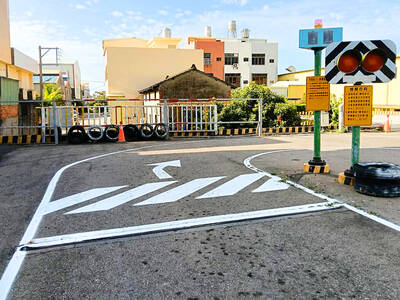
UPDATED TEST: The new rules aim to assess drivers’ awareness of risky behaviors and how they respond under certain circumstances, the Highway Bureau said Driver’s license applicants who fail to yield to pedestrians at intersections or to check blind spots, or omit pointing-and-calling procedures would fail the driving test, the Highway Bureau said yesterday. The change is set to be implemented at the end of the month, and is part of the bureau’s reform of the driving portion of the test, which has been criticized for failing to assess whether drivers can operate vehicles safely. Sedan drivers would be tested regarding yielding to pedestrians and turning their heads to check blind spots, while drivers of large vehicles would be tested on their familiarity with pointing-and-calling


 RSS
RSS