


■ Society
Hon Hai boss' wife dies
Lin Shu-ru, (林淑如), the wife of Hon Hai Precision Industry Co chairman Terry Gou (郭台銘) died at National Taiwan University Hospital on Saturday night of liver and lung failure after a long battle with breast cancer. She was 55. Lin had been battling breast cancer for three years. She made her last public appearance last July hand-in-hand with her husband at the wedding of their son Gou Shou-cheng (郭守正). Forbes magazine claims Terry Gou is the country's wealthiest man. He was ranked 170 on the magazine's list of the world's billionaires.
■ Politics
DPP seeking young experts
Democratic Progressive Party (DPP) Chairman Su Tseng-chang (蘇貞昌) yesterday said that the party will consider young law experts and academics as priority nominees for the National Assembly elections. Su said Yeh Chun-jung (葉俊榮), chairman of the Cabinet's Research, Development and Evaluation Commission and Mongolian and Tibetan Affairs Commission Chairman Hsu Chih-hsiung (許志雄) will both be nominees. Both have specialized in law and constitutional study. Su also said that if the DPP's local party branch nominates him as a candidate, he would ask the party to put his name last on the list of nominees.
■ Cross-strait ties
Kinmen plans giant Guanyin
Kinmen wants to build a giant statue of Guanyin (Avalokitesvara in Sanskrit) to serve as an inspiration for peace across the Taiwan Strait. Residents yesterday elected Kinmen County Commissioner Lee Chu-feng (李炷烽) to chair a committee supervising the building and management of a 36m-high white stone statue of the bodhisattva. Residents envisage building the island into a mecca for Buddhists, which will also serve as a "torch of peace" for people across the Taiwan Strait, Lee said after attending the first meeting of the committee. Buddhists in Kinmen decided last June that the island should build the Guanyin using white stone from Quanzhou, Fujian Province, to make the statue a Kinmen landmark. In a very short period of time, nearly NT$18 million (US$580,000) million) was raised for the project. Participants at yesterday's meeting, however, failed to reach a consensus on where the statue should be established. At least four township chiefs lobbied for their towns to be chosen.
■ Cross-strait ties
Women stage protest
A group of women organized by the Non-war Action Alliance of Taiwan protested in front of the Legislative Yuan yesterday against Beijing's proposed "anti-secession" law. The demonstrators put up posters and chanted "no war" and "peace." Chou Shen-hsin (周聖心), convener of the alliance, said that almost all wars were initiated by men, and women -- who account for half of the global population -- were always the victims.
■ Tourism
Taipei expo promoted
A Taipei City mission, headed by Deputy Mayor Yeh Chin-chuan (葉金川), left for Toronto yesterday to promote the Taipei International Healthy City Expo 2005. City officials said that the delegation will head to to Indianapolis, Indiana and then Copenhagen, Denmark and Helsinki, Finland before returning home on Friday. The expo, which brought together the chiefs of 16 international cities in Taipei last year, is expected to attract 40 to 50 city chiefs from around the world this year, they said.

FUKUOKA SITUATION: Japanese media reported that the pathogen is expected to be identified by the summer, while the CDC downplayed the idea that it was hMPV A “mysterious cold-like illness” reported in Japan’s Fukuoka Prefecture does not seem to be a new disease, but Japanese authorities have been asked about the situation, the Centers for Disease Control (CDC) said yesterday. The Fukuoka Prefectural Medical Association on Wednesday told a news conference that a “mystery cold” that has become a hot topic on social media is “highly likely to be caused by some kind of viral infection,” Japan’s KBC News reported. “Many people are experiencing symptoms starting with a sore throat, followed by a runny nose, phlegm and a severe cough,” KBC News reported, citing association officials. Health authorities are

Nvidia Corp CEO Jensen Huang (黃仁勳) arrived in Taiwan yesterday ahead of upcoming AI and technology events, saying he plans to meet with clients and Taiwan Semiconductor Manufacturing Co Chairman C.C. Wei (魏哲家) during his visit. After landing at Taipei Songshan Airport, Huang posed for photos with fans and handed out Yakult drinks to reporters and supporters waiting at the scene, saying he has “a lot to do” during the trip. Asked about reports that Nvidia’s planned headquarters site in Taipei’s Beitou Shilin Technology Park could break ground on May 27, Huang said that if the company holds an event, he would

The Ministry of Finance this afternoon announced the winning numbers for the March-April uniform invoice lottery. The winning number for the NT$10 million (US$318,060) special prize is 19531471, and the winning number for the NT$2 million grand prize is 85941329. Three numbers were drawn for the NT$200,000 first prize: 07225810, 20231230 and 83518781. Those with receipts matching the last seven digits of any of the first-prize numbers will win the NT$40,000 second prize, while those matching the last six digits will win the NT$10,000 third prize. Those whose receipts match the last five digits of the first-prize numbers can claim the NT$4,000 fourth prize,
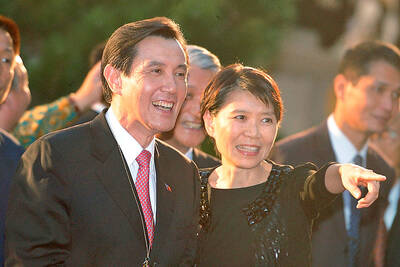
Former president Ma Ying-jeou (馬英九) yesterday expressed “shock and regret” over a statement issued by his wife without his consent, and rejected her assertion that his eldest sister, Ma Yi-nan (馬以南), would manage his medical care or act as his spokesperson amid an ongoing embezzlement probe into his foundation. Ma Ying-jeou in a statement said he was shocked by a statement by his wife, Chou Mei-ching (周美青), regarding his affairs. Ma Yi-nan “must not” be in charge of his healthcare and other personal affairs, nor can she be allowed to represent the Ma family, the former president said. He said he was also


 RSS
RSS