


A market-based, for-profit medical service introduced by health officials to curb costs in the ailing National Health Insurance (NHI) system has eroded public trust in doctors, according to physicians who attended a seminar yesterday.
The Public Rights Promotion Association convened the seminar to invite health experts to take the pulse of the over-commercialized health industry and find ways to rebuild trust between patients and doctors.
Disputes between doctors and patients often stem from the commercialization of medical service, physicians said.
"Relations between doctors and patients are no longer unmediated," said Lee Yuan-fang (
The problem, Lee said, is that some patients make unnecessary visits to hospitals just to make sure their health premium is well spent -- and doctors cannot turn these patients away, no matter how frivolous their health concerns.
"Doctors can't simply turn their back on them. [That would] violate the spirit of the medical profession," said Shih Chun-ming (
"Moreover, before the government placed a cap on each hospital's spending, the more patients you saw, the more money you earned," Shih said. "The NHI taught both patients and doctors to reap profits or gain advantages in the medical business."
As a result, many doctors inevitably become overworked. Shih, 41, has to see more than 60 patients in a single morning. Lee, a veteran orthopedist, has at least 200 people waiting for hours every day just for a brief diagnosis.
Official figures from the Bureau of National Health Insurance show that every person in Taiwan pays an average of 15.4 visits to hospitals each year.
Given the abuse of medical resources, it is hardly surprising that miscommunication often occurs between doctors and patients.
"When you have another 100 patients to see, you simply have no time to explain the treatment, the drug's effects or the therapy's risks to every patient," Shih said. "That could very often lead to misunderstandings between doctors and patients."
Shih recalled how he has received complaints when he did not give a brain scan to a patient with a mild bruise on his head, or when he prescribed anti-fever tablets rather than giving shots.
"As the practice of medicine becomes a commercial transaction, trust evaporates and bargaining sets in," said Democratic Progressive Party Legislator Hong Chi-chang (
Hong said that although markets work wonderfully for commodities like cars and computers, the free-market principle doesn't work in health care, where the goal should hardly be selling more hysterectomies or heart bypass surgeries.
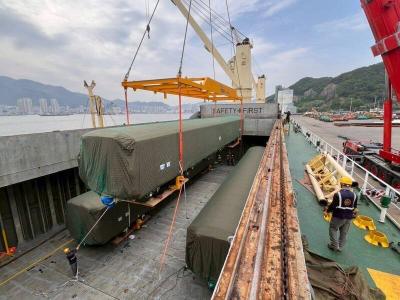
The first of 10 new high-capacity trains purchased from South Korea’s Hyundai Rotem arrived at the Port of Taipei yesterday to meet the demands of an expanding metro network, Taipei Rapid Transit Corp (TRTC) said yesterday. The train completed a three-day, 1,200km voyage from the Port of Masan in South Korea, the company said. Costing NT$590 million (US$18.79 million) each, the new six-carriage trains feature a redesigned interior based on "human-centric" transportation concepts, TRTC said. The design utilizes continuous longitudinal seating to widen the aisles and optimize passenger flow, while also upgrading passenger information displays and driving control systems for a more comfortable
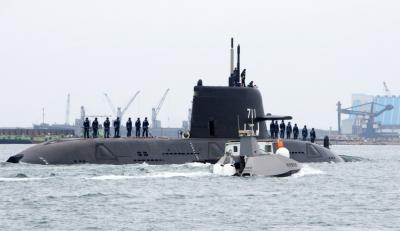
Taiwan's first indigenous defense submarine, the SS-711 Hai Kun (海鯤, or Narwhal), departed for its 13th sea trial at 7am today, marking its seventh submerged test, with delivery to the navy scheduled for July. The outing also marked its first sea deployment since President William Lai (賴清德) boarded the submarine for an inspection on March 19, drawing a crowd of military enthusiasts who gathered to show support. The submarine this morning departed port accompanied by CSBC Corp’s Endeavor Manta (奮進魔鬼魚號) uncrewed surface vessel and a navy M109 assault boat. Amid public interest in key milestones such as torpedo-launching operations and overnight submerged trials,
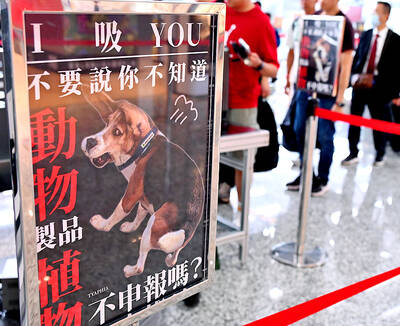
Quarantine awareness posters at Taiwan Taoyuan International Airport have gone viral for their use of wordplay. Issued by the airport branch of the Animal and Plant Health Inspection Agency, the posters feature sniffer dogs making a range of facial expressions, paired with advisory messages built around homophones. “We update the messages for holidays and campaign needs, periodically refreshing materials to attract people’s attention,” quarantine officials said. “The aim is to use the dogs’ appeal to draw focus to quarantine regulations.” A Japanese traveler visiting Taiwan has posted a photo on X of a poster showing a quarantine dog with a
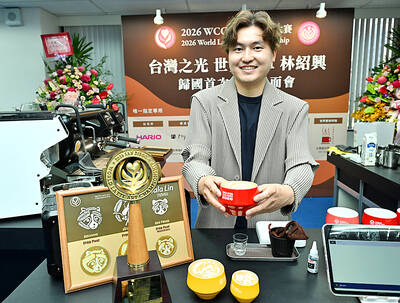
Taiwan’s coffee community has launched a “one-person-one-e-mail” campaign, calling for people to send a protest-e-mail to the World Coffee Championships (WCC) urging it to redesignate Taiwanese competitors as from “Taiwan,” rather than “Chinese Taipei.” The call followed sudden action last week after the WCC changed all references to Taiwanese competitors from “Taiwan” to “Chinese Taipei,” including recent World Latte Art champion Bala (林紹興), who won the World Latte Art Championship in San Diego earlier this month. When Bala received the trophy, he was referred to as representing Taiwan, as well as in the announcement on the WCC’s Web site, until it


 RSS
RSS