


It was chilly and rainy in Pingsi, a mountainous township an hour's drive from downtown Taipei, on Saturday night. But Thai singer TAE managed to squeeze a night out of his tight schedule to sing for those who had gathered there for a special occasion.
The event, called "Light of Peace, City of Hope," was held in commemoration for the victims of the Asian tsunami. Participants wrote their wishes or blessings for those affected by the tragedy on lanterns or paper balloons, and set them aloft.
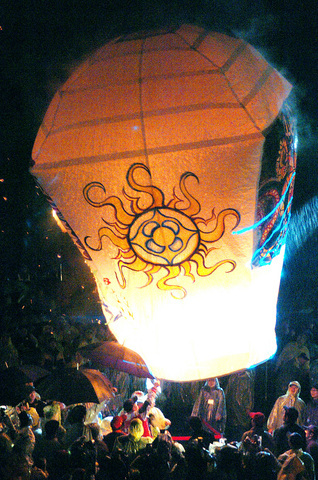
PHOTO: SEAN CHAO, TAIPEI TIMES
TAE was in Taiwan when the tsunami hit nations in Southeast Asia on Dec. 26. His friends called him from Thailand telling him the country was struck by huge waves.
"I thought in my heart: This is impossible. Where did the tsunami come from?' At that time, I was planning to have a vacation in Thailand and go snorkeling. I ended up joining a rescue team on the beach and snorkeling to seek bodies in the sea," TAE told participants at Saturday's event.
TAE, who has often had nightmares after searching for bodies in the sea for a few days, said he still felt the pain of tsunami victims.
"My friends' houses were swept away. When I worked with our rescue team, I saw international rescue teams from South Korea, Taiwan, the US, and other countries. I was moved," he said.
So when TAE received an invitation from Taiwan's Ministry of Foreign Affairs (MOFA) to represent tsunami victims in Thailand by joining the activity in Pingsi, he decided to take a day off from his work because he wanted to say blessings to those suffering from the tragedy.
More than 40 foreign diplomats and their spouses attended the event, which was co-organized by the MOFA and the Taipei County Government at Pingsi Middle School.
Saturday was one of the coldest days of the winter. The temperature dropped to below 8?C. Yet the diplomats, wearing raincoats and holding umbrellas, sat in the rain quietly and watched the night's program for nearly two hours.
"Nearly 300,000 people were killed by the tsunami. More lost their families and were left homeless. It was a disaster in human history," said Vice Minister of Foreign Affairs Quyang Jui-hsiung (歐陽瑞雄).
Every 20 minutes, 100 or 200 lanterns were set aloft at the same time from the playground of the middle school. Despite the rain, the lanterns, with people's wishes written all over them, rose slowly into the sky.
"It was the first time I have joined Pingsi's heavenly lantern activity. On my way here, I saw from the window of my car hundreds of lanterns floating in the dark skies. They are like stars. Suddenly my heart was filled with warmth and joy," said Premier Frank Hsieh (謝長廷), who came to the town to make his wishes as part of the event.
According to the elders of Pingsi, the tradition of setting off heavenly lanterns began during the Ching Dynasty. At that time, bands of outlaws frequently raided villages around Pingsi, forcing local residents to seek refuge in the mountains.
The heavenly lanterns were signals used by the village watchmen to inform the refugees that their houses were safe again. When those hiding in the mountains saw the lanterns in the sky, they knew it was time to go home.
Though the raids ceased long ago, villagers in Pingsi have still preserved the tradition of setting off heavenly lanterns, the elders said. Hsieh, who led the foreign diplomats in setting off their lanterns, said he hoped the countries' political parties can cooperate.
"Cooperation between political parties can bring Taiwan further prosperity," he said before lighting a 5.5m-high heavenly lantern, the largest set aloft that night.
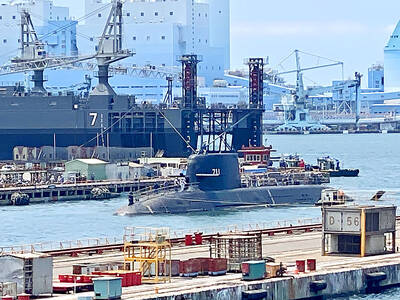
AGING: While Japan has 22 submarines, Taiwan only operates four, two of which were commissioned by the US in 1945 and 1946, and transferred to Taiwan in 1973 Taiwan would need at least 12 submarines to reach modern fleet capabilities, CSBC Corp, Taiwan chairman Chen Cheng-hung (陳政宏) said in an interview broadcast on Friday, citing a US assessment. CSBC is testing the nation’s first indigenous defense submarine, the Hai Kun (海鯤, Narwhal), which is scheduled to be delivered to the navy next month or in July. The Hai Kun has completed torpedo-firing tests and is scheduled to undergo overnight sea trials, Chen said on an SET TV military affairs program. Taiwan would require at least 12 submarines to establish a modern submarine force after assessing the nation’s operational environment and defense
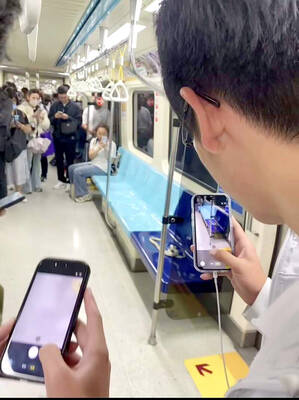
A white king snake that frightened passengers and caused a stir on a Taipei MRT train on Friday evening has been claimed by its owner, who would be fined, Taipei Rapid Transit Corp (TRTC) said yesterday. A person on Threads posted that he thought he was lucky to find an empty row of seats on Friday after boarding a train on the Bannan (Blue) Line, only to spot a white snake with black stripes after sitting down. Startled, he jumped up, he wrote, describing the encounter as “terrifying.” “Taipei’s rat control plan: Release snakes on the metro,” one person wrote in reply, referring
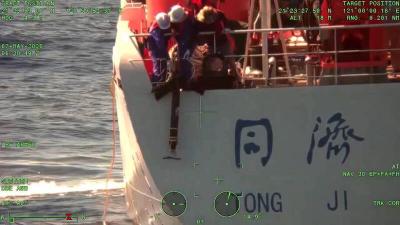
The coast guard today said that it had disrupted "illegal" operations by a Chinese research ship in waters close to the nation and driven it away, part of what Taipei sees a provocative pattern of China's stepped up maritime activities. The coast guard said that it on Thursday last week detected the Chinese ship Tongji (同濟號), which was commissioned only last year, 29 nautical miles (54km) southeast of the southern tip of Taiwan, although just outside restricted waters. The ship was observed lowering ropes into the water, suspected to be the deployment of scientific instruments for "illegal" survey operations, and the coast
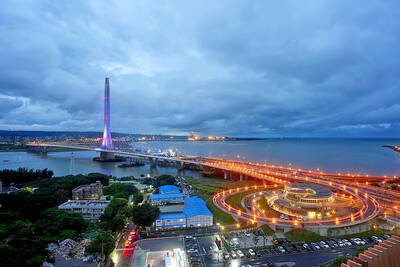
An inauguration ceremony was held yesterday for the Danjiang Bridge, the world’s longest single-mast asymmetric cable-stayed bridge, ahead of its official opening to traffic on Tuesday, marking a major milestone after nearly three decades of planning and construction. At the ceremony in New Taipei City attended by President William Lai (賴清德), Premier Cho Jung-tai (卓榮泰), Minister of Transportation and Communications Chen Shih-kai (陳世凱) and New Taipei City Mayor Hou Yu-ih (侯友宜), the bridge was hailed as both an engineering landmark and a long-awaited regional transport link connecting Tamsui (淡水) and Bali (八里)


 RSS
RSS