


Although Taiwan is not a signatory to the Kyoto Protocol, which took effect yesterday, the Executive Yuan said that it hoped to reduce the nation's greenhouse gas emissions to the level they were at in 2000 by 2020.
Taiwan is ranked 22nd on the global list of greenhouse gas producers, releasing over 2.17 million tonnes of carbon dioxide into the air each year, or about 1 percent of the global total. Although the pact was designed to regulate 38 of the world's industrialized countries, excluding Taiwan, Cabinet Spokesman Chou Jung-tai (卓榮泰) said that the nation feels obligated to safeguard sustainable development as a responsible member of the global village.
"We're calling on the international community to take note of the efforts we make to protect the international environment and let us be a member of the treaty," he said.
According to Yeh Chun-jung (
Yeh, who is also the executive officer of the Cabinet's task force for dealing with climate change and the Kyoto Protocol, said that the nation's interests and the feasibility of the goals need to be taken into account.
In addition to setting up the task force, Yeh said that the government will take a three-pronged approach to tackle the problem.
First, the government will enact a law to regulate the nation's greenhouse gas emissions.
Second, the government will take steps to increase the nation's percentage of renewable energy. Currently, recyclable energy makes up only 3 percent of the nation's total energy sources.
Yeh said that the government hopes to boost this figure to 10 percent by 2012, while increasing the efficiency of energy consumption and encouraging the industrial sector to focus more on carbon-free or service-oriented businesses.
Third, the government is mulling a plan to control the number of motor vehicles on the roads and having polluters shoulder more social responsibility.
While the task force has not yet proposed any concrete plan, Yeh said that if a "carbon-generating tax" were to be implemented, it would not be aimed at generating tax revenues to fill government coffers, but instead would be used as a means to compel polluters to pay for the damage they inflict on the environment.
He yesterday reiterated the government's resolve to build a nuclear-free homeland.
"There won't be any more nuclear power plants in the country, because this is the consensus that was reached between the ruling and opposition parties. It's only a matter of time before the nation's three nuclear power plants will be phased out," he said.
Yeh dismissed speculation that the steps to combat emissions would lead to higher utility fees.
"Greenhouse gas emission does affect the electricity and water fees, but it's not the sole and absolute factor," he said.
A legal basis for the control of greenhouse gas emissions is expected to be created in June, when the National Energy Conference is held, Environmental Protection Administration (EPA) head Chang Juu-en (
EPA statistics indicate that the amount of greenhouse gases emitted in Taiwan increased by nearly 70 percent between 1990 and 2000, when carbon dioxide emissions increased from 160 million tonnes to 272 million tonnes. If no action is taken, the EPA predicts that carbon dioxide emissions will exceed 665 million tonnes in 2020.
Chang said the nation should aggressively promote efficient consumption and conservation of energy, as well as the development of renewable energy sources.
He said that the EPA would compile draft regulations on the control of six kinds of greenhouse gases and put them up for discussion at the National Energy Conference in June.
"Regulations will be drawn up to specify the shared duties of the governments at all levels, industry and the public. A comprehensive inventory of greenhouse gas emissions will also be carried out," Chang said.
The regulations will form a legal basis for reducing emissions, offering economic incentives and creating emission standards, he said.
When asked what the EPA's stance is concerning the Cabinet's newly proposed economic development projects, which promote the petrochemical and steel industries and could lead to a significant increase in carbon dioxide emissions, Chang said that the agency would evaluate emission levels precisely during environmental impact assessments of the projects.
Government statistics estimate that 23 million tonnes of carbon dioxide will be produced every year as a result of the new projects, amounting to nearly 10 percent of the nation's total carbon dioxide emissions in 2000.
Environmentalists and researchers yesterday urged the government to take a more aggressive approach.
Eric Liou (
Wu Ming-chin (
"Taiwan' past studies focused more on short-term weather studies for the sake of disaster prevention. Since island countries are more vulnerable to the effects of global warming, Taiwan should also encourage studies on long-term climate change, from which more useful information will be available for decision-making," Wu said.
Chu Hsin-sen (
"Technologies improving the energy efficiency of power plants are now available. Japan has improved its power-generation efficiency to 45 percent, but Taiwan's remains at 39 percent. It's time to renew old facilities" Chu said.
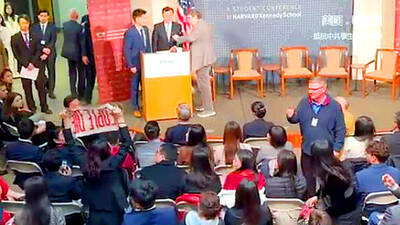
A group of Taiwanese-American and Tibetan-American students at Harvard University on Saturday disrupted Chinese Ambassador to the US Xie Feng’s (謝鋒) speech at the school, accusing him of being responsible for numerous human rights violations. Four students — two Taiwanese Americans and two from Tibet — held up banners inside a conference hall where Xie was delivering a speech at the opening ceremony of the Harvard Kennedy School China Conference 2024. In a video clip provided by the Coalition of Students Resisting the CCP (Chinese Communist Party), Taiwanese-American Cosette Wu (吳亭樺) and Tibetan-American Tsering Yangchen are seen holding banners that together read:

UNAWARE: Many people sit for long hours every day and eat unhealthy foods, putting them at greater risk of developing one of the ‘three highs,’ an expert said More than 30 percent of adults aged 40 or older who underwent a government-funded health exam were unaware they had at least one of the “three highs” — high blood pressure, high blood lipids or high blood sugar, the Health Promotion Administration (HPA) said yesterday. Among adults aged 40 or older who said they did not have any of the “three highs” before taking the health exam, more than 30 percent were found to have at least one of them, Adult Preventive Health Examination Service data from 2022 showed. People with long-term medical conditions such as hypertension or diabetes usually do not
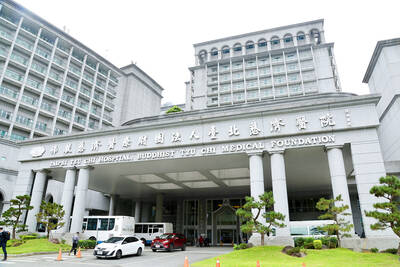
POLICE INVESTIGATING: A man said he quit his job as a nurse at Taipei Tzu Chi Hospital as he had been ‘disgusted’ by the behavior of his colleagues A man yesterday morning wrote online that he had witnessed nurses taking photographs and touching anesthetized patients inappropriately in Taipei Tzu Chi Hospital’s operating theaters. The man surnamed Huang (黃) wrote on the Professional Technology Temple bulletin board that during his six-month stint as a nurse at the hospital, he had seen nurses taking pictures of patients, including of their private parts, after they were anesthetized. Some nurses had also touched patients inappropriately and children were among those photographed, he said. Huang said this “disgusted” him “so much” that “he felt the need to reveal these unethical acts in the operating theater
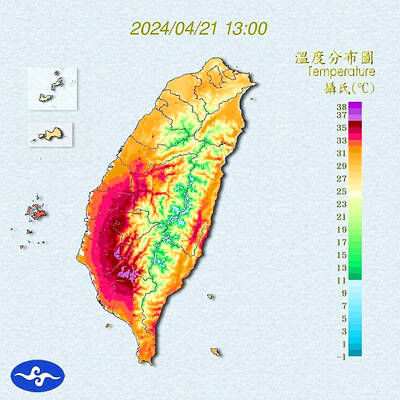
Heat advisories were in effect for nine administrative regions yesterday afternoon as warm southwesterly winds pushed temperatures above 38°C in parts of southern Taiwan, the Central Weather Administration (CWA) said. As of 3:30pm yesterday, Tainan’s Yujing District (玉井) had recorded the day’s highest temperature of 39.7°C, though the measurement will not be included in Taiwan’s official heat records since Yujing is an automatic rather than manually operated weather station, the CWA said. Highs recorded in other areas were 38.7°C in Kaohsiung’s Neimen District (內門), 38.2°C in Chiayi City and 38.1°C in Pingtung’s Sandimen Township (三地門), CWA data showed. The spell of scorching


 RSS
RSS