


Despite the absence of a new vice premier, laughter still filled the Executive Yuan yesterday when outgoing Premier Yu Shyi-kun handed over his position to his successor, former Kaohsiung City Mayor Frank Hsieh (
The Democratic Progressive Party (DPP)-led government has been wishing to cooperate with the opposition parties to fill the vacancy left by former vice premier Yeh Chu-lan (
Yu, who took over his new position as Presidential Office secretary-general from Su Tseng-chang (
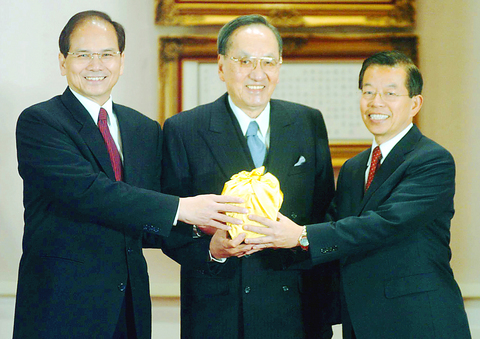
PHOTO: CHIANG YING-YING, TAIPEI TIMES
"When I took up the position about three years ago, I was 175.5cm tall, but then I became less than 175cm. I think it has a lot to do with the heavy workload of my job," he said. "I feel like I'm about to grow taller again since I just released the burden from my shoulders. From now on, no matter how much the burden weighs, it's not my responsibility but the new premier's."
Yu's remarks drew a round of laughter from a roomful of Cabinet officials and reporters. The hand-over ceremony was supervised by Senior Presidential Adviser Peng Ming-min (
Hsieh then presided over the hand-over ceremony of new Cabinet officials. They are Cabinet Secretary-General Lee Ying-yuan (李應元), director-general of the Central Personnel Administration Chang Chun-yen (張俊彥) and Minister of Justice Morley Shih (施茂林).
Apart from outlining the achievements made during his tenure, Yu expressed regret that certain priority bills deemed significant by the government failed to pass the last legislature.
Hsieh, who is known for his quick wit and sense of humor, appeared uptight at the event, but managed to crack some jokes and draw some laughter from the crowd.
"When I saw Yu's smiling face, I knew this is a tough job because he's so happy to leave it to me," he said. "I don't think I cannot afford to be any shorter because I'm pretty short already."
As Yu has likened his Cabinet team to "Shaolin monks," who managed to pass the challenge of the "18 Bronze Men," Hsieh asked Yu to kindly leave him some tips about how to do a good job in his new position.
Hsieh also pledged to run the government based on the foundation laid down by Yu and to equally develop the so-called "isosceles triangle" of public security, social justice and sustainable development.
"In line with what President Chen Shui-bian (
During the opening speech of his first Cabinet meeting yesterday afternoon, Hsieh stressed the importance of co-existence with opposition parties.
"Co-existence is about tolerance, and about Taiwan first," he said. "Only through co-existence can self-identification be created."
Responding to a reporter's question at a press conference after the Cabinet meeting, Cabinet Spokesman Cho Jung-tai (卓榮泰) said that social security would precede national health insurance and tax reform.
"The bottom line is that we'll strengthen negotiations with the public and opposition parties, especially about politically sensitive or controversial bills, before sending them to the legislature for review," he said.
Cho also reiterated the DPP government's resolve to build a nuclear-free homeland, but said that construction on the Fourth Nuclear Power Plant would continue unless there was a public consensus to have it stopped.
Cho made the remark in response to former DPP chairman Lin I-hsiung (林義雄), who led a group of anti-nuclear power activists to the Executive Yuan and Legislative Yuan yesterday morning.
The group called on the two government branches to hold a national referendum on halting construction of the partially finished nuclear facility.
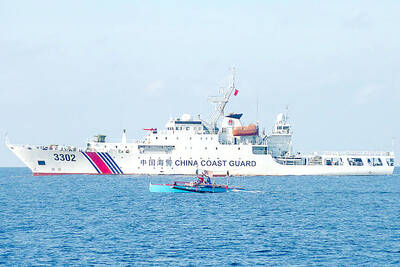
EXPANSIONIST: China deploys an average of 40 to 50 warships and coast guard vessels daily in the South China Sea, despite pledges not to militarize the region, an official said China is attempting to expand its influence across the First Island Chain and increase pressure on Japan by sending coast guard vessels into waters off of Taiwan under the pretext of maritime negotiations with Japan and the Philippines, a national security official said yesterday. China’s recent actions in the waters east of Taiwan and Japan and the Philippines’ exclusive economic zones (EEZ) are attempts to establish dominance in First Island Chain waters, said the official who declined to be named, adding that this is “expansion disguised as law enforcement.” Framing China’s actions solely as a cross-strait issue is a serious misjudgment that
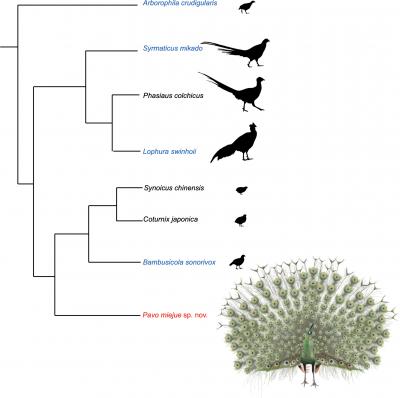
Through analyzing fossil evidence, a research team at National Taiwan University (NTU) discovered the largest endemic bird to have lived in Taiwan, naming it Pavo miejue, or extinct peafowl (滅絕孔雀). The Mikado pheasant, which is printed on the back of the NT$1,000 bank note, was previously believed to be the biggest endemic bird to Taiwan. The research team’s findings suggest that Pavo miejue lived during the Pleistocene epoch tens of thousands of years ago. It is the first endemic extinct bird species discovered and formally named in Taiwan. The study was coauthored by NTU Institute of Ecology and Evolutionary Biology professor Tsai Cheng-hsiu (蔡政修),
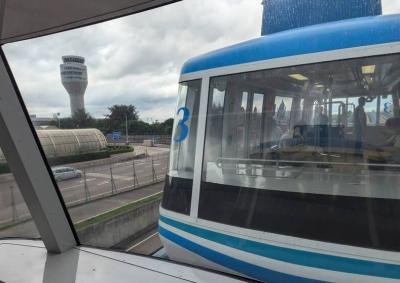
Taiwan Taoyuan International Airport is to suspend its automated Skytrain service connecting Terminal 1 and Terminal 2 starting on July 1 to facilitate connection works for the upcoming Terminal 3, the airport operator said today. Passengers and staff who need to travel between the two terminals after the suspension can instead use the Taoyuan MRT or the airport's 24-hour shuttle bus service, Taoyuan International Airport Corp said. The Taoyuan MRT Airport Line directly links the two terminals, while the shuttle buses are to operate around the clock, the company added. The Skytrain provides free transportation between the airport’s two terminals for travelers and
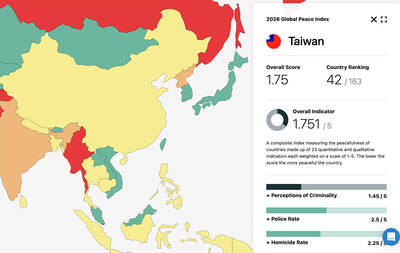
Taiwan ranked 42nd in terms of peacefulness among 163 countries, down five places from last year, according to this year’s Global Peace Index. With an overall score of 1.751, Taiwan dropped from 37th last year, the report published by the global Institute for Economics and Peace showed. The overall score measures a country’s level of peacefulness using 23 quantitative and qualitative indicators across three domains — ongoing domestic and international conflict, societal safety and security, and militarization. While Taiwan ranked 42nd worldwide, it was listed in ninth place among the 19 Asian-Pacific countries in the report, after New Zealand, Singapore, Japan, Malaysia,


 RSS
RSS