


Within a span of eight months, Cho Jung-tai (卓榮泰) was promoted from DPP lawmaker to deputy secretary-general of the Presidential Office in May of last year. He has since been promoted again, and will assume the position of Cabinet spokesperson on Feb. 1.
Cho, seen as the top aide and long-time follower of incoming premier Frank Hsieh (

PHOTO: YEH CHIH-MING, TAIPEI TIMES
"Viewing Cho as merely Hsieh's man is not entirely true," said an official with the Presidential Office who asked not to be named.
"President Chen Shui-bian (
In last year's presidential campaign, Cho served as deputy manager of Chen and Vice President Annette Lu's (呂秀蓮) campaign.
Cho's main job was to integrate support of pro-DPP local factions, seek grassroots votes and even solicit support from the opposition, said the official.
"Cho accomplished his job with high efficiency, which met Chen's expectations," the official said. "He therefore won the trust of the president. To cultivate young talent, the president decided to quickly promote Cho," he added.
Noting his hard-working nature, Cho once said "I lost 7kg in three months during the [presidential] campaign."
However, unavoidably, Cho, who still refers to Hsieh as "teacher" in person, has been benefiting from Hsieh's endorsement.
Cho, 49, earned a bachelor's degree in law from National Chunghsing University. During the 1980s, he worked as Hsieh's assistant when Hsieh served as a Taipei City councilor and then as a legislator. Cho's job at the time was to preside over constituency services and campaign activities.
He then served two terms as a Taipei City councilor from 1990-1998 and two terms as a legislator from 1998 to last year.
In 2001, when President Chen became chairman of the DPP and reformed the party, he appointed many young politicians to head the party's departments.
Cho became the head of the party's social development department, taking responsibility for grassroots organization nationwide.
After the presidential inauguration last May, Cho was nominated by Chen as deputy secretary general of the Presidential Office.
Serving as Chen's assistant, Cho's job was to look after domestic affairs, which involved integrating Presidential Office activities with those of civil groups.
In addition, he was also in charge of Chen's local visit itinerary, and assisted him in communicating with academics and other influential people of different fields.
"Since the job suited Cho's background and experience, he did very well," said chairman of the Council of Hakka Affairs and a close friend of Cho -- Luo Wen-jia (
When leaving the presidential office, Cho told reporters "I always keep alert and often sleep in office because Chen or Vice President Lu could need me any time."
Cho also told reporters "I would like to be an MP3 player as Cabinet spokesman," meaning that the government, like music, should communicate with the public in a soft and enjoyable tone, rather than a harsh one.

The Ministry of Finance this afternoon announced the winning numbers for the March-April uniform invoice lottery. The winning number for the NT$10 million (US$318,060) special prize is 19531471, and the winning number for the NT$2 million grand prize is 85941329. Three numbers were drawn for the NT$200,000 first prize: 07225810, 20231230 and 83518781. Those with receipts matching the last seven digits of any of the first-prize numbers will win the NT$40,000 second prize, while those matching the last six digits will win the NT$10,000 third prize. Those whose receipts match the last five digits of the first-prize numbers can claim the NT$4,000 fourth prize,

SIX SUBSIDIES: The monthly allowance for older farmers is to increase to NT$10,000, and NT$5,000 is to be given to homemakers under the national pension system, Lai said The government is to implement major welfare policies for disadvantaged groups, including raising the monthly allowance for older farmers to NT$10,000 and providing homemakers with NT$5,000 per month, President William Lai (賴清德) said yesterday. Lai made the remarks during a visit to Wangling Temple in Chiayi County, saying that the planned increases were being introduced amid economic growth and an increase in tax revenue. Touting a policy, in which the government plans to provide a monthly allowance of NT$5,000 for every child under the age of 18 in a bid to address Taiwan’s low birthrate, Lai said that if received for the
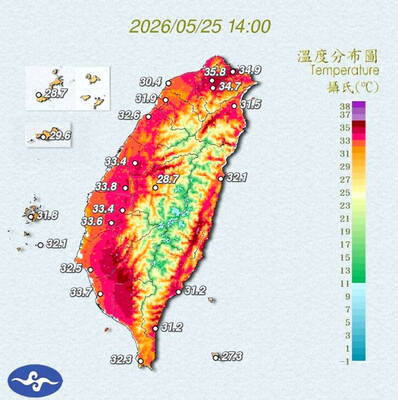
STAY COOL: The HPA recommended that people stay hydrated, use air-conditioning or fans while indoors, wear loose-fitting clothes and walk in the shade while outdoors Employers must implement measures such as installing cooling equipment, and providing drinking water and rest breaks for outdoor workers starting from Monday next week, the Taipei Department of Labor said on Sunday. Employers who fail to comply could face fines of NT$30,000 to NT$300,000 under the Occupational Safety and Health Act (職業安全衛生法), the department said. Businesses in Taipei employing fewer than 100 workers, as well as registered self-employed workers with labor insurance coverage, could receive on-site assessments and guidance from occupational safety consultants to help them apply for central government subsidies to implement or improve heat-protection measures, it said. Under the Ministry of

NATIONAL SECURITY: Authorities are working to confirm the identities of the military personnel involved and investigating possible illegal conduct and regulatory violations Authorities are probing possible national security implications after Kinmen police and immigration officers on Sunday found a Chinese woman allegedly posing as a tourist while engaging in prostitution involving more than 10 military personnel. The woman, surnamed Chen (陳), has since been deported, authorities said, adding that investigators are still working to confirm the identities of those implicated, as the records only listed code names and aliases. The case stemmed from a report received by the Kinmen District Prosecutors’ Office on Friday last week from the Jinhu Precinct of the Kinmen County Police Bureau. On Sunday, police, along with the National Immigration


 RSS
RSS