


A campus with a rainwater catchment system and a school with blank textbooks impressed ambassadors and representatives from 11 countries as they went on a tour of sustainable schools and eco-campuses earlier this week.
"The rainwater catchment system is an excellent and practical idea. Take the hand pump I see here for example: in my country, we practically always use hand pumps to pump water," said Malawian ambassador Thengo Maloya during the visit to Taipei County Shengkeng Elementary School, whose rainwater catchment system recycles two tonnes of wastewater per day.
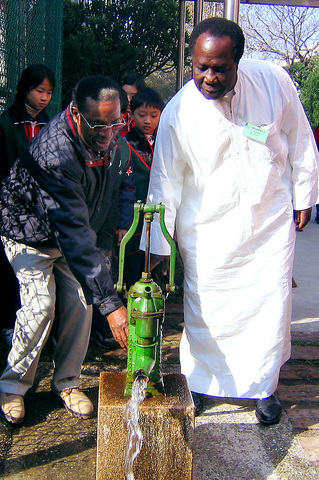
PHOTO: MO YAN-CHIH, TAIPEI TIMES
According to Maloya, people with no water in their villages need to travel around to get water in other places. So conserving and reusing water can be really important, the ambassador said.
Organized by the Ministry of Education, the tour was designed to demonstrate the achievements of schools participating in an "education for sustainable development" program.
Aiming to share the success of the program with the diplomats, the ministry invited them to join the trip for the first time since the launch of the tour last year.
The tour took the guests to Taipei County Shengkeng Elementary School and Ci-Xing Waldorf Education School of Ilan County. Both schools participated in the program, which was orchestrated by the Ministry of Education three years ago to create a more eco-friendly learning environment and develop creative curriculums in schools.
Participating ambassadors said they are impressed by how participating schools help students find satisfaction both within themselves and in their relationship with the environment.
"The two schools we visited showed two different educational approaches based on the same idea, which is to cultivate students' global views. I think both approaches help students appreciate the outside world and the self within," said the representative of the Turkish Trade Office, Unut Arik.
Shengkeng Elementary School, one of the 256 schools participating in the program conducted by the Ministry of Education since 1999, has carried out sustainable campus reform plans.
According to school principal Lin Jian-zong (
"We continually develop curriculums that motivate students to explore the environment. Activities like tree planting and inviting local farmers to give lessons successfully brings teachers, students and community members together to not only experience nature, but more importantly, to learn from nature," Lin said.
Tomasz Nowacki, the chief representative/director-general of the Warsaw Trade Office said that it is crucial to motivate students to protect nature voluntarily.
"The development of ecological schools in Poland began in the 1980s. I think environmental education should focus on how to bring out children's willingness to cherish nature," Nowacki said.
In addition to sustaining schools' ecology and energy-saving facilities, another key element of "education for sustainable development" program is reorganizing the traditional curriculum.
Ci-Xing Waldorf Education School, whose educational philosophy is based on the concepts of Rudolf Steiner, a German educator, is the second school the tour visited. It showed the creativity on the design of their curriculum, which is teaching without any textbooks.
According to Ci-Xing's principal Chang Chun-shu (
Jose Miguel Holguin, Prime Secretary of the Dominican Republic's embassy, lauded the philosophy of the school's program.
"The school's education is systematic. By teaching children how to think, instead of what to think, I think students are free to develop their own individualities. I really appreciate their educational philosophy," Holguin said.
Ambassador Francisco Ricardo Santana Berrios of the Republic of El Salvador, also admired the school's effort to provide students with an open learning environment.
"The interaction between teachers and students is impressive. I think through creative classes, such as singing and personal story-sharing, children are given more space to think creatively and freely, Berrios said.
Sandor Matyus, the representative of the Hungarian Trade Office, although appreciating the innovative teaching method, said that the school should pay attention to students' adjustment when they go on to receive higher education.
"I am anxious about the gap between this free-style learning environment and higher education institutions. For example, without a textbook, I fear students may face some reading difficulties when they go to high schools or colleges. This is something the school needs to be careful about," Matyus said.
According to the program designer of the campus reform plans, Su Huey-jen (
Besides, 60.5 percent of city schools began to plant organic products on campus.
Many schools also develop new curriculum to bring out the creativity of students.
She said that since the program has showed some achievements, the next step is to seek collaboration from international community.
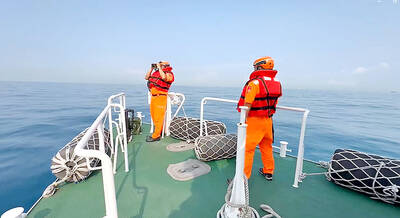
An increase in Taiwanese boats using China-made automatic identification systems (AIS) could confuse coast guards patrolling waters off Taiwan’s southwest coast and become a loophole in the national security system, sources familiar with the matter said yesterday. Taiwan ADIZ, a Facebook page created by enthusiasts who monitor Chinese military activities in airspace and waters off Taiwan’s southwest coast, on Saturday identified what seemed to be a Chinese cargo container ship near Penghu County. The Coast Guard Administration went to the location after receiving the tip and found that it was a Taiwanese yacht, which had a Chinese AIS installed. Similar instances had also

GOOD DIPLOMACY: The KMT has maintained close contact with representative offices in Taiwan and had extended an invitation to Russia as well, the KMT said The Chinese Nationalist Party (KMT) would “appropriately handle” the fallout from an invitation it had extended to Russia’s representative to Taipei to attend its international banquet last month, KMT Chairman Eric Chu (朱立倫) said yesterday. US and EU representatives in Taiwan boycotted the event, and only later agreed to attend after the KMT rescinded its invitation to the Russian representative. The KMT has maintained long-term close contact with all representative offices and embassies in Taiwan, and had extended the invitation as a practice of good diplomacy, Chu said. “Some EU countries have expressed their opinions of Russia, and the KMT respects that,” he
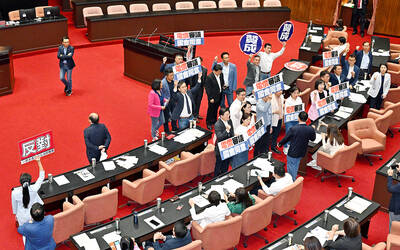
AMENDMENT: Contact with certain individuals in China, Hong Kong and Macau must be reported, and failure to comply could result in a prison sentence, the proposal stated The Chinese Nationalist Party (KMT) and the Taiwan People’s Party (TPP) yesterday voted against a proposed bill by Democratic Progressive Party (DPP) lawmakers that would require elected officials to seek approval before visiting China. DPP Legislator Puma Shen’s (沈伯洋) proposed amendments to the Act Governing Relations Between the People of the Taiwan Area and the Mainland Area (臺灣地區與大陸地區人民關係條例), stipulate that contact with certain individuals in China, Hong Kong and Macau should be reported, while failure to comply would be punishable by prison sentences of up to three years, alongside a fine of NT$10 million (US$309,041). Fifty-six voted with the TPP in opposition
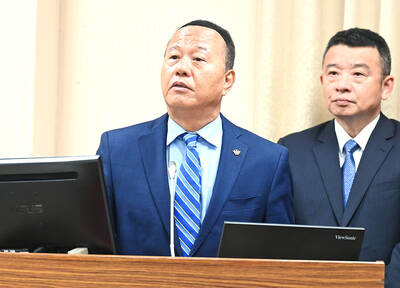
VIGILANCE: The military is paying close attention to actions that might damage peace and stability in the region, the deputy minister of national defense said The People’s Republic of China (PRC) might consider initiating a hack on Taiwanese networks on May 20, the day of the inauguration ceremony of president-elect William Lai (賴清德), sources familiar with cross-strait issues said. While US Secretary of State Anthony Blinken’s statement of the US expectation “that all sides will conduct themselves with restraint and prudence in the period ahead” would prevent military actions by China, Beijing could still try to sabotage Taiwan’s inauguration ceremony, the source said. China might gain access to the video screens outside of the Presidential Office Building and display embarrassing messages from Beijing, such as congratulating Lai


 RSS
RSS