


How to cooperate more effectively is on the agenda for troubled pan-blue allies the People First Party (PFP) and the Chinese Nationalist Party (KMT), PFP Chairman James Soong (
Returning to Taiwan from the US yesterday morning to attend a funeral service for former first lady Faina Chiang Fang-liang (蔣方良), Soong told reporters that the PFP and the KMT would work together to steer the nation's policy direction.
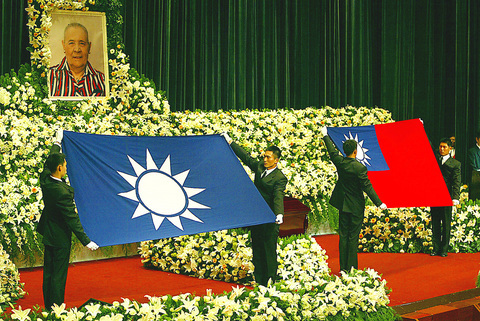
PHOTO: CNA
"I repeat: The KMT and the PFP will cooperate," Soong said on arrival at CKS International Airport yesterday morning.
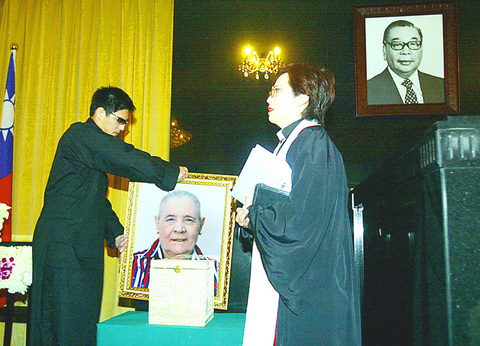
PHOTO: CNA
Soong said the two parties would work together to draw up policies that would maintain the status quo and defend the use of the title "Republic of China."
Adding to speculation that the troubled relationship between the two parties is on the mend, Legislative Speaker and KMT Vice Chairman Wang Jin-pyng (
Asked later in the day on when a highly-anticipated meeting between the leaders of the two parties would take place, Soong said he would leave the decision up to party officials.
The two parties have not met in an official capacity since the legislative elections. And while both parties have said that they would meet after the elections to discuss a pan-blue camp merger, conflict between the parties during the campaign strained relations, making the future of any merger an object of intense media speculation.
During Chiang's funeral later in the morning, Soong met briefly with Lien, shaking hands after the service.
Chiang, who died on Dec. 15 of pulmonary and cardiac failure at the age of 88, was the widow of late president Chiang Ching-kuo (
A large number of government officials and political figures attended yesterday's service, with President Chen Shui-bian (陳水扁) and Vice President Annette Lu (呂秀蓮) being the first to pay their respects at 8am.
After the ceremony concluded at around 10:30am, Chiang's body was sent to a crematorium in Keelung, where it was cremated. Her ashes were then taken to a temporary mausoleum in Touliao, Taoyuan County.
Chiang was praised during the funeral service by Pastor Chow Lien-hwa (
While Chiang had a "foreigner's face," Chow said, she also had a "Chinese heart."
While at the airport, Soong also chatted about his marriage, saying that Sunday was the 38th anniversary of his marriage to Chen Wan-shui (
Soong left for San Francisco two weeks ago amid speculation that his marriage was on the rocks.
"No matter if you're talking about [the relationship between] political parties or man and wife, or even between friends, there are bound to be differences in opinion at times," Soong said.
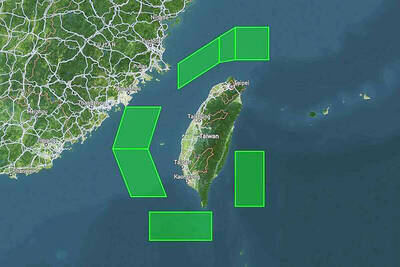
The disruption of 941 flights in and out of Taiwan due to China’s large-scale military exercises was no accident, but rather the result of a “quasi-blockade” used to simulate creating the air and sea routes needed for an amphibious landing, a military expert said. The disruptions occurred on Tuesday and lasted about 10 hours as China conducted live-fire drills in the Taiwan Strait. The Civil Aviation Administration (CAA) said the exercises affected 857 international flights and 84 domestic flights, affecting more than 100,000 travelers. Su Tzu-yun (蘇紫雲), a research fellow at the government-sponsored Institute for National Defense and Security Research, said the air
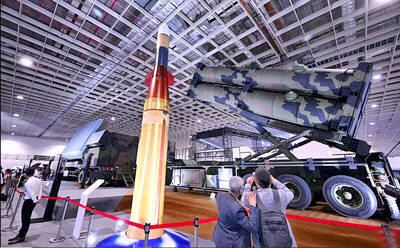
Taiwan is to commence mass production of the Tien Kung (天弓, “Sky Bow”) III, IV and V missiles by the second quarter of this year if the legislature approves the government’s NT$1.25 trillion (US$39.78 billion) special defense budget, an official said yesterday. Commenting on condition of anonymity, a defense official with knowledge of the matter said that the advanced systems are expected to provide crucial capabilities against ballistic and cruise missiles for the proposed “T-Dome,” an advanced, multi-layered air defense network. The Tien Kung III is an air defense missile with a maximum interception altitude of 35km. The Tien Kung IV and V
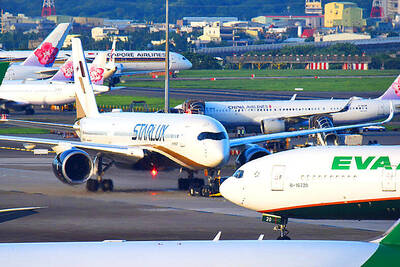
Trips for more than 100,000 international and domestic air travelers could be disrupted as China launches a military exercise around Taiwan today, Taiwan’s Civil Aviation Administration (CAA) said yesterday. The exercise could affect nearly 900 flights scheduled to enter the Taipei Flight Information Region (FIR) during the exercise window, it added. A notice issued by the Chinese Civil Aviation Administration showed there would be seven temporary zones around the Taiwan Strait which would be used for live-fire exercises, lasting from 8am to 6pm today. All aircraft are prohibited from entering during exercise, it says. Taipei FIR has 14 international air routes and
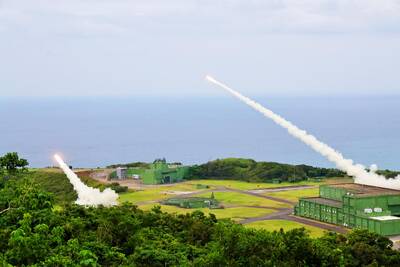
Taiwan lacks effective and cost-efficient armaments to intercept rockets, making the planned “T-Dome” interception system necessary, two experts said on Tuesday. The concerns were raised after China’s military fired two waves of rockets during live-fire drills around Taiwan on Tuesday, part of two-day exercises code-named “Justice Mission 2025.” The first wave involved 17 rockets launched at 9am from Pingtan in China’s Fujian Province, according to Lieutenant General Hsieh Jih-sheng (謝日升) of the Office of the Deputy Chief of the General Staff for Intelligence at the Ministry of National Defense. Those rockets landed 70 nautical miles (129.6km) northeast of Keelung without flying over Taiwan,


 RSS
RSS