


Taiwan would be wrong to devote the money the Chen Shui-bian (陳水扁) government wants to spend on US diesel-powered subma-rines, but should devote its re-sources to such things as hardening potential targets of missile attacks and retaining air superiority in the Taiwan Strait, a leading US military analyst with close connections to the US defense establishment says.
The analyst, retired rear admiral Michael McDevitt, made his comments at a Washington seminar on Thursday discussing Taiwan's situation in the wake of the legislative elections.
He also warned Taipei against declaring independence, saying such a move could involve the US in the long-term defense of Taiwan against retribution from China.
McDevitt spoke disparagingly about the plan to spend more than US$12 billion on eight diesel submarines, noting that "Taiwan is talking about investing 66 percent of its special [defense] budget on eight submarines that won't even show up for another decade."
He also criticized the subs that Taiwan is considering buying from Washington as incapable of meeting the purpose Taiwan wants them to perform.
"These subs have a search rate that is so slow, they will cover such a small body of water, that that's the wrong way to look for the other guy's submarines," he told a seminar hosted by the George Washington University's Center for Strate-gic and International Relations.
He also said that the Pentagon would be happy if Taiwan reneged on the submarine purchase. That would run counter to a strenuous and prolonged effort by the Pentagon to force Taiwan to buy the subs, which would likely be built by US defense contractors.
"I'll bet you," McDevitt said, "given the fact that it has caused so much problem for the [US] Department of Defense, if Taiwan was tomorrow to walk into the Department of Defense and say, `We've decided to withdraw our request for submarines,' you would hear quiet applause all over the Department of Defense.
"They'd breath a sigh of relief: `Thank God, that would solve our problem.' That's my speculation," McDevitt said.
Noting that Chen has maintained that Taiwan would declare independence if it were attacked by China, McDevitt cautioned that maintaining independence would be harder than declaring it.
"All efforts by Taipei has been focused on how to become independent, but none of it is focused on how to sustain independence," he said.
If Taiwan declared indepen-dence, "you would have a situation in which the United States would either have to sign up with a security arrangement that protects that independent Taiwan essentially in perpetuity, or you would have to get Beijing to agree to it."
"More thought," he cautioned, "has to be placed on how do you sustain independence once you've declared it," he said.
On other Taiwanese defense areas, McDevitt said Taipei's main strategy should be maintaining air superiority against China in the Taiwan Strait.
He said that Taiwan should also boost defenses against a Chinese missile attack by hardening potential targets against such strikes: "Pouring concrete," as he put it.
"Remember, a ballistic missile is a relatively small warhead. So unless it lands in the middle of the room, the blast damage is not going to be really great. So, hardening does really make a difference," he said.
McDevitt advised Taiwan's government against relying on any aggressive strikes against China as a deterrent strategy.
"It's a terrible strategic choice and its going to waste a lot of money," he said.
"If you argue that lobbing a few missiles into downtown Shanghai is going to deter Beijing, think about it for a minute," he said.
China realizes that any attack on Taiwan will cost it dearly in-ternationally, he said. So an attack on Shanghai, for instance, is not going to make a difference.
"If they have not been deterred by all the bad things that are going to happen to them, this is silly and a waste of money," McDevitt said.
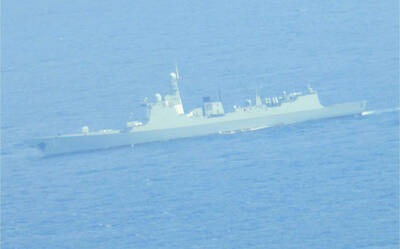
The military has spotted two Chinese warships operating in waters near Penghu County in the Taiwan Strait and sent its own naval and air forces to monitor the vessels, the Ministry of National Defense (MND) said. Beijing sends warships and warplanes into the waters and skies around Taiwan on an almost daily basis, drawing condemnation from Taipei. While the ministry offers daily updates on the locations of Chinese military aircraft, it only rarely gives details of where Chinese warships are operating, generally only when it detects aircraft carriers, as happened last week. A Chinese destroyer and a frigate entered waters to the southwest
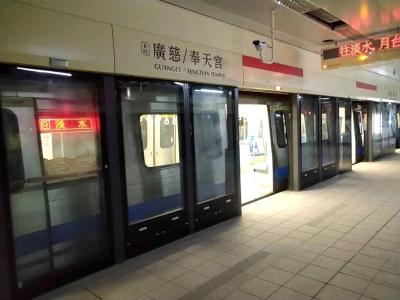
The eastern extension of the Taipei MRT Red Line could begin operations as early as late June, the Taipei Department of Rapid Transit Systems said yesterday. Taipei Rapid Transit Corp said it is considering offering one month of free rides on the new section to mark its opening. Construction progress on the 1.4km extension, which is to run from the current terminal Xiangshan Station to a new eastern terminal, Guangci/Fengtian Temple Station, was 90.6 percent complete by the end of last month, the department said in a report to the Taipei City Council's Transportation Committee. While construction began in October 2016 with an
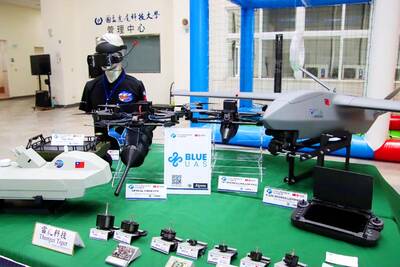
NON-RED SUPPLY: Boosting the nation’s drone industry is becoming increasingly urgent as China’s UAV dominance could become an issue in a crisis, an analyst said Taiwan’s drone exports to Europe grew 41.7-fold from 2024 to last year, with demand from Ukraine’s fight against Russian aggression the most likely driver of growth, a study showed. The Institute for Democracy, Society and Emerging Technology (DSET) in a statement on Wednesday said it found that many of Taiwan’s uncrewed aerial vehicle (UAV) sales were from Poland and the Czech Republic. These countries likely transferred the drones to Ukraine to aid it in its fight against the Russian invasion that started in 2022, it said. Despite the gains, Taiwan is not the dominant drone exporter to these markets, ranking second and fourth
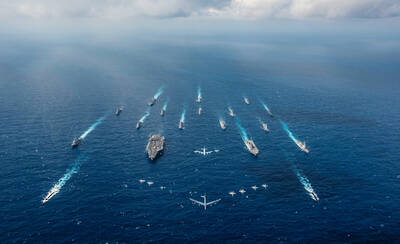
Japanese Prime Minister Sanae Takaichi’s comment last year on Tokyo’s potential reaction to a Taiwan-China conflict has forced Beijing to rewrite its invasion plans, a retired Japanese general said. Takaichi told the Diet on Nov. 7 last year that a Chinese naval blockade or military attack on Taiwan could constitute a “survival-threatening situation” for Japan, potentially allowing Tokyo to exercise its right to collective self-defense. Former Japan Ground Self-Defense Force general Kiyofumi Ogawa said in a recent speech that the remark has been interpreted as meaning Japan could intervene in the early stages of a Taiwan Strait conflict, undermining China’s previous assumptions


 RSS
RSS