


In keeping with tradition, the entire Executive Yuan led by Premier Yu Shyi-kun will resign together before newly elected legislators take their oaths of office on Feb. 1.
Following the pan-blue camp's victory in yesterday's legislative polls, the new premier is expected to encounter more vehement resistance from the opposition parties, which continue to take up more than half of the 225-seat lawmaking body.
Observers predicted that the odds of Yu's being re-appointed as premier are slim despite Yu's loyalty to President Chen Shui-bian (
Political columnist Hu Wen-huei (胡文輝) said that it is likely that President Chen will nominate someone who has an economic background and more neutral attributes.
"I suspect Yu will be out of the picture, leaving Vice President Annette Lu, Presidential Office Secretary-General Su Tseng-chang (
While Chinese Nationalist Party (KMT) Chairman Lien Chan (
"Unless they have the guts to cast a no-confidence vote against the new premier, it's highly improbable that the pan-blue camp will get its wish to form a new government," Hu said. "Then again, if it dares to do so, it will have to face resistance from the newly elected legislature and the subsequent consequences."
According to the 1997 additional articles to the Constitution, the premier is directly appointed by the head of state without obtaining the consent of the Legislative Yuan. The legislature has the power to pass a no-confidence vote against the premier, but the head of state also has the power to dissolve the legislature.
Wang Yeh-li (
If Chen wants the new premier to be merely his policy executor, Wang observed, the person must be obedient, loyal and not threatening to Chen's political stature. If Chen wants the new premier to become his future successor, Wang said that it will be a different story.
No matter who the new premier is, Wang said the position will be more difficult because the pan-blue camp still dominates the new legislative body.
Tsai Tzung-jen (蔡宗珍), an associate professor of law at National Taiwan University, said that she believes the key issue is not who will become the next premier, but rather who can carry out Chen's policies in the face of an opposition-controlled legislature.
"To appoint someone loyal to President Chen is mutually beneficial for both him and the new premier," she said. "The new premier will need the full support of Chen, while Chen needs the new premier to carry out his will."
While President Chen has been talking about stepping down from the party chairmanship, Tsai said that it seemed unlikely Chen will relinquish control. He has publicly asked the electorate to give him two more years to prove that he can turn things around, she said.
Commenting on the possibility of the KMT's proposal to form a new Cabinet after the election, Wang said that Lien has every right to ask President to take him or his hand-picked recommended candidate Deputy Legislative Speaker Chiang Pin-kun (
However, Chen has utterly rejected such proposals.
Wang wondered why Lien made the proposal now, instead of during the past three years when the pan-blue camp had a legislative majority and could easily have cast a no-confidence vote against the premier.
According to Tsai, even if the pan-blue camp manages to form a new Cabinet after the election, Cabinet officials must not be members of the legislature because the Constitution explicitly forbids lawmakers from assuming other public positions.
Therefore, they must come from the party. This, however, is expected to create resistance from legislators, who fought hard to win their seats.
"Who wants to support someone appointed by the party to lead the new Cabinet? The wish of the party chairman might be the wish of the party during the authoritarian KMT rule over the past 50 years, but not any more," Tsai said.
Wang expressed a different opinion, saying that it is possible for the coalition enjoying legislative majority to form a new Cabinet.
"While the legislature was deprived of its power to approve who will be premier, the Constitution gives the legislature a sharp weapon to force the president to nominate a premier the opposition party favors -- and that is to cast a no-confidence vote against the premier," Wang said.
If the president opts not to dissolve the newly elected legislature, Wang said, the opposition alliance can continue to cast a no-confidence vote against any premier not to their liking.
Wang said Taiwan's semi-presidential government system resembles that of France, where a separately elected president shares executive power with the premier. So-called "cohabitation" makes it possible for the president and premier to represent different and even opposed parties. This means the government can alternate between presidential and parliamentary systems, depending on what party, or coalition of parties, has a legislative majority.
However, no precedent of cohabitation has been established in Taiwan, which most academics concur acquired the constitutional framework for a semi-presidential system in 1997.
The 1997 round of constitutional reforms was carried out jointly by the KMT and the DPP under the leadership of former president Lee Teng-hui (
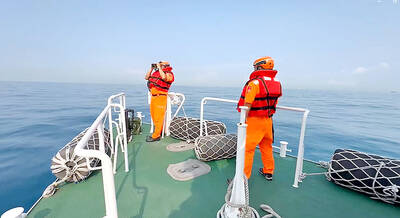
An increase in Taiwanese boats using China-made automatic identification systems (AIS) could confuse coast guards patrolling waters off Taiwan’s southwest coast and become a loophole in the national security system, sources familiar with the matter said yesterday. Taiwan ADIZ, a Facebook page created by enthusiasts who monitor Chinese military activities in airspace and waters off Taiwan’s southwest coast, on Saturday identified what seemed to be a Chinese cargo container ship near Penghu County. The Coast Guard Administration went to the location after receiving the tip and found that it was a Taiwanese yacht, which had a Chinese AIS installed. Similar instances had also

GOOD DIPLOMACY: The KMT has maintained close contact with representative offices in Taiwan and had extended an invitation to Russia as well, the KMT said The Chinese Nationalist Party (KMT) would “appropriately handle” the fallout from an invitation it had extended to Russia’s representative to Taipei to attend its international banquet last month, KMT Chairman Eric Chu (朱立倫) said yesterday. US and EU representatives in Taiwan boycotted the event, and only later agreed to attend after the KMT rescinded its invitation to the Russian representative. The KMT has maintained long-term close contact with all representative offices and embassies in Taiwan, and had extended the invitation as a practice of good diplomacy, Chu said. “Some EU countries have expressed their opinions of Russia, and the KMT respects that,” he
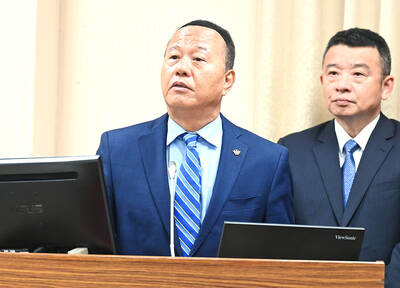
VIGILANCE: The military is paying close attention to actions that might damage peace and stability in the region, the deputy minister of national defense said The People’s Republic of China (PRC) might consider initiating a hack on Taiwanese networks on May 20, the day of the inauguration ceremony of president-elect William Lai (賴清德), sources familiar with cross-strait issues said. While US Secretary of State Anthony Blinken’s statement of the US expectation “that all sides will conduct themselves with restraint and prudence in the period ahead” would prevent military actions by China, Beijing could still try to sabotage Taiwan’s inauguration ceremony, the source said. China might gain access to the video screens outside of the Presidential Office Building and display embarrassing messages from Beijing, such as congratulating Lai
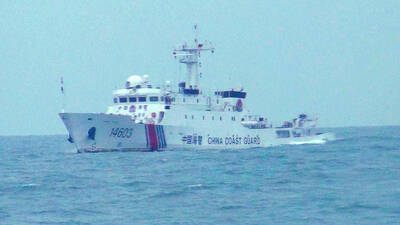
Four China Coast Guard ships briefly sailed through prohibited waters near Kinmen County, Taipei said, urging Beijing to stop actions that endanger navigation safety. The Chinese ships entered waters south of Kinmen, 5km from the Chinese city of Xiamen, at about 3:30pm on Monday, the Coast Guard Administration said in a statement later the same day. The ships “sailed out of our prohibited and restricted waters” about an hour later, the agency said, urging Beijing to immediately stop “behavior that endangers navigation safety.” Ministry of National Defense spokesman Sun Li-fang (孫立方) yesterday told reporters that Taiwan would boost support to the Coast Guard


 RSS
RSS