


The legislative election results will have little impact on Taiwan-US relations but the world would look at them as an indicator of the Taiwanese people's aspirations for their national identity, visiting US academics said yesterday.
"If the pan-greens win, Bush will reiterate his statement that each side should be careful not to disturb this `status quo,' and that would be a way of warning [President] Chen Shui-bian (陳水扁)," said June Teufel Dreyer, commissioner of the congressional US-China Economic and Security Review Commission.
"If the pan-blues win, [Bush] will probably say the same thing, but he will be less worried that pan-blues will make some provocative change. But to me, the positions of pan-blues and pan-greens on cross-strait relations aren't that different. The language is different, but I don't think the ultimate intent is," said Dreyer, who is also a professor at the Department of Political Science at the University of Miami.
Beijing will finally have to come to the realization that either it will deal with the pan-greens, or it will have not have anyone to deal with.
"If the pan-blues do not win this time, it may be a long time before there is a pan-blue victory," Dreyer told reporters.
John Tkacik, research fellow of the Washington-based Heritage Foundation's Asian Studies Center, said that if the blues win, foreign countries might conclude that Taiwanese voters have expressed a democratic aspiration to stop the momentum of the last four years and reconsider their relationship primarily with China.
Newspapers around the world "will look at the Taiwanese elections as an indicator of the Taiwan[ese] people's aspirations for their national identity," he said.
If the greens win, the foreign media will think voters want to "democratically keep the momentum going for a new identity."
"It remains to be seen how this will affect Taiwan's relations with those countries," Tkacik said.
"In China, I think they will say if the blues win, it means that Taiwan wants to consider joining China. If the greens win, it means the Taiwan[ese] people want to reinvent their national identity," he said.
No matter who wins, China knows there is a division in Taiwan that is going to keep it from ever fully embracing China, observed Richard Kagan, professor of history at Hamline University.
With regard to Chen's recent proposal to change the names of the country's overseas representative offices to include "Taiwan," Dreyer said she does not think the announcement has seriously hurt US-Taiwan relations.
"I think this [name change] has to be done by agreement with each country individually. I am sure President Chen will try, but I am not sure he will succeed with all countries," she said.
Dreyer said the US State Department's opposition to Chen's proposal is a pre-emptive move on the part of the Bush administration.
"I don't think China has had to put any pressure on them. I think it's like self-censorship. They are so convinced that Beijing is getting angry that they are reacting without Beijing putting any pressure on them," she said.
"I think the Bush administration should be a bit stronger with regard to China, because as we all know, everything makes China angry. It's a self-defeating policy for the Bush administration to do this," Dreyer said.
Tkacik said there is a desire on the part of the US to not be surprised by things.
"It will help if there is a certain amount of discussion on a lot of these issues," he suggested.
"The US policy is that we do not want the `status quo' in the Taiwan Strait changed unilaterally. But the US policy is also that we don't want the `status quo' as we defined it changed unilaterally. The big problem is that the US never defines the `status quo,'" Tkacik said.
"The US cannot, will not, does not, and is afraid to define the status quo," he added.
"Until the US government actually makes explicit what it considers the `status quo' to be, it is very difficult for either Taiwan or China for that matter to understand where the `red lines' are," he said.
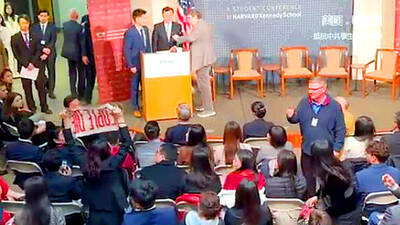
A group of Taiwanese-American and Tibetan-American students at Harvard University on Saturday disrupted Chinese Ambassador to the US Xie Feng’s (謝鋒) speech at the school, accusing him of being responsible for numerous human rights violations. Four students — two Taiwanese Americans and two from Tibet — held up banners inside a conference hall where Xie was delivering a speech at the opening ceremony of the Harvard Kennedy School China Conference 2024. In a video clip provided by the Coalition of Students Resisting the CCP (Chinese Communist Party), Taiwanese-American Cosette Wu (吳亭樺) and Tibetan-American Tsering Yangchen are seen holding banners that together read:

UNAWARE: Many people sit for long hours every day and eat unhealthy foods, putting them at greater risk of developing one of the ‘three highs,’ an expert said More than 30 percent of adults aged 40 or older who underwent a government-funded health exam were unaware they had at least one of the “three highs” — high blood pressure, high blood lipids or high blood sugar, the Health Promotion Administration (HPA) said yesterday. Among adults aged 40 or older who said they did not have any of the “three highs” before taking the health exam, more than 30 percent were found to have at least one of them, Adult Preventive Health Examination Service data from 2022 showed. People with long-term medical conditions such as hypertension or diabetes usually do not
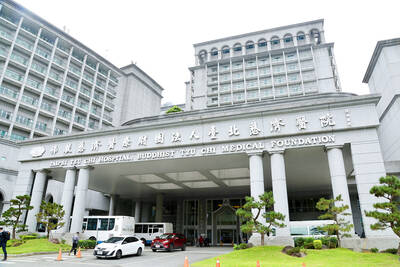
POLICE INVESTIGATING: A man said he quit his job as a nurse at Taipei Tzu Chi Hospital as he had been ‘disgusted’ by the behavior of his colleagues A man yesterday morning wrote online that he had witnessed nurses taking photographs and touching anesthetized patients inappropriately in Taipei Tzu Chi Hospital’s operating theaters. The man surnamed Huang (黃) wrote on the Professional Technology Temple bulletin board that during his six-month stint as a nurse at the hospital, he had seen nurses taking pictures of patients, including of their private parts, after they were anesthetized. Some nurses had also touched patients inappropriately and children were among those photographed, he said. Huang said this “disgusted” him “so much” that “he felt the need to reveal these unethical acts in the operating theater
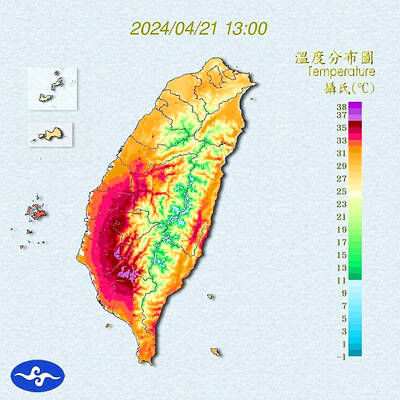
Heat advisories were in effect for nine administrative regions yesterday afternoon as warm southwesterly winds pushed temperatures above 38°C in parts of southern Taiwan, the Central Weather Administration (CWA) said. As of 3:30pm yesterday, Tainan’s Yujing District (玉井) had recorded the day’s highest temperature of 39.7°C, though the measurement will not be included in Taiwan’s official heat records since Yujing is an automatic rather than manually operated weather station, the CWA said. Highs recorded in other areas were 38.7°C in Kaohsiung’s Neimen District (內門), 38.2°C in Chiayi City and 38.1°C in Pingtung’s Sandimen Township (三地門), CWA data showed. The spell of scorching


 RSS
RSS