


The Non-Partisan Solidarity Union (NPSU) and independent lawmakers together won 10 seats in yesterday's legislative elections, and with the pan-blue camp holding a fragile majority of 13 seats out of a total of 225 in the legislature, most of these non-aligned lawmakers will side with the pan-blues in the coming three years based on their sentiments to date.
Given that the pan-blues' absolute majority of three seats may not remain immune to pan-green attack -- especially if high-profile government posts are given to pan-blue lawmakers -- the alignment of the NPSU and independents may be a key issue.
Of the 10 seats, the NPSU lawmakers-elect hold six, and the independent four.
All the NPSU's winners yesterday are incumbent lawmakers:
Yen Ching-piao (顏清標, Taichung County), Chen Chin-ting (陳進丁, Changhwa County), Lee Ho-shun (李和順, Tainan County), Tsai Hao (蔡豪, Pingtung County), Lin Ping-kun (林炳坤, Penghu) and May Chin (高金素梅, mountain area aboriginal).
NPSU chairwoman Chang Po-ya (張博雅) said after the results were published that although the NPSU only had six seats, the party was likely to play a pivotal role in the new legislature.
Chang said that the NPSU was prepared to see such a low number of seats, and that the election outcome was not a matter of success of failure, but was "fair."
"The pan-blues only have a fragile majority this time, and especially with their overseas lawmakers often absent from the legislature, the NPSU will still be a decisive minority," Chang said.
NPSU Secretary-General Chen Chieh-ju (
"So it ended up that NPSU candidates still depended mostly on their own local resources and personal networks," Chen said.
Meanwhile, the four independent lawmakers are Li Ao (李敖, Taipei City South), Chang Li-shan (張麗善, Yunlin County), Yang Tsung-jer (楊宗哲, Changhua County), and Tsao Er-tsung (曹爾忠, Kinmen).
But several newly-elected NPSU and independent lawmakers have held grudges against the Democratic Progressive Party (DPP) administration, and this means the pan-green camp would likely not be very successful in soliciting their support.
Among the lawmakers with grudges against the DPP include Chang Li-shan, whose brother, Yunlin County Commissioner Chang Jung-wei (張榮味), was sentenced to 12 months in jail for bribery during the 1994 election for the Yunlin County Council speakership.
Chang Jung-wei's arrest the day before the election is thought to have boosted his sister's campaign.
May Chin was another winner who has been fighting against the DPP administration on several Aboriginal issues. Last July Chin led a huge crowd of Aboriginals marching on Ketagalan Boulevard to protest Vice President Annette Lu's (
Taipei Society Chairman Hung Yu-hung (
"In the Taipei Society's evaluation, most NPSU lawmakers have performed lousily and have only advanced their own interests," Hung said.
"But now that the pan-green camp has not won a majority, it will need support from the NPSU, independent, and KMT pro-localization lawmakers when it wants to pass certain bills," Hung said.
People First Party (PFP) caucus whip Liu Wen-hsiung was even more blunt about the NPSU and independent lawmakers' future.
"Things are going to be chaotic. Now they can bargain for a good price," Liu said in a sly tone.

FUKUOKA SITUATION: Japanese media reported that the pathogen is expected to be identified by the summer, while the CDC downplayed the idea that it was hMPV A “mysterious cold-like illness” reported in Japan’s Fukuoka Prefecture does not seem to be a new disease, but Japanese authorities have been asked about the situation, the Centers for Disease Control (CDC) said yesterday. The Fukuoka Prefectural Medical Association on Wednesday told a news conference that a “mystery cold” that has become a hot topic on social media is “highly likely to be caused by some kind of viral infection,” Japan’s KBC News reported. “Many people are experiencing symptoms starting with a sore throat, followed by a runny nose, phlegm and a severe cough,” KBC News reported, citing association officials. Health authorities are

Nvidia Corp CEO Jensen Huang (黃仁勳) arrived in Taiwan yesterday ahead of upcoming AI and technology events, saying he plans to meet with clients and Taiwan Semiconductor Manufacturing Co Chairman C.C. Wei (魏哲家) during his visit. After landing at Taipei Songshan Airport, Huang posed for photos with fans and handed out Yakult drinks to reporters and supporters waiting at the scene, saying he has “a lot to do” during the trip. Asked about reports that Nvidia’s planned headquarters site in Taipei’s Beitou Shilin Technology Park could break ground on May 27, Huang said that if the company holds an event, he would

Carrefour Taiwan is to begin using a new name from the start of July, but it cannot divulge the name until then, the chairman of the supermarket chain's parent company said today. President Chain Store Co chairman Lo Chih-hsien (羅智先) was asked by reporters after a shareholders' meeting to confirm whether the company has settled on a new name for the supermarket brand. In March, the government-registered name of two Carrefour Taiwan branches was quietly changed to "Le Chia Kang" (樂家康) in Chinese, raising speculation that has been selected as the name. Lo said that because of local regulations and contractual obligations, the
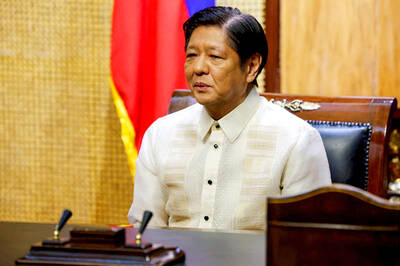
The Philippines would likely be involved in any conflict over Taiwan due to its proximity to the democracy claimed by China, President Ferdinand Marcos Jr said, reiterating a stance that risks angering Beijing. “In the Philippines, we do not have a choice because Taiwan is so close to the Philippines and we have almost 200,000 Filipino nationals living and working in Taiwan,” Marcos said in an interview with Japanese media in Manila on Monday. The Philippine leader’s comments come ahead of a state visit to Japan next week, where he is to meet with Japanese Prime Minister Sanae Takaichi to discuss security


 RSS
RSS