


President Chen Shui-bian (
Chen made the vow during a campaign rally held in Kaohsiung City last night.
During the rally, Chen once again said that it was imperative that the pan-greens are successful in the legislative elections, adding that the pan-blues have exploited their majority in the legislature while attempting to paralyze the government over the past three years.
Chen said, when he took over the office of Taipei Mayor in 1998, he told Taipei's citizens that he would improve Taipei's notorious traffic situation within two years. After his determined efforts, the traffic situation was improved.
"I believed that if people of Taiwan could give us a chance and support the pan-green camp to win a majority in the legislature -- only give us two years and I promise that I will do a good job as a president and lead the country to become a great, normal and complete country," Chen said. "Otherwise, I am willing to step down as president."
Chen added that Kaohsiung City Government, which is supported by a pan-green controlled City Council, provides an example of a government that can really do something good for citizens.
Chen also promised that if the pan-greens win a majority in the legislature, the government will pass a National Pension Law (
Legislation governing the Resolution Trust Cooperation (
The Democratic Progressive Party (DPP) yesterday held a campaign rally in northern Kaohsiung City to boost its legislative candidates Kuan Pi-ling (
Noticeably, the five candidates did not boast about themselves. Instead, they showered praise on their fellow candidates, showing that the united pan-green campaign strategy and vote allocation plan is working.
Kaohsiung Mayor Frank Hsieh (
Meanwhile, early in the day before attending the rally in Kaohsiung City, President Chen Shui-bian (
There he called on people of different ethnic groups to get along with each other and stressed that only if Taiwan's people unite can the country face threats from outside.
"It is undeniable that Taiwan has different ethnic groups. But everyone has to know we only have one country," Chen said. "I believe that Taiwan has no ethnic problem, but only a problem of national identification."
In his speech, Chen redefined the "five ethnic groups" proposed by Sun Yat-sen (孫中山), pointing out that the five ethnic groups who reside in Taiwan are Hoklo, Hakka, Aborigine, Mainlanders and foreigners -- including brides from Southeast Asian countries and China.
"It is unnecessary for a small number of ethnic groups to bear historical burdens," Chen said. "Under the principle of the DPP's Resolution on Ethnic Diversity and National Unity, there was no oppressor and victim. Everyone is equal and everyone is the owner of the land."
Chen once again stressed that "Taiwan is the Republic of China, the Republic of China is Taiwan," asking people not to hold on to fantasies about the country's territory and to acknowledge the nation's reality.
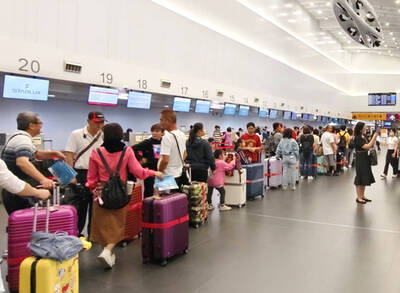
Three Taiwanese airlines have prohibited passengers from packing Bluetooth earbuds and their charger cases in checked luggage. EVA Air and Uni Air said that Bluetooth earbuds and charger cases are categorized as portable electronic devices, which should be switched off if they are placed in checked luggage based on international aviation safety regulations. They must not be in standby or sleep mode. However, as charging would continue when earbuds are placed in the charger cases, which would contravene international aviation regulations, their cases must be carried as hand luggage, they said. Tigerair Taiwan said that earbud charger cases are equipped
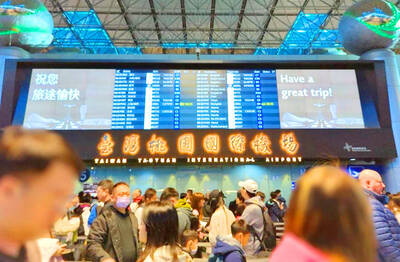
Foreign travelers entering Taiwan on a short layover via Taiwan Taoyuan International Airport are receiving NT$600 gift vouchers from yesterday, the Tourism Administration said, adding that it hopes the incentive would boost tourism consumption at the airport. The program, which allows travelers holding non-Taiwan passports who enter the country during a layover of up to 24 hours to claim a voucher, aims to promote attractions at the airport, the agency said in a statement on Friday. To participate, travelers must sign up on the campaign Web site, the agency said. They can then present their passport and boarding pass for their connecting international
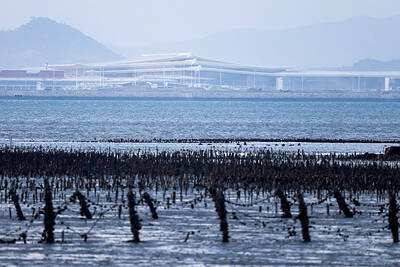
UNILATERAL MOVES: Officials have raised concerns that Beijing could try to exert economic control over Kinmen in a key development plan next year The Civil Aviation Administration (CAA) yesterday said that China has so far failed to provide any information about a new airport expected to open next year that is less than 10km from a Taiwanese airport, raising flight safety concerns. Xiamen Xiangan International Airport is only about 3km at its closest point from the islands in Kinmen County — the scene of on-off fighting during the Cold War — and construction work can be seen and heard clearly from the Taiwan side. In a written statement sent to Reuters, the CAA said that airports close to each other need detailed advanced
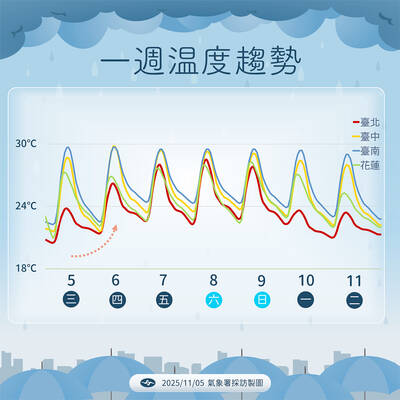
UNKNOWN TRAJECTORY: The storm could move in four possible directions, with the fourth option considered the most threatening to Taiwan, meteorologist Lin De-en said A soon-to-be-formed tropical storm east of the Philippines could begin affecting Taiwan on Wednesday next week, the Central Weather Administration (CWA) said yesterday. The storm, to be named Fung-wong (鳳凰), is forecast to approach Taiwan on Tuesday next week and could begin affecting the weather in Taiwan on Wednesday, CWA forecaster Huang En-hung (黃恩鴻) said, adding that its impact might be amplified by the combined effect with the northeast monsoon. As of 2pm yesterday, the system’s center was 2,800km southeast of Oluanbi (鵝鑾鼻). It was moving northwest at 18kph. Meteorologist Lin De-en (林得恩) on Facebook yesterday wrote that the would-be storm is surrounded by


 RSS
RSS