


Three legislative candidates whose campaigns have been the target of bribery investigations yesterday insisted on their innocence, after 50 people -- including one of the candidates, 48 vote-captains, and one township representative -- were indicted by prosecutors on Monday night.
The three campaigns involved are those of independent candidate and former Democratic Progressive Party (DPP) member Ho Chin-sung (何金松), who is seeking re-election in Chiayi; the DPP's Lin Kuo-hua (林國華), who is seeking re-election in Yunlin; and the Taiwan Solidarity Union's Chen Chiang-sun (陳江順), who is campaigning in Taoyuan County.
Ho was indicted on bribery charges on Monday night, along with 33 of his vote-captains and Minhsiung Township Resident Representative Ho-Tsung-chi (
At a press conference at the Minhsiung Township Office yesterday, Ho said the charge was unfair and criticized prosecutors for indicting him so quickly after only a three-day investigation.
"I can't believe that they have gone through all the details and decided to indict me within three days," Ho said. "It is obvious that somebody wants to defame me."
According to Chiayi Prosecutor Wang Chuan-cheng's (王全成) indictment, Ho allegedly treated 40 voters in his constituency to a free buffet dinner that cost the campaign NT$30,000, during their trip to Taipei City on Oct. 27. Ho Tsung-chi also attended the dinner to seek support from those present.
Wang suggested a two-year sentence for both Ho Chin-sung and Ho Tsung-chi.
Wang also indicted 33 of Ho Chin-sung's vote-captains but did not suggest sentences.
As for the DPP's Lin, the Yunlin prosecutor did not indict him, but did indict 15 of his vote-captains and suggested eight-month sentences for each. Lin's vote-captains allegedly organized a free dinner party for nearly 250 people in Hsilo Township -- Lin's constituency -- and asked these participants to support Lin to win his re-election.
According to video footage which was presented by prosecutors as evidence, Lin attended the dinner party as well. But prosecutors decided that he did not join his vote-captains' campaign activity during the dinner.
Lin said that he was only a guest at the dinner party and that the vote-captains held the party for him as a token of appreciation for his helping them apply for compensation from the Ministry of National Defense on land issues.
"I was considering whether I should go, but I eventually decided to join them because I have nothing to fear," Lin said. "I did not do anything illegal."
The TSU's Chen was not indicted either, but three of his vote-captains were detained by Taoyuan Prosecutor Liao Chiang-hsien (廖江憲), in a case that is still under investigation.
Vote-captains Lin Chin-hsing (林金興), Chen Chuan-tsu (陳傳族) and Wang Ming-teh (王明德) were detained because they allegedly bought votes for Chen by giving away free packages of rice, tea, coffee and wine to Chen's constituents.
"We spent nearly a month carrying out surveillance against Chen's vote-captains and supporters and discovered that these voters would pick up their free giveaways at Chen's campaign headquarters," Liao said.
Chen said that he would respect the prosecutors' investigation, but claimed that it is impossible for him to buy votes.
"For campaign activities, I am dead broke now," Chen said. "How can it be possible for me to have the budget to buy votes?"

FUKUOKA SITUATION: Japanese media reported that the pathogen is expected to be identified by the summer, while the CDC downplayed the idea that it was hMPV A “mysterious cold-like illness” reported in Japan’s Fukuoka Prefecture does not seem to be a new disease, but Japanese authorities have been asked about the situation, the Centers for Disease Control (CDC) said yesterday. The Fukuoka Prefectural Medical Association on Wednesday told a news conference that a “mystery cold” that has become a hot topic on social media is “highly likely to be caused by some kind of viral infection,” Japan’s KBC News reported. “Many people are experiencing symptoms starting with a sore throat, followed by a runny nose, phlegm and a severe cough,” KBC News reported, citing association officials. Health authorities are

Nvidia Corp CEO Jensen Huang (黃仁勳) arrived in Taiwan yesterday ahead of upcoming AI and technology events, saying he plans to meet with clients and Taiwan Semiconductor Manufacturing Co Chairman C.C. Wei (魏哲家) during his visit. After landing at Taipei Songshan Airport, Huang posed for photos with fans and handed out Yakult drinks to reporters and supporters waiting at the scene, saying he has “a lot to do” during the trip. Asked about reports that Nvidia’s planned headquarters site in Taipei’s Beitou Shilin Technology Park could break ground on May 27, Huang said that if the company holds an event, he would

The Ministry of Finance this afternoon announced the winning numbers for the March-April uniform invoice lottery. The winning number for the NT$10 million (US$318,060) special prize is 19531471, and the winning number for the NT$2 million grand prize is 85941329. Three numbers were drawn for the NT$200,000 first prize: 07225810, 20231230 and 83518781. Those with receipts matching the last seven digits of any of the first-prize numbers will win the NT$40,000 second prize, while those matching the last six digits will win the NT$10,000 third prize. Those whose receipts match the last five digits of the first-prize numbers can claim the NT$4,000 fourth prize,
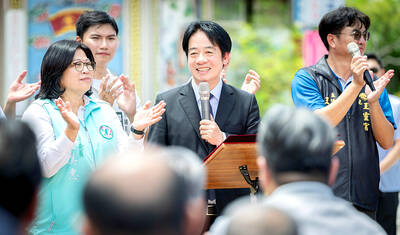
SIX SUBSIDIES: The monthly allowance for older farmers is to increase to NT$10,000, and NT$5,000 is to be given to homemakers under the national pension system, Lai said The government is to implement major welfare policies for disadvantaged groups, including raising the monthly allowance for older farmers to NT$10,000 and providing homemakers with NT$5,000 per month, President William Lai (賴清德) said yesterday. Lai made the remarks during a visit to Wangling Temple in Chiayi County, saying that the planned increases were being introduced amid economic growth and an increase in tax revenue. Touting a policy, in which the government plans to provide a monthly allowance of NT$5,000 for every child under the age of 18 in a bid to address Taiwan’s low birthrate, Lai said that if received for the


 RSS
RSS