


Freezing South American red fire ants in liquid nitrogen could be the most effective and most environmental friendly method to eradicate the species, scientists at Academia Sinica said yesterday.
The ants, which have cause the irrational fear among many Taiwanese people after they were discovered recently, have been the target of a government-funded eradication plan. Authorities have spent enormous sums money to tackle the infestation.
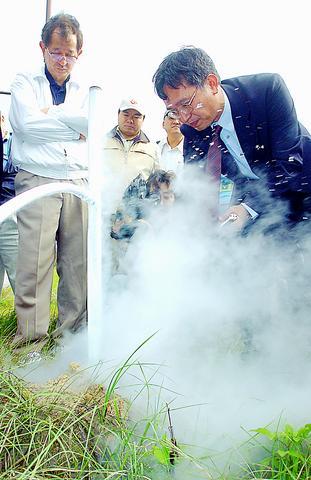
Two weeks ago, Academia Sinica President Lee Yuan-tseh (李遠哲) promised legislators that the nation's leading scientists would soon come up with an effective method to destroy the species, such as using liquid nitrogen to freeze the ants to death. At a press conference yesterday in Taipei, Lee said that liquid nitrogen's capacity to kill the ants has been convincingly demonstrated by physicists, zoologists and other researchers.
Over the last two weeks, Chen Yang-yuan (陳洋元), a research fellow at Academia Sinica's Institute of Physics has used liquid nitrogen to freeze red fire ant colonies on the campus of National Taipei University in Sansia, Taipei County.
"The species can't survive at temperatures lower than -17?C. They were all killed immediately after being exposed to liquid nitrogen, which cools things down to -196?C," Chen said.
To help make liquid nitrogen usable in killing ants, scientists have designed reusable iron tubes which cost only NT$150. When liquid nitrogen is injected into an ant colony, it will flow underground through the ants' tunnels, Chen said.
"Five minutes' worth of exposure to liquid nitrogen kills all ants inside a colony," Chen said.
Chen also said that the method would cause no harm to the environment because liquid nitrogen vaporizes and returns to the air.
After analyzing destroyed colonies, William Can-jen Maa (馬堪津), a research fellow at Academia Sinica's Institute of Zoology said all ants, including adults and larva, were killed by the nitrogen.
Maa said that about 24 hours after treating a colony certain types insects and other parasites began occupying the series of ant tunnels.
"Four or five days after the treatment, the ant hills of destroyed colonies will become fertilizer which can be used by other creatures," Maa said.
In addition to liquid nitrogen, Maa suggested using other environmental-friendly methods to tackle the problem of multiple queens that sometimes exist in a large ant colony.
"Originally in South America, there's one queen for each ant colony. Several decades after the fire ants migrated to the US, it is now observed that several queens can co-exist in an anthill," Maa said
Lin Chung-chi (林宗岐), an ant expert at the department of entomology at National Taiwan University, said that the conventional method of eradicating ants by using toxic chemicals might be replaced by liquid nitrogen because the negative impact it made on the ecosystem was limited.
However, cost is an issue. Using liquid nitrogen to destroy a single ant colony costs about NT$600 and leaves no environmental pollution. Using toxic pesticides costs only NT$10, but environmental pollution is a concern.
Tomorrow, the national fire ant task force will be launched to effectively control fire ants.
Yang Ping-shih (楊平世), a professor of entomology at National Taiwan University and head of the task force said yesterday he would probably use liquid nitrogen against fire ants on university campuses. So far, there have been more than 40 schools affected by fire ants.
Shao Kwang-tsao (邵廣昭), a zoologist at Academia Sinica's Research Center for Biodiversity, said that other methods involving ozone, infrared rays and could be used by the task force in near future.
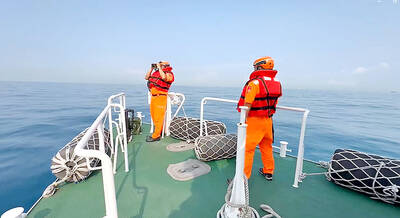
An increase in Taiwanese boats using China-made automatic identification systems (AIS) could confuse coast guards patrolling waters off Taiwan’s southwest coast and become a loophole in the national security system, sources familiar with the matter said yesterday. Taiwan ADIZ, a Facebook page created by enthusiasts who monitor Chinese military activities in airspace and waters off Taiwan’s southwest coast, on Saturday identified what seemed to be a Chinese cargo container ship near Penghu County. The Coast Guard Administration went to the location after receiving the tip and found that it was a Taiwanese yacht, which had a Chinese AIS installed. Similar instances had also

GOOD DIPLOMACY: The KMT has maintained close contact with representative offices in Taiwan and had extended an invitation to Russia as well, the KMT said The Chinese Nationalist Party (KMT) would “appropriately handle” the fallout from an invitation it had extended to Russia’s representative to Taipei to attend its international banquet last month, KMT Chairman Eric Chu (朱立倫) said yesterday. US and EU representatives in Taiwan boycotted the event, and only later agreed to attend after the KMT rescinded its invitation to the Russian representative. The KMT has maintained long-term close contact with all representative offices and embassies in Taiwan, and had extended the invitation as a practice of good diplomacy, Chu said. “Some EU countries have expressed their opinions of Russia, and the KMT respects that,” he

AMENDMENT: Contact with certain individuals in China, Hong Kong and Macau must be reported, and failure to comply could result in a prison sentence, the proposal stated The Chinese Nationalist Party (KMT) and the Taiwan People’s Party (TPP) yesterday voted against a proposed bill by Democratic Progressive Party (DPP) lawmakers that would require elected officials to seek approval before visiting China. DPP Legislator Puma Shen’s (沈伯洋) proposed amendments to the Act Governing Relations Between the People of the Taiwan Area and the Mainland Area (臺灣地區與大陸地區人民關係條例), stipulate that contact with certain individuals in China, Hong Kong and Macau should be reported, while failure to comply would be punishable by prison sentences of up to three years, alongside a fine of NT$10 million (US$309,041). Fifty-six voted with the TPP in opposition

VIGILANCE: The military is paying close attention to actions that might damage peace and stability in the region, the deputy minister of national defense said The People’s Republic of China (PRC) might consider initiating a hack on Taiwanese networks on May 20, the day of the inauguration ceremony of president-elect William Lai (賴清德), sources familiar with cross-strait issues said. While US Secretary of State Anthony Blinken’s statement of the US expectation “that all sides will conduct themselves with restraint and prudence in the period ahead” would prevent military actions by China, Beijing could still try to sabotage Taiwan’s inauguration ceremony, the source said. China might gain access to the video screens outside of the Presidential Office Building and display embarrassing messages from Beijing, such as congratulating Lai


 RSS
RSS