


Endangered black-faced spoonbills this winter returned to lagoons in Chiku, Tainan County, earlier than they did in previous years, and in greater numbers. The Wild Bird Federation Taiwan said yesterday that the nation's conservation efforts over the last decade have borne fruit, leading to a significant increase in the number of birds.
Beginning late last month, conservationists from diverse groups have systematically watched for black-faced spoonbills returning from the north to lagoons in Chiku, near the estuary of Tsengwen River, and nearby coastal wetlands.
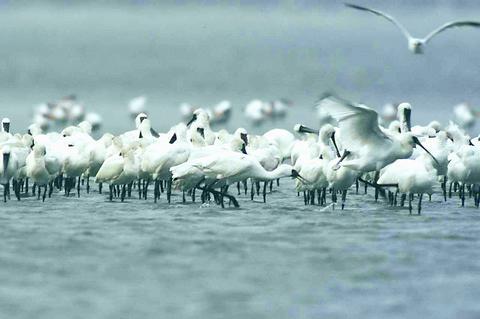
PHOTO: CHEN YI-MIN, TAIPEI TIMES
A survey jointly carried out by the Wild Bird Society of Tainan and the Tainan County Black-faced Spoonbill Conservation Society on Sunday shows that 168 black-faced spoonbills have arrived in Chiku. A bird was also sighted in the Ssu-tsao wetlands in Tainan City.
What especially excited bird conservationists was the appearance of two spoonbills that had been treated for botulism in Chiku last year. By identifying colored rings on the two spoonbills' legs, conservationists said that they were indeed Hsiaopao and Meiman, two of the 17 surviving spoonbills released early last year after receiving medical treatment over a number of weeks.
The birds seem to have completely regained their health, federation secretary-general Chiang Kuen-dar (
Chiang said that another spoonbill wearing colored rings had been released by conservationists in Hong Kong in 1998.
Chiang said that efforts made in the last decade by bird conservationists have helped to increase the population of the species.
The birds leave North Korea in winter for wetlands near river estuaries in the south. They have been sighted along the southeast coast of China, in Japan, Hong Kong, Macau, Taiwan, Vietnam and the Philippines.
According to a survey in January 1995, there were only 430 black-faced spoonbills globally at that time. However, a minimum of 1,069 black-faced spoonbills were counted in last year's census. Wintering census data from January this year shows that at least 1,206 black-faced spoonbills were observed.
"We've seen the population growing. As long as we keep preventing coastal wetlands from being destroyed, not only the spoonbill but also other endangered birds will be preserved," Chiang said.
According to the Tainan-based Wild Bird Society of Happy Family, the number of black-faced spoonbills in the area reached 223 yesterday. On the same date last year, there were only 78.
"The environment in Chiku remains ideal for these spoonbills," said Wang Jeng-jyi (王徵吉), a member of the society who has been taking pictures of the birds for 12 years.
A realtime water-quality monitoring system established by the Tainan County Government trans-fers data to the local environment bureau. The system was established when 73 black-faced spoonbills in Chiku died after being infected with botulism in December 2002.
In February and March last year, 17 surviving black-faced spoonbills were released at lagoons in Chiku after receiving medical treatment. Last winter, most of them were sighted by bird conservationists in Taiwan and Japan.
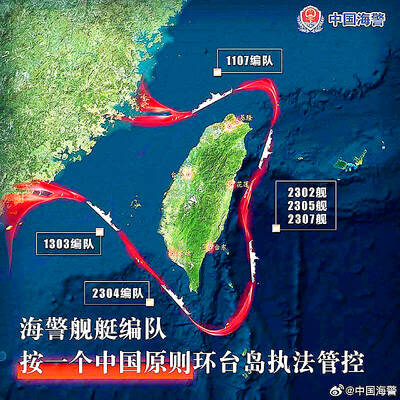
Taiwan would benefit from more integrated military strategies and deployments if the US and its allies treat the East China Sea, the Taiwan Strait and the South China Sea as a “single theater of operations,” a Taiwanese military expert said yesterday. Shen Ming-shih (沈明室), a researcher at the Institute for National Defense and Security Research, said he made the assessment after two Japanese military experts warned of emerging threats from China based on a drill conducted this month by the Chinese People’s Liberation Army’s (PLA) Eastern Theater Command. Japan Institute for National Fundamentals researcher Maki Nakagawa said the drill differed from the

‘WORSE THAN COMMUNISTS’: President William Lai has cracked down on his political enemies and has attempted to exterminate all opposition forces, the chairman said The legislature would motion for a presidential recall after May 20, Chinese Nationalist Party (KMT) Chairman Eric Chu (朱立倫) said yesterday at a protest themed “against green communists and dictatorship” in Taipei. Taiwan is supposed to be a peaceful homeland where people are united, but President William Lai (賴清德) has been polarizing and tearing apart society since his inauguration, Chu said. Lai must show his commitment to his job, otherwise a referendum could be initiated to recall him, he said. Democracy means the rule of the people, not the rule of the Democratic Progressive Party (DPP), but Lai has failed to fulfill his

A fugitive in a suspected cosmetic surgery fraud case today returned to Taiwan from Canada, after being wanted for six years. Internet celebrity Su Chen-tuan (蘇陳端), known as Lady Nai Nai (貴婦奈奈), and her former boyfriend, plastic surgeon Paul Huang (黃博健), allegedly defrauded clients and friends of about NT$1 billion (US$30.66 million). Su was put on a wanted list in 2019 when she lived in Toronto, Canada, after failing to respond to subpoenas and arrest warrants from the Taipei District Prosecutors’ Office. Su arrived at Taiwan Taoyuan International Airport at 5am today on an EVA Air flight accompanied by a

A rally held by opposition parties yesterday demonstrates that Taiwan is a democratic country, President William Lai (賴清德) said yesterday, adding that if opposition parties really want to fight dictatorship, they should fight it on Tiananmen Square in Beijing. The Chinese Nationalist Party (KMT) held a protest with the theme “against green communists and dictatorship,” and was joined by the Taiwan People’s Party. Lai said the opposition parties are against what they called the “green communists,” but do not fight against the “Chinese communists,” adding that if they really want to fight dictatorship, they should go to the right place and face


 RSS
RSS