


China's state media yesterday rejected President Chen Shui-bian's (陳水扁) Double Ten National Day call for peace talks with Beijing, saying it was "too insincere and vague to be treated seriously."
In a speech on Sunday, Chen urged China to begin peace talks so the rivals can avoid war.
"Because we can't com-municate, there's a lot of misunderstanding," Chen said.
As is often the case, the Beijing government has not responded directly to the overture.
However, the state-run China Daily, often used as a medium to communicate the country's policies, ran a front-page commentary citing researchers accusing Chen of "playing word games."
"The researchers said Chen's peace overture was `too insincere and too vague to be treated seriously by the mainland,'" it said.
It added, "He did not spell out what he meant by the proposal."
The China Daily said Chen's refusal to accept the "one China" principle, which it contends was accepted by both sides in a 1992 "consensus" would prevent progress toward a rapprochement.
"If he continues to reject the consensus reached at the 1992 meeting as he did before, his proposal will be tantamount to nonsense and will be of no use to help jump-start" talks, the paper cited Liu Guoshen, president of the Academy of Taiwan Research at Xiamen University, as saying. "It seems that Chen is playing with words again."
Wu Nengyuan (

Actor Darren Wang (王大陸) was sentenced to six months in prison, commutable to a fine, by the New Taipei District Court today for contravening the Personal Data Protection Act (個人資料保護法) in a case linked to an alleged draft-dodging scheme. Wang allegedly paid NT$3.6 million (US$114,380) to an illegal group to help him evade mandatory military service through falsified medical documents, prosecutors said. He transferred the funds to Chen Chih-ming (陳志明), the alleged mastermind of a draft-evasion ring, although he lost contact with him as he was already in detention on fraud charges, they said. Chen is accused of helping a

SECURITY: Starlink owner Elon Musk has taken pro-Beijing positions, and allowing pro-China companies to control Taiwan’s critical infrastructure is risky, a legislator said Starlink was reluctant to offer services in Taiwan because of the nation’s extremely high penetration rates in 4G and 5G services, the Ministry of Digital Affairs said yesterday. The ministry made the comments at a meeting of the legislature’s Transportation Committee, which reviewed amendments to Article 36 of the Telecommunications Management Act (電信管理法). Article 36 bans foreigners from holding more than 49 percent of shares in public telecommunications networks, while shares foreigners directly and indirectly hold are also capped at 60 percent of the total, unless specified otherwise by law. The amendments, sponsored by Chinese Nationalist Party (KMT) Legislator Ko

The eastern extension of the Taipei MRT Red Line could begin operations as early as late June, the Taipei Department of Rapid Transit Systems said yesterday. Taipei Rapid Transit Corp said it is considering offering one month of free rides on the new section to mark its opening. Construction progress on the 1.4km extension, which is to run from the current terminal Xiangshan Station to a new eastern terminal, Guangci/Fengtian Temple Station, was 90.6 percent complete by the end of last month, the department said in a report to the Taipei City Council's Transportation Committee. While construction began in October 2016 with an
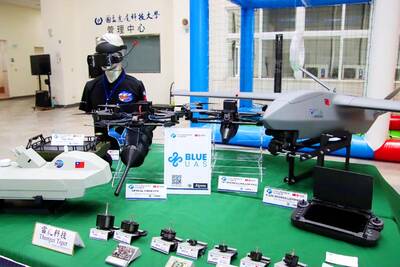
NON-RED SUPPLY: Boosting the nation’s drone industry is becoming increasingly urgent as China’s UAV dominance could become an issue in a crisis, an analyst said Taiwan’s drone exports to Europe grew 41.7-fold from 2024 to last year, with demand from Ukraine’s fight against Russian aggression the most likely driver of growth, a study showed. The Institute for Democracy, Society and Emerging Technology (DSET) in a statement on Wednesday said it found that many of Taiwan’s uncrewed aerial vehicle (UAV) sales were from Poland and the Czech Republic. These countries likely transferred the drones to Ukraine to aid it in its fight against the Russian invasion that started in 2022, it said. Despite the gains, Taiwan is not the dominant drone exporter to these markets, ranking second and fourth


 RSS
RSS