

"March 19 Shooting Truth Investi-gation Special Committee" (三一九槍擊事件真相調查特別委員會) has been the past week's most popular item on search engines as the nation's Internet surfers eagerly tracked the panel's mishaps.
For instance, the committee invited Tainan prosecutors who were investigating the March 19 assassination attempt on the president and vice president to its Taipei office for discussion of the case on Thursday. The prosecutors did not appear, so the committee tried to visit them in Tainan instead. On Friday, it invited the National Police Agency's Criminal Investigation Bureau Commissioner Hou You-yi (侯友宜) to the office. Hou did not appear.
Hou said that his decision not to appear before the committee was based on orders from the Cabinet.
"I was merely following my superior officer's order," Hou said. Hou said both the committee and and the police investigation could encounter problems if police and prosecutors transfer their investigation results to the controversial panel.
"For instance, we are currently working on more than ten tips that may possibly lead us to the arrest of the gunman. How do we `transfer' these tips to them, given that the committee does not have any professionals to continue our work? And since they have the authority to direct us, it is quite possible that they will ask us to continue our surveillance of certain suspects. If that is the case, then what is the meaning of the transfer?" Hou said.
The commissioner said that he wants to solve the case, and that he would definitely cooperate with the committee if all the allegations that the committee is illegal were resolved.
Minister of the Interior Su Jia-chyuan (
Su echoed Hou's concern, asking what would happen to evidence once the police and prosecutors transfer to the committee all the materials that they have collected and analyzed. Su asked how the evidence would be handled or protected, since there is no armed protection at the committee's office. Evidence in criminal cases must be kept in secure custody if it is to be used in subsequent legal procedures and trials.
Article 21-2 of the Criminal Code says "An act performed by a public official in the course of his duties and pursuant to the order of his superior is not punishable unless such public official knew that such an order was contrary to law."
Hou's concern highlights some of the major legal problems with the panel: Which government body does this committee belong to? Where does its budget come from? How long will the committee exist?
"Currently, the committee does not belong to any government bodies. It is something outside the government system, something outside the Constitution. That creates a lot of problems," said Examination Yuan President Yao Chia-wen (
Regarding its monetary problems, the committee's spokeswoman, Wang Ching-fong (
"We need at least approximately NT$10 million to maintain operations here. Currently we can only rely on our 17 members' own contributions to pay all necessary expenses, and we have paid at least NT$200,000," Wang said. "I really do not know how much longer we can do this. But this is unacceptable."
In response to Wang's claim, Chief Accountant Hsu Chang-yao (
Premier Yu Shyi-kun said that the statute stipulates that "the Cabinet shall not decline the committee's request for necessary funding." But it does not say that the committee is authorized for unlimited budget requests without further approval by the Legislative Yuan.
According to the statute's Article Eight, the committee has the authority to investigate all "potential criminal allegations" that may concern the March 19 assassination attempt. But the article does not clearly define what "potential criminal allegations" entail.
"What are potential criminal allegations? Does a committee member have the authority to indict anyone now that they can order around prosecutors, which is obviously against the Constitution?" Vice Minister of Justice Hsieh Wen-ding (
Minister of Justice Chen Ding-nan (
In the meantime, Article Nine says that committee members have the authorization to order or direct prosecutors and military prosecutors, but it does not say whether prosecutors shall quit whatever they are working on whenever they are requested to provide their services to committee members.
In addition, whoever is summoned and interrogated by committee members does not have the constitutional right to remain silent. "This is obviously against human rights," Chen said.
Article 13 says that "the case must be reheard if the court's decision does not match the commit-tee's investigation."
"I take that as a humiliation of all our prosecutors, judges and police officers as well as all fellow law enforcement officers," Chen said.
The minister said he is also afraid that this article may be used to meddle in two other legal cases filed by the pan-blue camps to request the high court to suspend or invalidate President Chen Shui-bian's (
While the president was meeting with Harvard Law Professor Jerome Cohen last Tuesday, he noted that the panel does not need search warrants, summonses or arrest warrants, and that it is authorized to command prosecutors and military prosecutors as well as police, military police and other law enforcement officers whose jobs concern national security and public order.
Currently, to carry out a raid or an arrest, all law enforcement officials require warrants from prosecutors or approved by judges. The committee has the authority to interrogate suspects without first seeking a warrant, and the suspects have none of their ordinary constitutional protections.
In addition, the statute specifies that those who do not cooperate with these sweeping powers can be fined up to NT$1 million or sentenced to two to three years in jail and banned from leaving the country. By law, the request to ban somebody from leaving the country needs to be filed by prosecutors and approved by judges before the order is carried out.
"This is ridiculous," the president said. "Taiwan is a democratic country, but we still have such an outrageous law that is against human rights."
Despite being criticized, Wang said that it is the committee's goal to solve the case of the assassination attempt. Since the panel was created by a law passed by the Legislative Yuan, she demanded that everyone follow, respect and trust in the committee.
"We will keep inviting related personnel for interrogation. If they do not come, we will visit them in person," Wang said.
While the pan-green camp is trying to suspend the statute by filing a request for a Constitutional interpretation from the nation's grand justices, they also appended a request for a temporary injunction against it, and hoped that this would suspend the committee's actions before the interpretation is made.
The grand justices have scheduled debates over the request for a temporary injunction on Oct. 14, Oct. 27 and Oct. 29.
The debates will concern what authorization the committee has, whether the Legislative Yuan's authorization to make new laws has constitutional limits, whether the Legislative Yuan is authorized to empower the panel, whether the statute violates the Constitution and whether it compromises duly constituted authorities' jurisdictions.
The grand justices invited to the debates five representatives on behalf of the applicant for the temporary injunction request, five lawmakers, three Control Yuan members, two officials from the Ministry of Justice, two from the Ministry of the Interior and two from the Judges' Association.

‘FRIENDSHIP FLEET’: A CGA official is scheduled to meet with the president of the Pacific nation, while one of the ships is to host a banquet and National Day event Two Coast Guard Administration (CGA) patrol vessels have docked at Malakal Harbor in Palau as part of an expedition exercise and diplomatic visit, during which a senior official is expected to meet with Palauan President Surangel Whipps Jr, the agency said yesterday. The two vessels, the 4,000-tonne-class Chiayi and the 1,000-tonne-class Penghu, set sail for Palau from Taiwan last week and arrived on Tuesday at Malakal Harbor, the CGA’s Fleet Branch said in a statement. The journey marks the second time the CGA has dispatched a “friendship fleet” to another country, after it sent its first-ever goodwill fleet, comprising the Hualien and
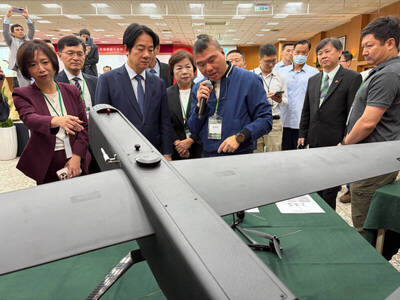
Two executives of drone supplier Jiin Ming Industry Co (錦明實業) have been detained and held incommunicado over the company's alleged use of prohibited China-made chips and camera lenses in drones supplied under recent military contracts, the Taoyuan District Prosecutors' Office said today. In a statement, prosecutors said they raided the offices of Jiin Ming — headquartered in Taoyuan — as well as those of its subsidiaries and its suppliers on Thursday last week. The raids followed a report that the company had breached its procurement contracts by putting the prohibited components into drones delivered to the military. During the raids, prosecutors summoned

South Korean boy band BigBang drew 120,000 fans to three concerts at Taipei Dome from Friday through yesterday, as the band thanked them for their support over their 20-year career. The Taipei Dome concerts were part of BigBang's "2026-2027 World Tour XX: Cosmos." Friday's concert was BigBang's first performance in Taiwan in 11 years. During the encore, group leader G-Dragon (GD) shouted "I love you" in Chinese and said he was especially happy to perform in Taiwan with bandmates Taeyang and Daesung. "Taipei, I'm very grateful to you all," GD said in Chinese, asking fans to wait for the band's return. Daesung thanked
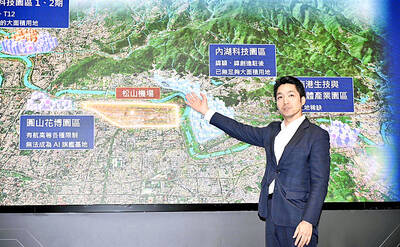
DETAILED PLAN NEEDED: Relocating the airport would affect not just travelers, but also undermine national defense and emergency medical services, a legislator said Taipei Mayor Chiang Wan-an (蔣萬安) yesterday proposed relocating Taipei International Airport (Songshan airport) and turning the site into an artificial intelligence (AI) park, drawing opposition from politicians across party lines. Chiang’s plan would turn the 300 hectares into an AI park featuring tech clusters, residential communities and green space. The industrial cluster would host 200 domestic enterprises, generate NT$12 trillion (US$376.47 billion) in output, and accommodate 65,000 jobs and 35,000 residents, he said. Cabinet spokeswoman Michelle Lee (李慧芝) said the Executive Yuan was surprised by the announcement, as the Taipei City Government did not discuss the proposal with the central government before making


 RSS
RSS