


Cross-strait relations and localization still remain thorny reform issues for the Chinese Nationalist Party (KMT), which has been incapable of offering firm and clear responses. These problems were clear yesterday during a symposium on party's future held by a group of KMT politicians.
The Taiwan New Hope Alliance (
The session yesterday was designed to focus on the party's positioning, and most people concentrated on discussing the party's policy on Taiwan's status and cross-strait relations.
Legislative Speaker and KMT Vice Chairman Wang Jin-pyng (
"I have often mulled over what the pro-localization approach is, and I have asked many about it and got many different answers," Wang said.
"Finally I have decided that the best approach for the KMT in the future would be to pursue the maximum interests for the country and the people, and to strive for national development, stability and peace between the two sides of the Taiwan Strait," Wang said.
Wang proposed future cross-strait relations should be defined as a relation between the "free area" and "the mainland area," as mapped out by the Constitution and consistent with the status quo.
"The Constitution uses the words `free area,' and `mainland area,' and the Statute Governing the Relations Between the People of the Taiwan Area and the Mainland Area (兩岸人民關係條例) also uses the words such as `Taiwan area' and `mainland area,'" Wang said.
"The two sides should first create an indefinite space both can accept so both sides can relax and try to seek a peaceful solution," Wang said.
Chang Zu-kang (
"To restart, we should speak the name `ROC' loudly, to maintain the ROC's dignity and sovereignty, so that we can fight the independence group effectively on cross-strait relations, and separate ourselves from the `Taiwan Republic' ideal proposed by the independence group," Chang said.
"We should also tell the public clearly that the KMT is a pro-localization group, and try to develop pluralism to replace a closed-minded localization culture," he said.
The host, KMT legislator and Taiwan New Hope Alliance member Lo Shih-hsiung, stated his determination to make reform come about.
"We should not just talk about the reform policies, but we have to carry them out -- otherwise our opponents may laugh at us and say this talk is just election tricks," Lo said.
Meanwhile, three Taiwan Solidarity Union (TSU) legislative candidates appeared outside the convention hall to lampoon the Taiwan New Hope alliance, changing "New Hope" to "No Hope."
"The alliance chickened out at the voting for the reconsideration request on the March 19 Shooting Truth Investigation Special Committee Statute (
Huang, present with Chiu Teh-hung (
Ling, the TSU legislative candidate in Chiayi City, later also got into an argument with Chang about Taiwan's national title when Ling went inside the hall to attend the symposium and asked questions during the question-and-answer session.
"The ROC is disappearing, and it is a false identity given by others while Taiwan is the real identity of the country," Ling said.
But Chang disagreed with Ling's opinion, and said Ling was trying to judge others with arbitrary values.
"It is the other way around: Taiwan is a virtual existence, and the ROC the real one," Chang said.
The symposium's ideas were further attacked when Democratic Progressive Party Legislator Shen Fu-hsiung criticized the KMT's ills as incurable and its visions as ineffective remedies.
"The KMT is incurable now, and from what you said earlier, you are talking about using aspirin to cure a patient who needs surgery," Shen said.
"Although Legislative Speaker Wang proposed the `two areas' discourse to define cross-strait relations, while it is legal and constitutional and takes the threat from PRC into major consideration, his discourse would fail to win any election," he said.
"What the KMT needs now is not mild changes, because time is not with the KMT. What the KMT needs now is an epiphany, so you can immediately say and act as a real pro-localization party," Shen said.
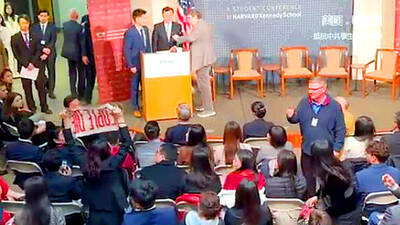
A group of Taiwanese-American and Tibetan-American students at Harvard University on Saturday disrupted Chinese Ambassador to the US Xie Feng’s (謝鋒) speech at the school, accusing him of being responsible for numerous human rights violations. Four students — two Taiwanese Americans and two from Tibet — held up banners inside a conference hall where Xie was delivering a speech at the opening ceremony of the Harvard Kennedy School China Conference 2024. In a video clip provided by the Coalition of Students Resisting the CCP (Chinese Communist Party), Taiwanese-American Cosette Wu (吳亭樺) and Tibetan-American Tsering Yangchen are seen holding banners that together read:

UNAWARE: Many people sit for long hours every day and eat unhealthy foods, putting them at greater risk of developing one of the ‘three highs,’ an expert said More than 30 percent of adults aged 40 or older who underwent a government-funded health exam were unaware they had at least one of the “three highs” — high blood pressure, high blood lipids or high blood sugar, the Health Promotion Administration (HPA) said yesterday. Among adults aged 40 or older who said they did not have any of the “three highs” before taking the health exam, more than 30 percent were found to have at least one of them, Adult Preventive Health Examination Service data from 2022 showed. People with long-term medical conditions such as hypertension or diabetes usually do not
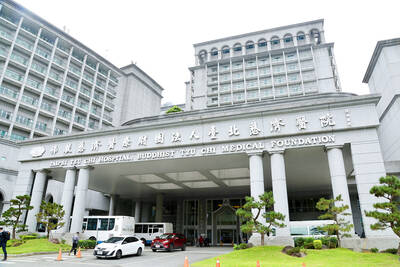
POLICE INVESTIGATING: A man said he quit his job as a nurse at Taipei Tzu Chi Hospital as he had been ‘disgusted’ by the behavior of his colleagues A man yesterday morning wrote online that he had witnessed nurses taking photographs and touching anesthetized patients inappropriately in Taipei Tzu Chi Hospital’s operating theaters. The man surnamed Huang (黃) wrote on the Professional Technology Temple bulletin board that during his six-month stint as a nurse at the hospital, he had seen nurses taking pictures of patients, including of their private parts, after they were anesthetized. Some nurses had also touched patients inappropriately and children were among those photographed, he said. Huang said this “disgusted” him “so much” that “he felt the need to reveal these unethical acts in the operating theater
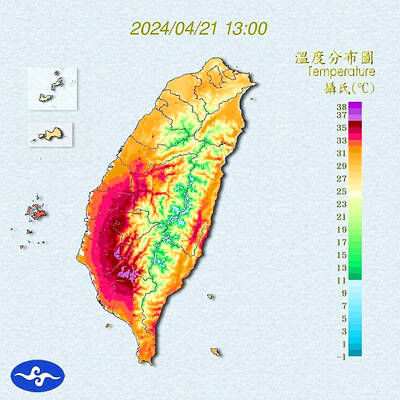
Heat advisories were in effect for nine administrative regions yesterday afternoon as warm southwesterly winds pushed temperatures above 38°C in parts of southern Taiwan, the Central Weather Administration (CWA) said. As of 3:30pm yesterday, Tainan’s Yujing District (玉井) had recorded the day’s highest temperature of 39.7°C, though the measurement will not be included in Taiwan’s official heat records since Yujing is an automatic rather than manually operated weather station, the CWA said. Highs recorded in other areas were 38.7°C in Kaohsiung’s Neimen District (內門), 38.2°C in Chiayi City and 38.1°C in Pingtung’s Sandimen Township (三地門), CWA data showed. The spell of scorching


 RSS
RSS