


The Olympics are the setting for many tales of athletes striving for victory. Some meet with success, but for others, the years of training and deprivation only lead to defeat. For Taiwan's Olympic delegation at Athens 2004, the stories of table tennis star Chuan Chih-yuan (
Chuan, 23, has been fighting the odds from the beginning.
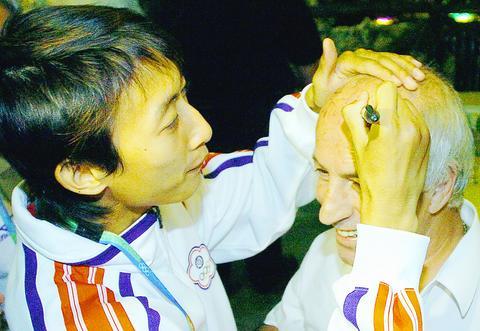
PHOTO: LIN CHENG-KUN, TAIPEI TIMES
At only 169cm tall, he is short for a table tennis player, and he does not have the telegenic good looks of compatriot Chiang Peng-luung (蔣澎龍), the darling of Taiwan's table tennis scene. Chuang didn't even seem to have any natural talent for the game, and it was not until his victory in the 2002 Pro Tour that he was seriously thought of as a medal prospect and picked up by Taiwan's table tennis establishment.
Even so, he was generally overshadowed by the more high-profile baseball, aekwondo and archery squads.
The son of Lee Kuei-mei (李貴美), a former national team table tennis player, Chuang had always wanted to become a table tennis star. Although his mother believed he lacked the natural abilities of a top player, his dedication to the sport was unshakeable. He dedicated his life to training, giving himself no time for enjoyment, rest or girlfriends.
In March 2000, Chuan, who knows a little bit of English, went to Germany alone to join a German table tennis club, starting a lonely journey of more than three years. He attended numerous of competitions without any company, and most times his coach's seat was empty.
"Loneliness could not defeat my son; it just made him more dedicated. I would sometimes ask him to stop practicing, to go out with friends, to go dancing, go for a drive ... but he would always shake his head and continue with his practice," said Lee.
Now ranked fifth in the world, Chuan is regarded as one of the young stars of table tennis along with China's Wang Hao (
In the quarterfinals, Chuan came face to face with Wang, who eventually went on to win the silver in the men's singles. In previous competitions, Chuang had defeated Wang in three out of four matches, but at Athens, Wang had changed his game to get the better of Chuan's fearsome smash.
Chuan went into his game with Wang feeling confident, and at one point led 2-1. At this point Wang's coach, Liu Kuo-liang (
According to Chen Shi-sung (
"Despite his world-class technique, he couldn't win the initiative from Wang," Chen said. "The Chinese coach had picked out Chuan's weak points and made Wang boldly forgo his usual game, focusing on Chuan's right side instead. This is what gave him the victory."
Although Chuan will probably not get any huge endorsement deals, his dedication to the sport has earned him his opponents' respect. With more support from the home crowd, Chuan might well fulfill his promise in four years.
Another quiet competitor is shooter Lin Yi-chun (
"Archers and shooters both face this kind of problem. They get lost in their own thoughts, fearing to lose the medal they haven't even won yet, and this easily leads to a breakdown in concentration," said Hung Tsung-min (
"With the government offering huge financial bonuses for medal winners, with your eye on the target, if you think about the one shot being worth US$340,000, wouldn't your hand shake?" Hung said.
To help solve this problem, coach Tseng Chao-hsiung (曾兆雄) brought in hypnotist Hsu Ming (徐明) to get to the bottom of Lin's depression. After arriving in Athens, Lin's psychological problems took on a physical dimension, and despite the intense Athens heat she insisted on sleeping with three blankets. On the field she was incapable of shutting out the distraction from ongoing work in the stadium, and put in some of her weakest performances ever.
The situation was made even worse when Hsu's daughter jumped to her death in Taiwan. Although Hsu is famous for having helped many entertainment stars and celebrities overcome emotional problems, he had been unable to prevent his own daughter's suicide. Despite this, Hsu stayed on in Athens to counsel Lin, but the shadow of death seemed to engulf her, adding to the pressure on the already depressed athlete.
In the qualifying rounds, Lin earned a better score than she did four years ago in Sydney. However, her performance was not good enough due to errors, and she was eliminated without even making it into the second round.
Hung Tsung-min said that Lin's experience, as well as the narrow losses by Taiwan's archers, indicate that sports officials should pay more attention to stress among athletes, lest more hopefuls be hampered in their efforts to give their best performances.
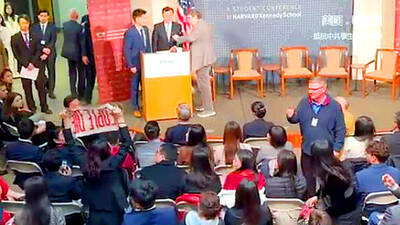
A group of Taiwanese-American and Tibetan-American students at Harvard University on Saturday disrupted Chinese Ambassador to the US Xie Feng’s (謝鋒) speech at the school, accusing him of being responsible for numerous human rights violations. Four students — two Taiwanese Americans and two from Tibet — held up banners inside a conference hall where Xie was delivering a speech at the opening ceremony of the Harvard Kennedy School China Conference 2024. In a video clip provided by the Coalition of Students Resisting the CCP (Chinese Communist Party), Taiwanese-American Cosette Wu (吳亭樺) and Tibetan-American Tsering Yangchen are seen holding banners that together read:

UNAWARE: Many people sit for long hours every day and eat unhealthy foods, putting them at greater risk of developing one of the ‘three highs,’ an expert said More than 30 percent of adults aged 40 or older who underwent a government-funded health exam were unaware they had at least one of the “three highs” — high blood pressure, high blood lipids or high blood sugar, the Health Promotion Administration (HPA) said yesterday. Among adults aged 40 or older who said they did not have any of the “three highs” before taking the health exam, more than 30 percent were found to have at least one of them, Adult Preventive Health Examination Service data from 2022 showed. People with long-term medical conditions such as hypertension or diabetes usually do not
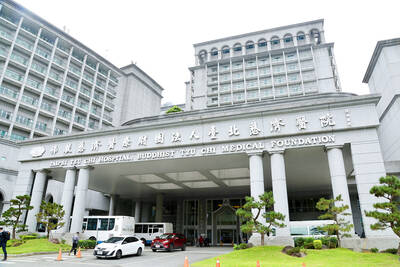
POLICE INVESTIGATING: A man said he quit his job as a nurse at Taipei Tzu Chi Hospital as he had been ‘disgusted’ by the behavior of his colleagues A man yesterday morning wrote online that he had witnessed nurses taking photographs and touching anesthetized patients inappropriately in Taipei Tzu Chi Hospital’s operating theaters. The man surnamed Huang (黃) wrote on the Professional Technology Temple bulletin board that during his six-month stint as a nurse at the hospital, he had seen nurses taking pictures of patients, including of their private parts, after they were anesthetized. Some nurses had also touched patients inappropriately and children were among those photographed, he said. Huang said this “disgusted” him “so much” that “he felt the need to reveal these unethical acts in the operating theater
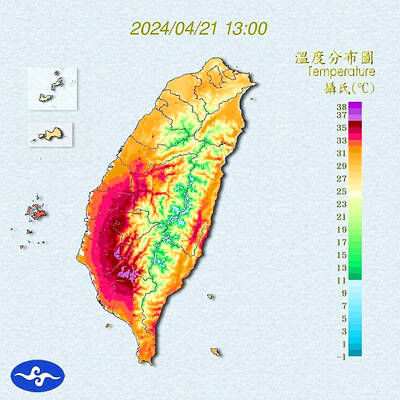
Heat advisories were in effect for nine administrative regions yesterday afternoon as warm southwesterly winds pushed temperatures above 38°C in parts of southern Taiwan, the Central Weather Administration (CWA) said. As of 3:30pm yesterday, Tainan’s Yujing District (玉井) had recorded the day’s highest temperature of 39.7°C, though the measurement will not be included in Taiwan’s official heat records since Yujing is an automatic rather than manually operated weather station, the CWA said. Highs recorded in other areas were 38.7°C in Kaohsiung’s Neimen District (內門), 38.2°C in Chiayi City and 38.1°C in Pingtung’s Sandimen Township (三地門), CWA data showed. The spell of scorching


 RSS
RSS