


Taipei Times: How will China's democratic development influence cross-strait relations?
Carl Gershman: If you have more democracy on the mainland, it would be much easier to work out a proper relation between Taiwan and China.
It is not for me to say how those things should be worked out, but I do suggest that there are various ways in which you can work out federal or confederal relationships, like the Europe today.
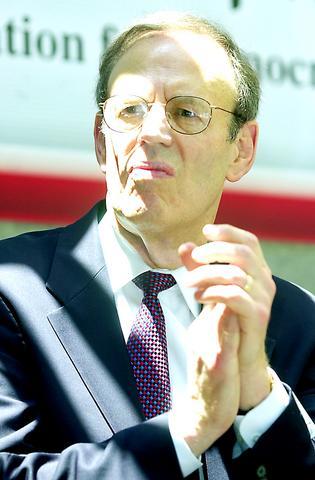
PHOTO: SEAN CHAO, TAIPEI TIMES
Look at the difference with democracy in Europe today and the way it was in the 19th century. Look at the relations between France and Germany. These countries remain independent and sovereign but they also have a growing federal relationship through the EU.
Democracy allows these forms of political relationship to develop with the independence of the different parts not challenged. They can find ways of living and working together and being part of a common political unit. It is only possible for democracies.
One of the preconditions to become a part of the EU today is democracy. Poland, Hungary, the Czech Republic and Baltic countries could become part of the EU because they are democratic.
I could imagine that as China becomes more democratic, it would be possible to work out some appropriate federal or confederal relationship that would deal with the political problem that we should allow people to have their own sense of sovereignty and independence.
TT: Fifteen years after the Tiananmen Square massacre, the Chinese government has managed to quieten dissenting voices, partly through giving them wealth. Are the Chinese people forgetting the event?
Gershman: It is inevitable that an authoritarian government would seek to use prosperity as a means of containing political differences.
But I don't think, in the long run, this can be a successful strategy because prosperity ultimately involves the development of a stronger middle class, a stronger intellectual class.
As you develop these new social and class formations, inevitably people are going to want to speak, express themselves and help influence the direction of the country.
This ultimately will involve some forms of freedom and democracy.
What happened in Tiananmen Square cannot in the long term be forgotten. It is embedded in the consciousness and it will just come back. There is no way that it can be eliminated. It has to be dealt with.
My hope is that what happened in Tiananmen Square will be integrated in the way that helps to reconcile the differences in China.
TT: You said Taiwan's democratic experience can help China develop its democracy. Given the current cross-strait tensions, how much can the Chinese people, who widely regard Chen's government as a separatist regime, accept lessons from Taiwan's democracy?
Gershman: First of all, I don't think this can be done alone. It's a matter of dialogue and exchange of views. Simply starting a discussion about democracy is very important to China. They made progress in China in the past. While China develops economically, many people feel that it needs to develop politically as well. Political discussion is going on now in China. If China can discuss that question, there can also be the involvement of people in Taiwan in that discussion. People from the US and all over the world are talking about democracy in China.
TT: Can you suggest some practical ways for Taiwan to help China's democracy?
Gershman: I think it is something this foundation [TFD] is going to help develop. Taiwan has made a very important and difficult transition from an authoritarian regime to democracy. Yet it was a peaceful transition.
People who are associated with the old authoritarian government are now involved in the new democracy. That is an interesting experience. That should be a great interest to people on the mainland as to how it can be done.
TT: Has China's control of its media affected its people's perception of democracy in Taiwan?
Gershman: The relationship of democracy to the future of China is an essential subject. We should be discussing how the development of democracy in China will affect the future of the relationship between China, Taiwan, Hong Kong and so forth.
As democracy develops, there could be discussions as to how to the development of democracy on the mainland could have affected the relations between China and Taiwan.
Maybe it is possible to have a closer relationship between China and Taiwan as democracy develops on the mainland. I don't see democracy being a problem for relations between China and Taiwan. I think it is an opportunity because as China becomes more democratic, the possibility is of a new relationship between China and Taiwan.
TT: But after the March presidential election here, the Chinese media spent much of its coverage on the chaos caused by the election results. It seems they wanted to portray democracy as a potential origin of instability.
Gershman: You have the rule of law. As [late US] President Ronald Reagan said in his Westminster Address, democracy is a way to resolve conflicts peacefully. That is what democracy is.
Democracy does not mean there won't be conflict. There will be conflict. But the whole purpose of democracy is to be able to resolve conflicts through the rule of law peacefully. That's what happened in Taiwan.
Obviously there could be disagreement, but that disagreement is not chaos. Disagreement is natural. We have sharp disagreement in the US, but we don't have chaos.
TT: The Chinese media's focus on Taiwanese society's conflicts put Taiwan's democracy on a very negative light. Will that affect the Chinese people's pursuit for democracy?
Gershman: It probably can be the case that the people who preside over an authoritarian order will try to make the case that it is better than democracy and that it is more orderly.
There are some authoritarian rulers who warn democracy will bring chaos. This is quite normal. But it [China] cannot stop change. China is a changing country. China is becoming increasingly diversified economically.
As it develops economically, there are now a developing middle class and business class. They are even being invited to join the Communist Party. As you develop and diversify, you have to find new institutions to be able to accommodate the differences. There is no way to do it other than democracy and to try to have orderly political population.
TT: You lauded Taiwan as a beacon for Asia's democracy. However, when Taiwan held its first ever national referendum in March, it encountered enormous international pressure, including that from Asian countries, as a result of China's diplomatic efforts.
Gershman: The referendum is not the essence of democracy. It is simply one expression. Taiwan has very practical problems to deal with in terms of relations with the mainland. It's going to have worked out this relationship. This is a practical question, not a fundamental question.
The prospect for the long term is the development of democracy on the mainland. That is going to happen over time. The challenge is to maintain peace as democracy develops.
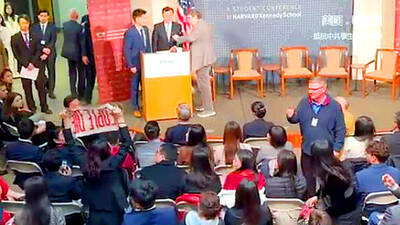
A group of Taiwanese-American and Tibetan-American students at Harvard University on Saturday disrupted Chinese Ambassador to the US Xie Feng’s (謝鋒) speech at the school, accusing him of being responsible for numerous human rights violations. Four students — two Taiwanese Americans and two from Tibet — held up banners inside a conference hall where Xie was delivering a speech at the opening ceremony of the Harvard Kennedy School China Conference 2024. In a video clip provided by the Coalition of Students Resisting the CCP (Chinese Communist Party), Taiwanese-American Cosette Wu (吳亭樺) and Tibetan-American Tsering Yangchen are seen holding banners that together read:

UNAWARE: Many people sit for long hours every day and eat unhealthy foods, putting them at greater risk of developing one of the ‘three highs,’ an expert said More than 30 percent of adults aged 40 or older who underwent a government-funded health exam were unaware they had at least one of the “three highs” — high blood pressure, high blood lipids or high blood sugar, the Health Promotion Administration (HPA) said yesterday. Among adults aged 40 or older who said they did not have any of the “three highs” before taking the health exam, more than 30 percent were found to have at least one of them, Adult Preventive Health Examination Service data from 2022 showed. People with long-term medical conditions such as hypertension or diabetes usually do not
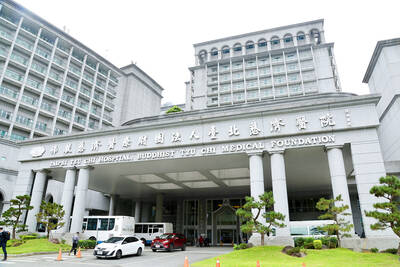
POLICE INVESTIGATING: A man said he quit his job as a nurse at Taipei Tzu Chi Hospital as he had been ‘disgusted’ by the behavior of his colleagues A man yesterday morning wrote online that he had witnessed nurses taking photographs and touching anesthetized patients inappropriately in Taipei Tzu Chi Hospital’s operating theaters. The man surnamed Huang (黃) wrote on the Professional Technology Temple bulletin board that during his six-month stint as a nurse at the hospital, he had seen nurses taking pictures of patients, including of their private parts, after they were anesthetized. Some nurses had also touched patients inappropriately and children were among those photographed, he said. Huang said this “disgusted” him “so much” that “he felt the need to reveal these unethical acts in the operating theater
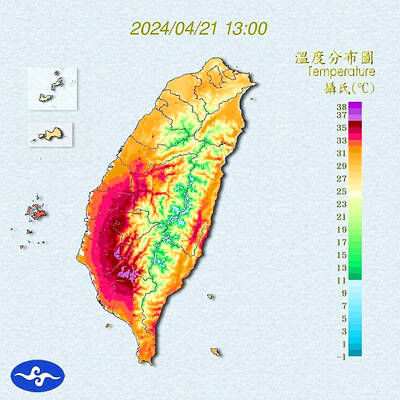
Heat advisories were in effect for nine administrative regions yesterday afternoon as warm southwesterly winds pushed temperatures above 38°C in parts of southern Taiwan, the Central Weather Administration (CWA) said. As of 3:30pm yesterday, Tainan’s Yujing District (玉井) had recorded the day’s highest temperature of 39.7°C, though the measurement will not be included in Taiwan’s official heat records since Yujing is an automatic rather than manually operated weather station, the CWA said. Highs recorded in other areas were 38.7°C in Kaohsiung’s Neimen District (內門), 38.2°C in Chiayi City and 38.1°C in Pingtung’s Sandimen Township (三地門), CWA data showed. The spell of scorching


 RSS
RSS