


The film The Day After Tomorrow, in which abrupt climate change thrusts the world into chaos, has triggered discussion about climate change in Taiwan and disputes about the nation's policies on emissions of greenhouse gases.
Legislators, environmentalists and academics have joined a chorus of voices demanding measures to tackle climate change and steps to increase people's awareness of the problem.
Early this month, the Environmental Protection Administration (EPA) announced that it would at the end of this year sign formal memorandums of understanding with business associations in the semiconductor and thin-film transistor liquid-crystal display industries. The memos are intended to curb emissions of perfluorocarbons (PFCs).
Officials have said that the EPA will help firms in these industries reach emission goals for PFCs by offering up-to-date information and keeping track of greenhouse gas emissions.
EPA Deputy Administrator Tsay Ting-kuei (
Leu Horng-guang (
However, last week, legislators and environmentalists argued that PFCs are only one of six greenhouse gas groups covered under the Kyoto Protocol.
The UN treaty sets targets for reducing emissions of greenhouse gases in industrialized countries and sets country-specific measures for reducing emissions.
To effectively limit emissions of greenhouse gases produced by industries that consume a lot of energy, both legislators and activists says that the government must make changes to the nation's industrial structure.
"Taiwan should phase out industries that emit carbon dioxide during the production process, including cement production, lime production, steel-making and others," Sam Lin (
Environmentalists say that emissions of carbon dioxide have to be cut severely in order for the nation to avoid severe criticism in the near future.
The amount of carbon dioxide emitted in Taiwan increased dramatically between 1990 and 2000 -- with 272 million tonnes being emitted in 2000 compared to 160 million tonnes in 1990, for an increase of 70 percent.
Taiwan produces more carbon dioxide emissions than all but 21 nations, despite its modest size.
Eric Liou (
The treaty aims, between 2008 and 2012, to reduce greenhouse gases from developed countries to a level 5 percent below 1990 levels.
"Even though Taiwan is not a UN member, it should not avoid the responsibilities that are shared by the entire global village," Liou said.
Liou said that so far the EPA has not developed a strategy to effectively limit the top 100 sources of carbon dioxide in Taiwan.
"Does the government have the guts to limit influential firms' emissions of carbon dioxide, such as China Steel (
According to Democratic Progressive Party Legislator Eugene Jao (
"I don't think the EPA has faced up to the serious problems the nation will encounter if it doesn't even consider emissions of greenhouse gases when it performs environmental impact assessment reports for new development projects," Jao said.
EPA officials said that global treaties on climate change had been closely followed since the 1990s and that policies would be slightly revised to effectively control emissions.
"At this very moment, raising people's awareness is more important," Leu said.
Taking advantage of the release of The Day After Tomorrow, EPA Administrator Chang Juu-en (張祖恩) last week invited to a screening more than 100 experts on air pollution prevention, representatives of environmental groups and legislators interested in promoting sustainable development.
Also, the EPA distributed a pamphlet teaching residents how to alter their energy-use habits in order to reduce greenhouse gas emissions, called Let's work together to slow down the warming-up of Earth.
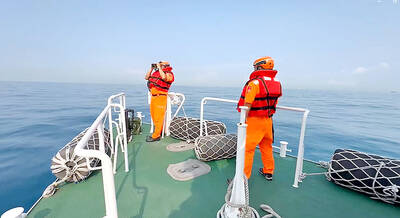
An increase in Taiwanese boats using China-made automatic identification systems (AIS) could confuse coast guards patrolling waters off Taiwan’s southwest coast and become a loophole in the national security system, sources familiar with the matter said yesterday. Taiwan ADIZ, a Facebook page created by enthusiasts who monitor Chinese military activities in airspace and waters off Taiwan’s southwest coast, on Saturday identified what seemed to be a Chinese cargo container ship near Penghu County. The Coast Guard Administration went to the location after receiving the tip and found that it was a Taiwanese yacht, which had a Chinese AIS installed. Similar instances had also
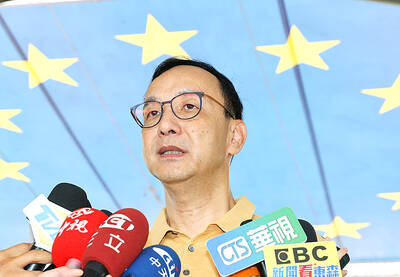
GOOD DIPLOMACY: The KMT has maintained close contact with representative offices in Taiwan and had extended an invitation to Russia as well, the KMT said The Chinese Nationalist Party (KMT) would “appropriately handle” the fallout from an invitation it had extended to Russia’s representative to Taipei to attend its international banquet last month, KMT Chairman Eric Chu (朱立倫) said yesterday. US and EU representatives in Taiwan boycotted the event, and only later agreed to attend after the KMT rescinded its invitation to the Russian representative. The KMT has maintained long-term close contact with all representative offices and embassies in Taiwan, and had extended the invitation as a practice of good diplomacy, Chu said. “Some EU countries have expressed their opinions of Russia, and the KMT respects that,” he
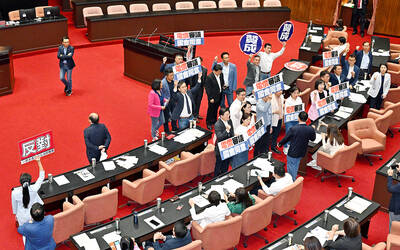
AMENDMENT: Contact with certain individuals in China, Hong Kong and Macau must be reported, and failure to comply could result in a prison sentence, the proposal stated The Chinese Nationalist Party (KMT) and the Taiwan People’s Party (TPP) yesterday voted against a proposed bill by Democratic Progressive Party (DPP) lawmakers that would require elected officials to seek approval before visiting China. DPP Legislator Puma Shen’s (沈伯洋) proposed amendments to the Act Governing Relations Between the People of the Taiwan Area and the Mainland Area (臺灣地區與大陸地區人民關係條例), stipulate that contact with certain individuals in China, Hong Kong and Macau should be reported, while failure to comply would be punishable by prison sentences of up to three years, alongside a fine of NT$10 million (US$309,041). Fifty-six voted with the TPP in opposition
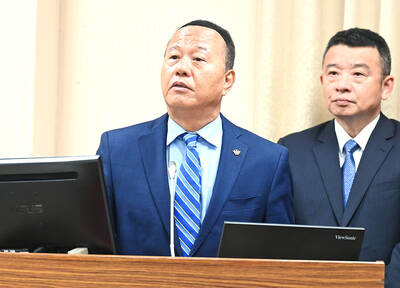
VIGILANCE: The military is paying close attention to actions that might damage peace and stability in the region, the deputy minister of national defense said The People’s Republic of China (PRC) might consider initiating a hack on Taiwanese networks on May 20, the day of the inauguration ceremony of president-elect William Lai (賴清德), sources familiar with cross-strait issues said. While US Secretary of State Anthony Blinken’s statement of the US expectation “that all sides will conduct themselves with restraint and prudence in the period ahead” would prevent military actions by China, Beijing could still try to sabotage Taiwan’s inauguration ceremony, the source said. China might gain access to the video screens outside of the Presidential Office Building and display embarrassing messages from Beijing, such as congratulating Lai


 RSS
RSS