


Wise Taiwan politicians should take effective measures to promote national reconciliation, Control Yuan President Fredrick Chien (錢復) said in Washington Friday.
Chien, who attended the state funeral of the late US President Ronald Reagan on behalf of Taiwan President Chen Shui-bian (陳水扁) earlier in the day, made the appeal while meeting with a group of Taiwan journalists stationed in the US capital.
Chien, a former career diplomat who served as the Taiwan's minister of foreign affairs from 1990 through 1996, encountered a demonstration launched by supporters of Taiwan's opposition "pan-blue alliance" when he arrived in Washington on Thursday as President Chen's special envoy to Reagan's funeral.
The "pan-blue alliance" ticket of Chinese Nationalist Party (KMT) Chairman Lien Chan (連戰) and People First Party (PFP) Chairman James Soong (宋楚瑜) lost to incumbent President Chen and Vice President Annette Lu (呂秀蓮) by a razor-thin margin of 29,518 votes, or 0.228 percent of the more than 13 million ballots cast in the March 20 presidential election.
Lien and Soong have so far refused to concede defeat and have filed two lawsuits to challenge the Chen-Lu ticket's re-election victory and to demand an annulment of the election so that a new one can be held.
With Chen's consent, a full-scale judicial recount of the ballots cast in the bitterly fought election has been completed. No solid evidence has been found to back up the alliance's claim that the election was rigged. The Taiwan High Court has yet to mete out rulings on the two law suits.
Chien said the election outcome indicates that Taiwan society has become polarized, a situation similar to that faced by Reagan during the early days of his eight-year presidency. When Reagan took the helm in January 1981, Chien said, US society was still covered by the shadows of the Vietnam War and the Watergate scandal of the previous decade.
In the face of a divided society, Chien said, it's imperative that politicians use wisdom to promote national reconciliation and heel the wounds and rifts.
As the head of the nation's supreme watchdog body, Chien said he is not in a position to talk about domestic political issues, such as how to achieve national reconciliation.
Nevertheless, Chien mentioned that President Chen had already declared in his May 20 inaugural speech that he would not push for changes to the national title and flag while carrying out constitutional reforms during his second term to avoid provoking China.
During a meeting late last month with senior executives of foreign financial groups with interests in Taiwan, Chien said, President Chen had reaffirmed his commitment to no provocation to Beijing.
As to the post-election disputes, Chien said the Control Yuan has formed a special task force to investigate why relevant government authorities had failed to take effective measures to prevent the occurrence of the March 19 shooting of President Chen and Vice President Lu, whether there was a national security mechanism to be activated in an emergency situation like the post-March 19 shooting, and whether the simultaneous holding of a nationwide referendum on the presidential election day had caused any problems to the presidential election itself.
Starting in July, Chien said, the Control Yuan team will publish a series of comprehensive investigative reports on all those issues.
As for the criminal investigations into the election-eve shooting, Chien said it's none of the Control Yuan business. "It's up to law enforcement authorities to investigate who was involved in the criminal case," he added.
Touching on Taiwan's government restructuring plan, Chien said the Control Yuan should continue to exist to supervise the executive branch's operations.
"The Control Yuan's function is like that of an independent director of a business corporation. It can supervise the Cabinet's operations without any political interference," Chien said.
In his view, he went on, such supervisory power should not be delegated to the Legislative Yuan as some people have suggested because the Legislature is a political body and cannot be free of partisan influence in its operations.
In the run-up to the 2004 presidential election, President Chen often assured voters that he wouldn't cave in to Beijing, and he often questioned his sole challenger Lien Chan's willingness to stand up to Beijing. Political and ethnic divisions have become more serious after Taiwan-born Chen narrowly defeated mainland China-born Lien.
Except for a small group of aboriginal tribes, most of Taiwan's 23 million people are ethnic Chinese. But the population can be divided into two sub-ethnic groups: the "Mainlanders" whose families fled to Taiwan when the Chinese Communists took over the mainland in 1949, and the "native Taiwanese" whose ancestors began arriving on the island in the 17th century or earlier.
The Mainlanders, about 15 percent of the population, have largely supported the "pan-blue alliance," whose support base is in northern Taiwan. The native Taiwanese tend to favor the "pan-green camp" of Chen's Democratic Progressive Party and its smaller ally the Taiwan Solidarity Union, whose support base is in southern Taiwan.
The Mainlanders have traditionally supported eventual unification with China, while the native Taiwanese lean more toward formal independence.
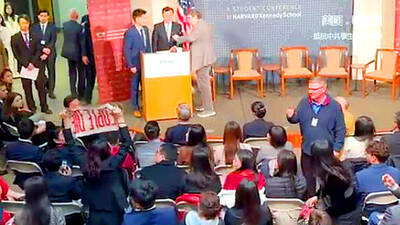
A group of Taiwanese-American and Tibetan-American students at Harvard University on Saturday disrupted Chinese Ambassador to the US Xie Feng’s (謝鋒) speech at the school, accusing him of being responsible for numerous human rights violations. Four students — two Taiwanese Americans and two from Tibet — held up banners inside a conference hall where Xie was delivering a speech at the opening ceremony of the Harvard Kennedy School China Conference 2024. In a video clip provided by the Coalition of Students Resisting the CCP (Chinese Communist Party), Taiwanese-American Cosette Wu (吳亭樺) and Tibetan-American Tsering Yangchen are seen holding banners that together read:

UNAWARE: Many people sit for long hours every day and eat unhealthy foods, putting them at greater risk of developing one of the ‘three highs,’ an expert said More than 30 percent of adults aged 40 or older who underwent a government-funded health exam were unaware they had at least one of the “three highs” — high blood pressure, high blood lipids or high blood sugar, the Health Promotion Administration (HPA) said yesterday. Among adults aged 40 or older who said they did not have any of the “three highs” before taking the health exam, more than 30 percent were found to have at least one of them, Adult Preventive Health Examination Service data from 2022 showed. People with long-term medical conditions such as hypertension or diabetes usually do not
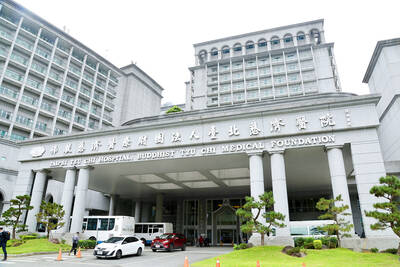
POLICE INVESTIGATING: A man said he quit his job as a nurse at Taipei Tzu Chi Hospital as he had been ‘disgusted’ by the behavior of his colleagues A man yesterday morning wrote online that he had witnessed nurses taking photographs and touching anesthetized patients inappropriately in Taipei Tzu Chi Hospital’s operating theaters. The man surnamed Huang (黃) wrote on the Professional Technology Temple bulletin board that during his six-month stint as a nurse at the hospital, he had seen nurses taking pictures of patients, including of their private parts, after they were anesthetized. Some nurses had also touched patients inappropriately and children were among those photographed, he said. Huang said this “disgusted” him “so much” that “he felt the need to reveal these unethical acts in the operating theater
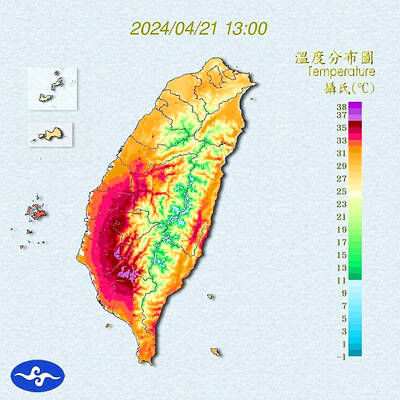
Heat advisories were in effect for nine administrative regions yesterday afternoon as warm southwesterly winds pushed temperatures above 38°C in parts of southern Taiwan, the Central Weather Administration (CWA) said. As of 3:30pm yesterday, Tainan’s Yujing District (玉井) had recorded the day’s highest temperature of 39.7°C, though the measurement will not be included in Taiwan’s official heat records since Yujing is an automatic rather than manually operated weather station, the CWA said. Highs recorded in other areas were 38.7°C in Kaohsiung’s Neimen District (內門), 38.2°C in Chiayi City and 38.1°C in Pingtung’s Sandimen Township (三地門), CWA data showed. The spell of scorching


 RSS
RSS