


Members of the pro-independence Taiwan Association of University Professors (TAUP) yesterday warned President Chen Shui-bian (
TAUP Chairman Wang To-far (王塗發), an economics professor at National Taipei University, yesterday said Chen should not bow to US pressure to repeat his "five noes" pledge, which would undermine the goal to build Taiwan into a normal and independent country.
"Presidential advisor Koo Kuan-min (辜寬敏) told Chen that he would leave the inauguration ceremony immediately if he hears Chen mention the `five noes' pledge. The TAUP will organize an emergency group to monitor Chen's inauguration speech. If we also hear Chen speak of it on May 20, we will decide on our counter measures," Wang told a press conference.
At his swearing-in ceremony four years ago, Chen made five promises, including that he would not declare independence or change the nation's title.
The US has been hinting that Chen should reaffirm the five promises after winning the March 20 presidential election. US Deputy Secretary of State Richard Armitage said last month that Washington wanted Chen to restate his "five noes" pledge in his May 20 speech.
Wang yesterday said that "Taiwan is not a state of the US, and the US can't prescribe what Taiwan should do. Taiwan should take care of its own national interests."
Wang said Chen is a president elected by the 23 million people of Taiwan and he should not dictate the people's will by unilaterally deciding that he won't push for independence.
"Chen's victory in the March 20 presidential election represents the consolidation of Taiwan's national identity. Chen's re-election happened not because Chen did well with his four-year administration; rather, it was because of the development of a Taiwan-centered awareness," Wang said.
Examination Yuan member Chang Cheng-shuh (張正修), also a member of TAUP, said Chen should not bind himself to the "five noes" pledge, which has contradicted Chen's theory that China and Taiwan are "one country on each side of the Taiwan Strait."
Chang said Chen should live up to his campaign promises to rewrite the Constitution by 2006 and further reforms to ensure Taiwan's status as an independent sovereign country.
"We urge Chen not to speak of `five noes' pledges again, because it might cause legal problems; that is, if Chen fails to deliver on his campaign promises, he would have to face the consequences of political responsibility, which could mean impeachment," Chang said.
"Such an impeachment won't come from his pan-blue rivals but from Chen's own staunch pan-green supporters," he said.
The TAUP was not the only group warning Chen. In recent days, many pro-independence heavyweights expressed similar concerns and urged Chen to avoid the "five noes" promises in his inaugural speech.
Senior presidential adviser Koo Kuan-min (
Koo said Chen is still considering whether to mention the "five noes" pledge in his speech. He predicted that Chen will not speak of it at the inauguration ceremony.
Chairman of World United Formosans for Independence Ng Chiau-tong (黃昭堂), presidential advisor Chen Lung-chu (陳隆志) and Democratic Progressive Party Legislator Trong Chai (蔡同榮) also urged Chen to drop the "five noes" pledge and, in the meantime, asked the US to adjust its "one China" policy and to not excessively interfere with Taiwan's internal affairs.
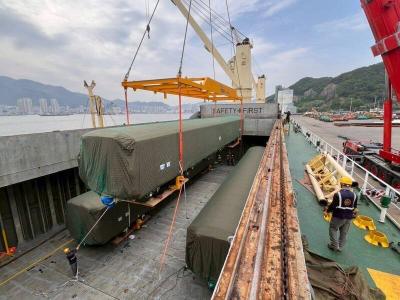
The first of 10 new high-capacity trains purchased from South Korea’s Hyundai Rotem arrived at the Port of Taipei yesterday to meet the demands of an expanding metro network, Taipei Rapid Transit Corp (TRTC) said yesterday. The train completed a three-day, 1,200km voyage from the Port of Masan in South Korea, the company said. Costing NT$590 million (US$18.79 million) each, the new six-carriage trains feature a redesigned interior based on "human-centric" transportation concepts, TRTC said. The design utilizes continuous longitudinal seating to widen the aisles and optimize passenger flow, while also upgrading passenger information displays and driving control systems for a more comfortable
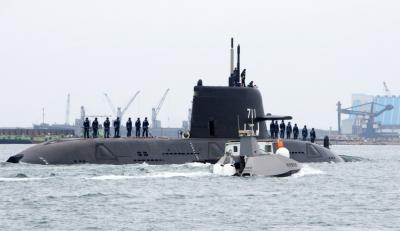
Taiwan's first indigenous defense submarine, the SS-711 Hai Kun (海鯤, or Narwhal), departed for its 13th sea trial at 7am today, marking its seventh submerged test, with delivery to the navy scheduled for July. The outing also marked its first sea deployment since President William Lai (賴清德) boarded the submarine for an inspection on March 19, drawing a crowd of military enthusiasts who gathered to show support. The submarine this morning departed port accompanied by CSBC Corp’s Endeavor Manta (奮進魔鬼魚號) uncrewed surface vessel and a navy M109 assault boat. Amid public interest in key milestones such as torpedo-launching operations and overnight submerged trials,
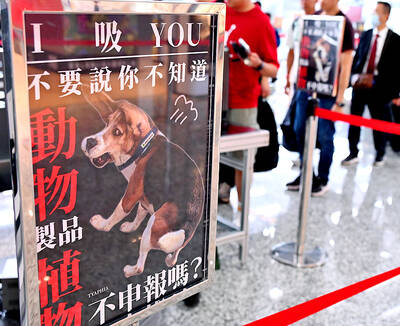
Quarantine awareness posters at Taiwan Taoyuan International Airport have gone viral for their use of wordplay. Issued by the airport branch of the Animal and Plant Health Inspection Agency, the posters feature sniffer dogs making a range of facial expressions, paired with advisory messages built around homophones. “We update the messages for holidays and campaign needs, periodically refreshing materials to attract people’s attention,” quarantine officials said. “The aim is to use the dogs’ appeal to draw focus to quarantine regulations.” A Japanese traveler visiting Taiwan has posted a photo on X of a poster showing a quarantine dog with a

Taiwan’s coffee community has launched a “one-person-one-e-mail” campaign, calling for people to send a protest-e-mail to the World Coffee Championships (WCC) urging it to redesignate Taiwanese competitors as from “Taiwan,” rather than “Chinese Taipei.” The call followed sudden action last week after the WCC changed all references to Taiwanese competitors from “Taiwan” to “Chinese Taipei,” including recent World Latte Art champion Bala (林紹興), who won the World Latte Art Championship in San Diego earlier this month. When Bala received the trophy, he was referred to as representing Taiwan, as well as in the announcement on the WCC’s Web site, until it


 RSS
RSS